Daily Trading Planner
Trading only works when the rules are defined before the session begins. I believe that without structure, decisions drift, emotion fills the gaps, and consistency disappears.
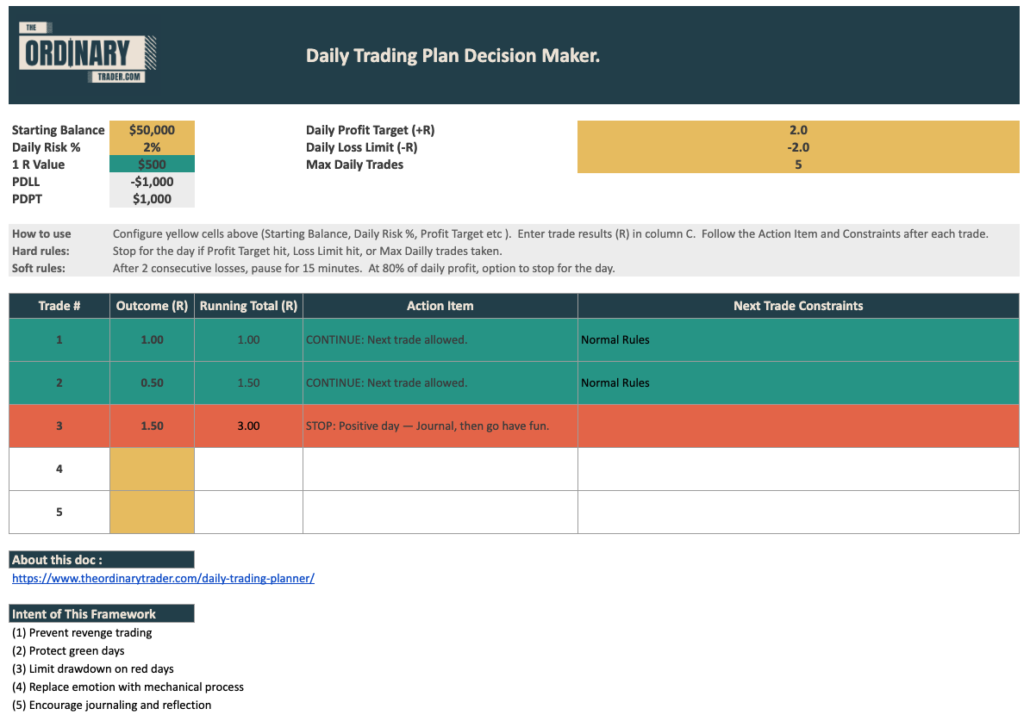
This page outlines the framework I use every trading day. It is built around a simple idea. Define risk clearly, limit decision-making during the session, and stop trading before discipline starts to erode. This framework is captured in my Daily Trading Planner, which I use to plan each session and track execution. The planner is available to download for anyone who wants to apply the same structure.
What follows is an overview of how it works.
Intent of this framework
My framework exists to do five simple things well:
- Prevent revenge trading when emotions run high
- Protect green days from being given back
- Limit drawdowns on red days
- Replace emotional decision-making with a mechanical process
- Encourage consistent journaling and honest reflection
It is structured around the following :
- Three rules never to be broken.
- Two soft rules offering guidance.
Defining risk and reward
All risk in this project is defined in R. But what is “R” I hear you say? R represents a fixed percentage of account capital and acts as a common unit of measurement across trades, days, and account sizes.
My maximum allowable risk in any single trading day is 2% of the starting balance. Next, and because I do not want that entire daily risk exposed on one single trade, I split it evenly. One R is therefore defined as half of the daily risk, or 1% of the account balance.
For example, with a starting balance of $100,000, the maximum daily risk is $2,000 and the maximum risk per trade is $1,000.
One R is defined as half of the daily risk allowance, or 1% of the starting account balance.
This immediately caps downside and removes ambiguity. Every trade risks the same amount. Every loss is measured the same way. There is no adjusting size based on confidence or recent results.
If two consecutive losses occur, the daily % risk limit has effectively been reached. Trading stops for the day. The following session begins with a slightly smaller account balance, which automatically reduces dollar risk per trade. Risk scales naturally with performance.
Daily profit targets
The daily profit target is also set at 2 R.
At first glance, limiting profit may seem counterintuitive. Why pit a cap on profits and stop trading when things are going well? Experience and data suggest otherwise. Once a daily goal is reached, decision quality often deteriorates. Traders start to become looser with entries, chase additional setups, or try to press an edge that has already played out.
Many of my largest losing days started out as winning ones.
By stopping after reaching the daily profit target, I reduce the likelihood of overtrading and protect gains that have already been earned. This is a practical application of the idea often summarised as quit while you are ahead.
Maximum number of trades
In addition to risk and profit limits, there is also a cap on activity (number of trades taken per day)
For my strategy, the maximum number of trades allowed in a single day is five.
If five trades are taken before reaching either the daily loss limit or the daily profit target, trading stops. If the profit target or loss limit is reached before five trades are taken, trading also stops.
This creates a clear decision tree. There is no room to justify extra trades simply because time remains in the session. Activity is capped, focus is preserved, and fatigue is reduced.
The hard rules
These elements form what I refer to as the 3 hard rules.
- A maximum daily loss of two R.
- A maximum daily profit of two R.
- A maximum of five trades per day.
They are non-negotiable. If any one of these limits is reached, trading stops. No exceptions. No discretion. No adjustments mid-session.
Together, these rules minimise downside, prevent overtrading, and lock in profits when conditions are favourable. More importantly, they remove emotion from the most critical decisions of the day. When to stop. How much to risk. Whether to continue trading.
That work is done in advance.
Soft rules and intraday guidance
Not every decision in trading can be reduced to a hard stop. Some situations benefit from pause rather than termination. That is where the soft rules come in.
- Pause after 2 consecutive losses
- Pause after 80% daily profit target reached
These are intraday guidelines designed to slow things down, reduce emotional momentum, and protect decision quality when conditions start to change. They do not override the hard rules, but they sit alongside them as early warning signals.
Two consecutive losses
Two consecutive losses are a signal, not a failure.
When this occurs, trading pauses for a minimum of fifteen minutes. The screen is stepped away from. No charts, no scrolling, no searching for the next setup. The purpose of the break is to interrupt emotional momentum and reset perspective.
Losses often cluster because decision-making degrades, not because the market suddenly becomes untradeable. A short, enforced break reduces the risk of revenge trading and prevents frustration from bleeding into the next decision.
Losses often cluster because decision-making degrades, not because the market suddenly becomes untradeable.
After the pause, trading can resume only if focus is restored and rules are still being followed. If not, the session ends early. There is always another day.
Eighty percent of daily profit reached
When eighty percent of the daily profit target is reached, a different kind of risk appears. Confidence increases. Selectivity often decreases.
At this point, the planner prompts a decision. Either stop trading for the day, or reduce risk by lowering position size. The goal is to protect gains already earned and reduce the likelihood of giving them back through overconfidence or fatigue.
Many red days begin after strong starts. This rule exists specifically to prevent the common pattern of turning a green day into a losing one.
Why soft rules matter
Hard rules define boundaries. Soft rules protect behaviour inside them.
They create space for reflection, reduce impulsive decisions, and encourage trading from a calm and deliberate state. They are not designed to maximise profit, but to preserve consistency and discipline over time.
The planner does not force these decisions. It surfaces them. The responsibility still sits with the trader.
That distinction matters.
The Daily Trading Planner
This framework is implemented through my Daily Trading Planner. It is designed to be completed before the session begins and updated during the day after each trade concludes. It forces clarity around risk, limits, and execution before and after any trades are placed.
I have made the planner available to download for anyone who wants to apply the same structure to their own trading. It is not a strategy and it will not tell you what to trade. What it does is enforce discipline, define boundaries, and create a repeatable process.
The rules are simple by design.
The hard part is following them.
Trade well. Stay ordinary.