
Latest Journal Entry

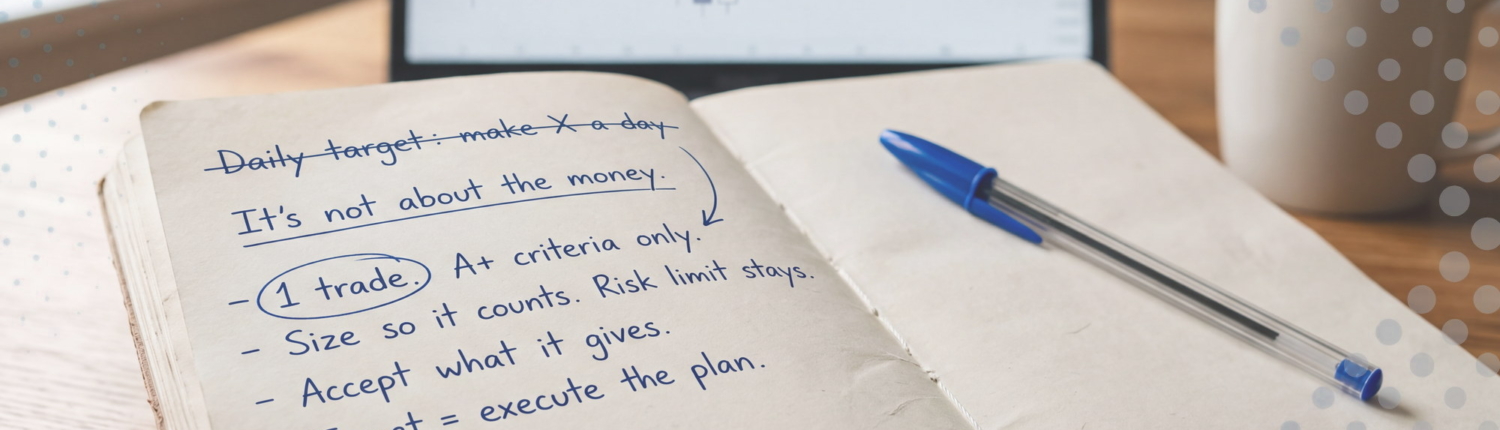
Open notebook on a wooden desk with handwritten notes in blue ink: "Daily target: make X a day" crossed out, then "It's not about the money" and a list starting with a circled "1 trade".

It’s not about the money

For years I've had a daily number to hit. Lately it's been the reason I keep trading after I'm already green, and the reason some of those days end red. One phrase made me question whether I was chasing setups at all, or just chasing a figure.

More from the Journal

What Trading Did to My Marriage (Mostly Good)

My partner can now tell when I'm about to lose an argument: I go quiet and start waiting for a better entry. Trading habits leak out of the trading room. Mostly that's a good thing for family life, occasionally it's deeply annoying for everyone around me.
Two yellow sticky notes on a warm wooden desk labelled CONVICTION and REVENGE, beside an open trading journal with handwritten notes and a blue Bic pen, laptop with candlestick chart in background, natural daylight.

Revenge trading dressed up as conviction: spotting it in yourself before the account does

After a losing trade, the next setup always looks cleaner. More obvious. More deserved. The problem is that this feeling isn't always analysis - sometimes it's your account balance talking. Here's how to catch the difference before you place the trade.
Open trading journal on a wooden desk with handwritten notes under the heading "No news day": safer from spikes is not easier to trade, no catalyst means more chop, be careful the day before CPI.

Are no news days good for trading?

Most traders scan the calendar, find nothing, and read it as a safe day. But a no news day is a different kind of session - not necessarily easier. Here's what actually changes when the calendar is clear, and why the day before a big release deserves the most caution of all.

A trader’s worst habits

Most accounts don't die from one bad trade. They die from one bad habit, repeated until the balance runs out. Here are the worst offenders, some genuinely costly, some just a bit ridiculous, and most of which I've been guilty of myself.

How I journal my trades, and why the notes matter more than the numbers

The trade is logged, the result is there, but by the next morning you can't remember what you were actually thinking when you moved the stop. That gap is the reason I journal the notes, not just the stats. Here's the three-part template I keep open on screen, and how I use it live.
Handwritten trading journal comparing two columns of four trades with identical R outcomes: sized the same it nets +1R and +$500, with sizing drifting it nets +1R but -$1,050, under the note risk the same 1% every trade.

Why position sizing could be turning your green days red

You can win more trades than you lose, follow your plan, and still close the day in the red. Usually it isn't your analysis that did the damage. It's sizing the losers big and the winners small, so the dollars and the R end up telling two different stories.

The two filters in the STRATEGY indicator – what’s the difference?

Two filters in the STRATEGY indicator both lean on EMAs, so it's easy to assume they do the same job. They don't. One judges where a single setup stage sits against a moving average. The other reads the higher-timeframe trend from two. Same building block, very different purposes.
Hand-drawn pen chart: a bullish move from entry to +2R with 90% locked and the last 10% to TP circled as 'the most expensive 10%', with a 9R risk to 1R reward note.

When is enough profit enough?

There's a moment in every winning trade where you stop watching the chart and start willing it forward. You're 2R up, almost at target, and then the candles swing back. This isn't about your daily profit target. It's about the harder question, the one you ask mid-trade.

The hidden costs of trading micros

Take a trade on 20 MES, make $600 gross, and you might assume that's $600 in your account. It isn't. Once commission, exchange fees, and clearing costs come out, the real number is closer to $525. Here's the maths, and what it means for traders running size in micros.
© 2026 The Ordinary Trader Ltd. All rights reserved.
Registered in England and Wales. No. 17144683. 128 City Road, London, United Kingdom, EC1V 2NX