How I journal my trades, and why the notes matter more than the numbers
You sit down to review yesterday’s trade. The chart is still there. The entry, the exit, the result, all logged. But the part you actually need has gone. What were you thinking when you moved that stop? Why did you nearly close the position early? You can’t quite remember.
That critical lost in detail is the whole reason I journal. And it is why I care more about the notes than the numbers.
I use TradeZella for this. It is a solid platform, and most people know it for the stats: win rate, average R, all the dashboards. Useful, but not what this post is about. I want to talk about the Notes side, where you capture what you were thinking and feeling before, during and after a trade. Tags and Strategies are worth their own post another day. For now, here is the template I use and how I actually use it.
That critical lost in detail is the whole reason I journal.
Three sections, one job
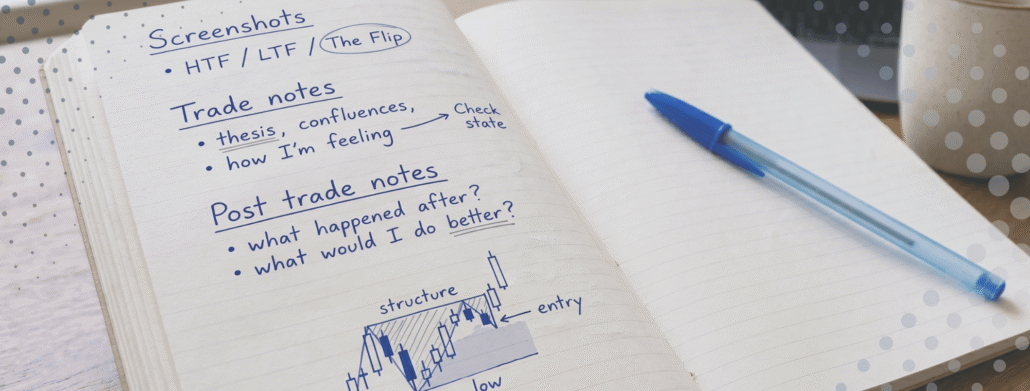
My template has three parts. Screenshots, Trade Notes, and Post Trade Notes. Each one captures a different slice of the same trade, and together they let me rebuild the whole thing later without relying on memory.
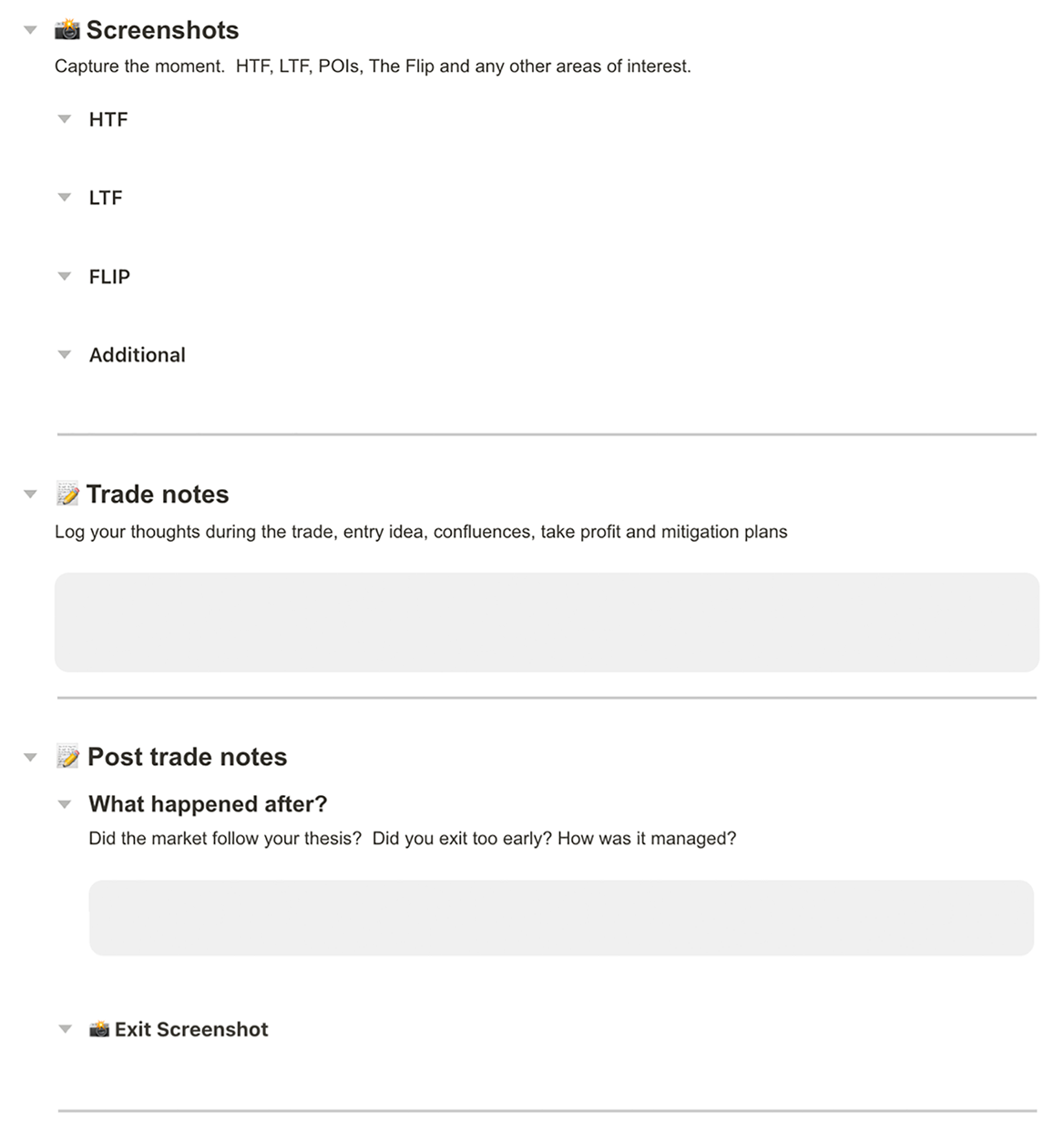
Screenshots: capture the moment
The first section is just images. I take a few as the trade develops, not all at the end.
A higher time frame shot (HTF, usually the 15 minute) to show the structure and the bias. A lower time frame shot (LTF, usually the 1 or 2 minute) for the detail of the entry. A zoomed-in shot of The Flip, because that is a key part of the setup I want to study again later. And an Additional slot for anything else worth keeping: the Path to Profit, a point of interest (POI) like a supply and demand zone (SNDR) or a fair value gap, whatever mattered on the day.
A fair value gap, by the way, is just the imbalance price leaves behind when it moves too fast to trade an area cleanly.
The reason I screenshot in the moment is that a chart looks completely different an hour later. Price has moved on, levels have been swept, and the thing that looked obvious at entry is buried. The screenshot freezes what I actually saw.
And this is the part most people skip. I write down how I am feeling.
Trade notes: the thinking and the feeling
This is the main section, and the one that does the most work.
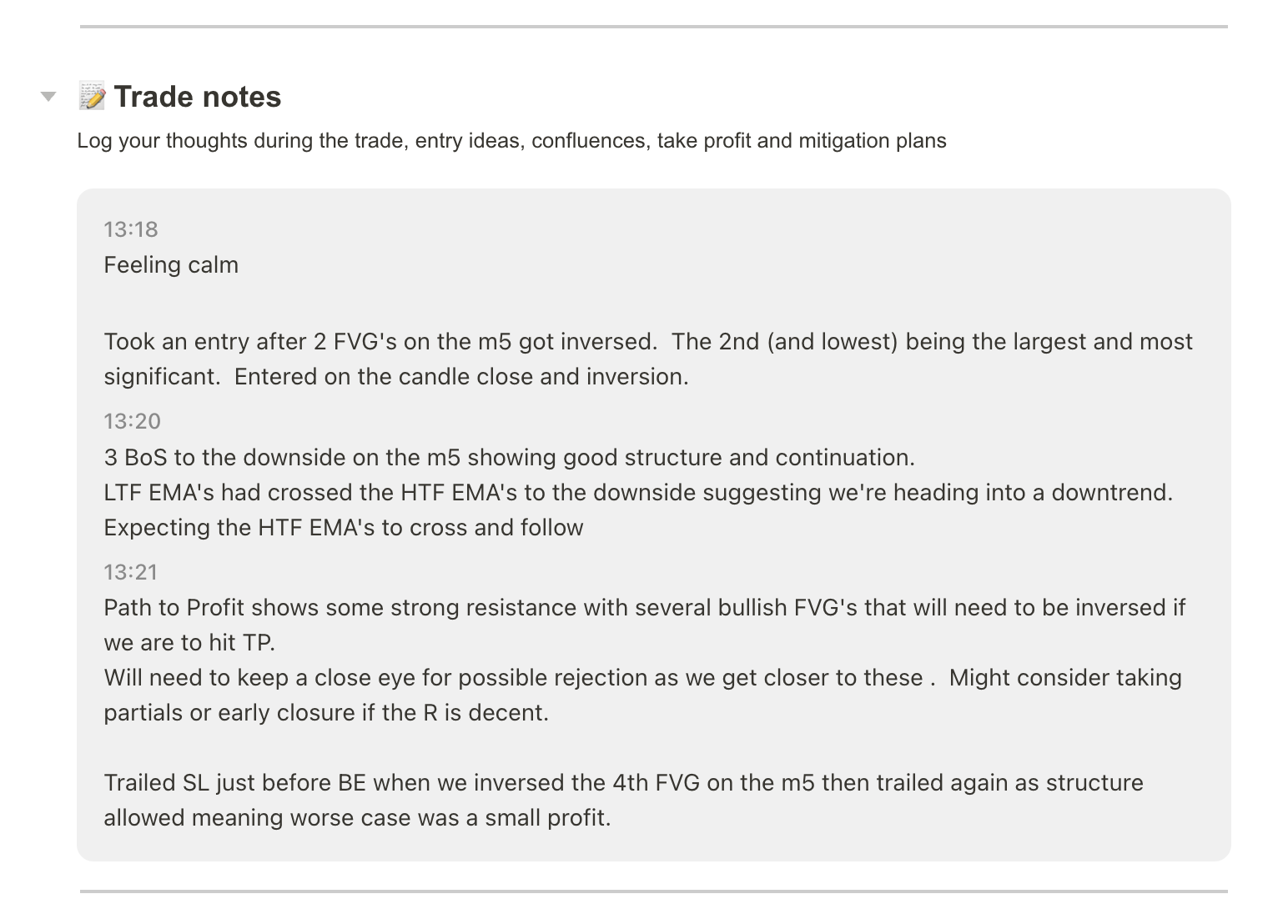
Here I write my thesis before I enter. The idea, the confluences, where I expect price to react, my take profit plan, and how I will manage the trade if it goes against me. Getting this down before entry matters, because it is the version of my thinking that has not yet been bent by an open position.
Then I keep adding to it as the trade runs. And this is the part most people skip. I write down how I am feeling.
That sounds soft. It is not. Emotion is where most of my mistakes start, and the only way to catch the pattern is to have it written down in your own words at the time. Read it back later and you can often see exactly where a feeling got in the way of a perfectly good setup. Sometimes it works the other way, and a note of unease turns out to be a warning sign you should have listened to.
Post trade notes: what actually happened
The last section is the review. I answer a few plain questions.
What happened after I took the trade? Did the market follow my thesis, or not? Did I exit too early, or enter too early? How did I manage it? Then the one that matters most: what would I do better next time, and if I could go back, what is the single piece of advice I would give myself?
This section also holds the exit screenshot. Did I hit my target, get stopped out, or close manually? I grab the final chart, and often what happened next too. Plenty of times I have hit TP1 and then watched price run on to take the previous day’s high. Capturing that teaches me something about where I am leaving money, and whether my targets are too conservative.
Capture it live, not from memory
I keep the journal open on my screen the entire session, next to the chart. I write as I go, in real time, as I enter and manage.
If you leave it until the evening, you do not really journal the trade. You are actually journalling your memory of the trade, which is a tidier, kinder, less accurate version of events. The hesitation gets smoothed over. The near-miss exit disappears. The thing you most needed to see is exactly the thing memory edits out.
You are actually journalling your memory of the trade, which is a tidier, kinder, less accurate version of events.
One trade, fully journalled, before the next
One rule I hold myself to. I do not take another trade until the first one is journalled and the lesson is captured.
Easier said than done, especially on an active session. But the moment you skip it “just this once,” the journal stops being a record and starts being a highlight reel. I treat finishing the journal as part of finishing the trade.
None of this is here to make me feel good about wins or bad about losses. It is here to make my behaviour visible. When I follow my rules, the results tend to take care of themselves. When I do not, the journal shows me exactly where. The chart only ever tells me what I did. The notes are the only place that remembers why.
Trade well. Stay ordinary.