Revenge trading dressed up as conviction: spotting it in yourself before the account does

The story you tell yourself
You’ve just taken a loss. Clean setup, sensible risk, nothing reckless. But the market did what markets do, and you’re down.
You close the trade and scan the chart again. Another setup appears. Clear structure, a level that holds, everything pointing in the right direction. You size up slightly to recover ground. You enter.
That is the moment. Not obviously revenge trading. Not a red-mist doubling down. Just a trade. Justified. Logical. Backed by analysis.
Or was it?
The disguise
Most traders think they’d recognise revenge trading if it showed up. The obvious version is easy to spot: tripling size, ignoring every rule you built, entering on impulse and calling it a hunch. That failure mode gets talked about.
The harder version looks nothing like that.
It looks like patience. Like carefully reading the chart and finding what you were looking for. The position size is only slightly larger. The entry makes sense. You could walk someone through it and they’d probably nod along.
But underneath all of that, the question you were actually answering was not “is this a good trade?” It was “how do I get that money back?”
The analysis was real. The justification was real. The conviction felt real. But the thing driving the decision was not analysis at all.
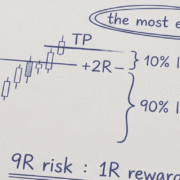
most emotional decisions happen in the first twenty minutes after a losing trade.
The tells
There is no clean single diagnostic for this. But there are patterns worth watching.
You entered faster than usual. Normally you wait for a specific condition – a close through a level, a retest, some form of confirmation. On this one, you moved quicker. The reason felt sound. But if you’re honest, you were looking for permission rather than evidence.
The position size changed. Not dramatically. But it went up. And the reason you gave yourself – strong setup, good R – would apply to most of your trades. Size doesn’t usually move for good setups. It moved because you needed more on the line.
You skipped a step. The Daily Trading Planner didn’t get filled in. Or it was filled in after the trade was already open. Or you glanced at it and decided the trade had already passed the check. There’s a difference between working through the checklist and working around it.
You felt better after entering. This one is subtle. Good trades usually come with calm. You’ve done the work, you’re in the trade, now you wait. This one felt like relief. Like something had been repaired. That shift in feeling is worth noticing.
None of these individually disqualifies a trade. But when several arrive together, shortly after a loss, they’re worth pausing for.
The self-check
Before the next entry, try three things.
Write down why you’re taking the trade in a single sentence. Not a paragraph, not a bullet list. One sentence. If that sentence contains anything about the previous trade – recovering a loss, proving a read was right, getting back to flat – the trade isn’t ready.
Then write down the R. Not what you hope it will be. What it actually is, based on where your stop sits right now. If that number is larger than your usual position, ask why. If the answer is anything other than “the setup calls for it,” step away.
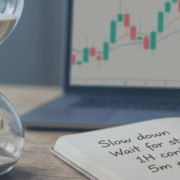
Finally, check how long it has been since the loss. There’s no magic number. But most emotional decisions happen in the first twenty minutes after a losing trade. Most sound ones happen after you’ve had time to reset. Entering again quickly isn’t always wrong, but it deserves more scrutiny, not less.
Before the account shows you
The account has no patience for this distinction. It doesn’t know whether you were trading from conviction or from frustration. It just records the outcome.
That’s part of what makes this pattern hard to break. You might take a revenge trade dressed as conviction and win. The justification gets reinforced. The process that generated the decision feels validated. And the next time a loss arrives, the same pattern runs again with a little more confidence behind it.
Catching it early isn’t about doubting every trade you place after a loss. It’s about being honest with yourself about the question you’re actually trying to answer when you enter.
Analysis asks: does this setup meet my criteria?
Revenge asks: can this trade undo what just happened?
They can produce the same entry. But only one of them is a repeatable process.
Trade well. Stay ordinary.