You sit down to review yesterday’s trade. The chart is still there. The entry, the exit, the result, all logged. But the part you actually need has gone. What were you thinking when you moved that stop? Why did you nearly close the position early? You can’t quite remember.

That critical lost in detail is the whole reason I journal. And it is why I care more about the notes than the numbers.

I use TradeZella for this. It is a solid platform, and most people know it for the stats: win rate, average R, all the dashboards. Useful, but not what this post is about. I want to talk about the Notes side, where you capture what you were thinking and feeling before, during and after a trade. Tags and Strategies are worth their own post another day. For now, here is the template I use and how I actually use it.

That critical lost in detail is the whole reason I journal.

Three sections, one job

My template has three parts. Screenshots, Trade Notes, and Post Trade Notes. Each one captures a different slice of the same trade, and together they let me rebuild the whole thing later without relying on memory.
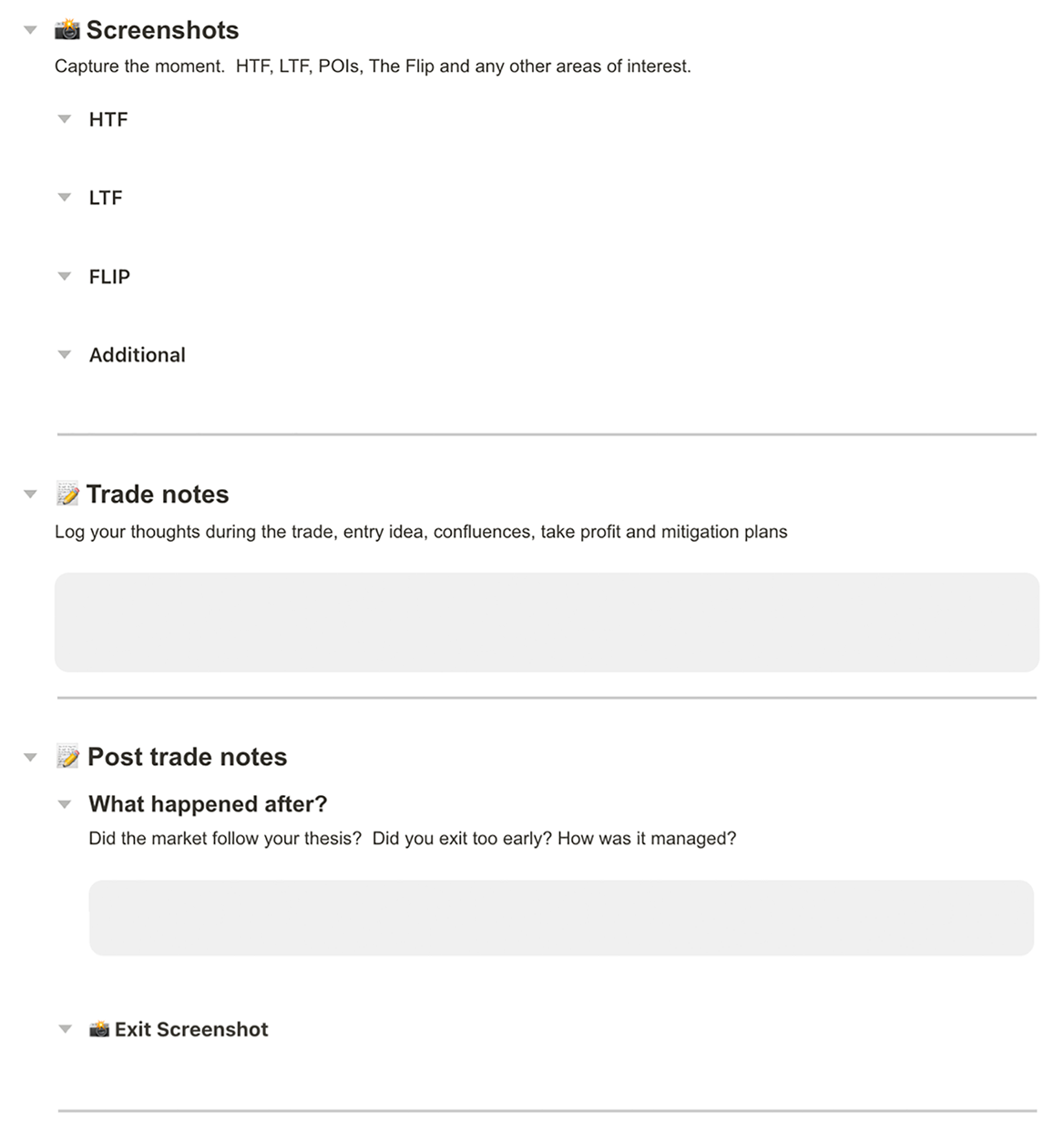
 

Screenshots: capture the moment

The first section is just images. I take a few as the trade develops, not all at the end.

A higher time frame shot (HTF, usually the 15 minute) to show the structure and the bias. A lower time frame shot (LTF, usually the 1 or 2 minute) for the detail of the entry. A zoomed-in shot of The Flip, because that is a key part of the setup I want to study again later. And an Additional slot for anything else worth keeping: the Path to Profit, a point of interest (POI) like a supply and demand zone (SNDR) or a fair value gap, whatever mattered on the day.

A fair value gap, by the way, is just the imbalance price leaves behind when it moves too fast to trade an area cleanly.

The reason I screenshot in the moment is that a chart looks completely different an hour later. Price has moved on, levels have been swept, and the thing that looked obvious at entry is buried. The screenshot freezes what I actually saw.

And this is the part most people skip. I write down how I am feeling.

Trade notes: the thinking and the feeling

This is the main section, and the one that does the most work.

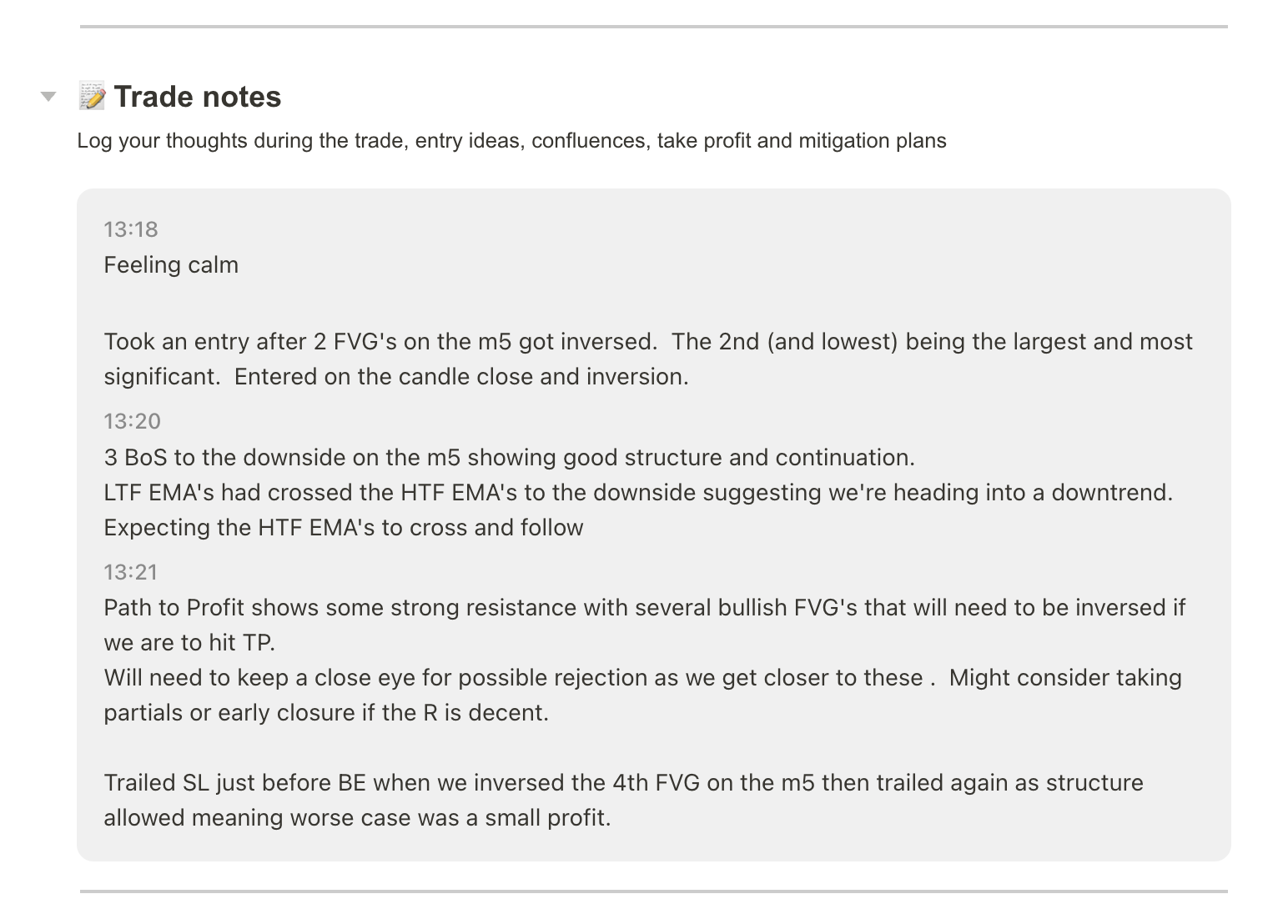
Here I write my thesis before I enter. The idea, the confluences, where I expect price to react, my take profit plan, and how I will manage the trade if it goes against me. Getting this down before entry matters, because it is the version of my thinking that has not yet been bent by an open position.

Then I keep adding to it as the trade runs. And this is the part most people skip. I write down how I am feeling.

That sounds soft. It is not. Emotion is where most of my mistakes start, and the only way to catch the pattern is to have it written down in your own words at the time. Read it back later and you can often see exactly where a feeling got in the way of a perfectly good setup. Sometimes it works the other way, and a note of unease turns out to be a warning sign you should have listened to.
Post trade notes: what actually happened

The last section is the review. I answer a few plain questions.

What happened after I took the trade? Did the market follow my thesis, or not? Did I exit too early, or enter too early? How did I manage it? Then the one that matters most: what would I do better next time, and if I could go back, what is the single piece of advice I would give myself?

This section also holds the exit screenshot. Did I hit my target, get stopped out, or close manually? I grab the final chart, and often what happened next too. Plenty of times I have hit TP1 and then watched price run on to take the previous day’s high. Capturing that teaches me something about where I am leaving money, and whether my targets are too conservative.

Capture it live, not from memory

I keep the journal open on my screen the entire session, next to the chart. I write as I go, in real time, as I enter and manage.

If you leave it until the evening, you do not really journal the trade. You are actually journalling your memory of the trade, which is a tidier, kinder, less accurate version of events. The hesitation gets smoothed over. The near-miss exit disappears. The thing you most needed to see is exactly the thing memory edits out.

You are actually journalling your memory of the trade, which is a tidier, kinder, less accurate version of events.

One trade, fully journalled, before the next

One rule I hold myself to. I do not take another trade until the first one is journalled and the lesson is captured.

Easier said than done, especially on an active session. But the moment you skip it “just this once,” the journal stops being a record and starts being a highlight reel. I treat finishing the journal as part of finishing the trade.

None of this is here to make me feel good about wins or bad about losses. It is here to make my behaviour visible. When I follow my rules, the results tend to take care of themselves. When I do not, the journal shows me exactly where. The chart only ever tells me what I did. The notes are the only place that remembers why.

A real trade journal example of SMT divergence using NQ and ES. See how correlation breaks, liquidity shifts, and market structure alignment create high probability setups.

Crude oil, mid-afternoon into the New York session.

The higher-timeframe picture had already shifted. After a sustained downtrend, price showed a clear change of character and then a break of structure back to the upside. The bias was no longer the question.

Execution was.

I’d already had a win earlier in the session on a similar-looking long. That mattered more than I wanted it to. Confidence was up, but so was the temptation to assume the next trade would behave the same way.

As price pulled back, I was watching two things closely. A bearish M15 fair value gap above, likely to cause early resistance and chop. And deeper liquidity and SNDR zones closer to the 78.6 retracement, which is where I initially expected price to go.

It didn’t.

Instead, price flipped cleanly at the 61.8. The reaction was decisive. We had inversion of a fair value gap, followed by the creation of new bullish imbalance. The entry was there, even if it wasn’t the one I’d mentally rehearsed.

So I took it.

Early on, the trade behaved exactly as expected. Some hesitation. Sideways action into the M15 fair value gap. Nothing smooth, nothing impulsive. I trailed my stop as structure allowed, keeping it logical, not aggressive.

There was a moment where price pushed deep into that M15 imbalance and looked like it might stall completely. I considered taking profit early. It would have been less than one R, and that’s where the internal debate started.

Technically, banking something would have felt good. Emotionally, it would have been comfortable. But it would also have broken a rule I’ve set deliberately: no profit-taking below minimum expectancy unless it’s earned via structure-based stop management.

So I did nothing.

I moved the stop to break-even, not because I was afraid, but because structure justified it.

Eventually, the M15 fair value gap broke. That mattered. It changed the context of the trade, not just the open P&L. I moved the stop to break-even, not because I was afraid, but because structure justified it.

Targets were still ahead.

My first target was set just under a five-minute fair value gap that had the potential to act as resistance that late in the move. Only after the trade was live did I realise that target also sat just above the New York high. An obvious magnet. Possibly an obvious rejection point.

I let it play out.

When price traded into that level and TP1 was hit, the management became simpler. Stop to break-even. No decisions left to negotiate with myself. When the five-minute fair value gap inverted, I trailed the stop again, just beneath the new structure.

From there, the trade did the rest of the work.

The lesson here isn’t about entries or setups. It’s about restraint once the trade is on.

Most mistakes don’t come from bad analysis. They come from trying to improve a trade that’s already working.

Most mistakes don’t come from bad analysis. They come from trying to improve a trade that’s already working. Taking profits because something feels obvious. Adjusting stops because price pauses. Optimising for emotional relief instead of following the plan through.

This trade worked because I stayed aligned with my rules even when the market gave me reasons not to. Earlier confidence didn’t turn into overreach. Late-session hesitation didn’t turn into fear-based exits.

The takeaway is simple.

If the trade plan still makes sense, and structure hasn’t changed, the most disciplined action is often to stop managing and start observing. Let the market decide how far it wants to go.

Friday evening, platinum, around 7–8pm UK time.

It was the second time price had traded back into the same zone. I almost ignored it out of habit. I rarely take a second trade from the same level.

But this one looked different.

Price pushed back down into the zone with intent, swept liquidity deeper than before, then failed to make a new low. On the lower timeframes, bullish fair value gaps began to form. The reaction was clean. Controlled. It didn’t feel random.

So I took it.

Because it was a second opportunity from the same zone, I sized the expectations differently. I didn’t think it would have the same energy as the first move. Less gas. Less conviction. That assumption shaped everything that followed.

I managed the trade with a tight trailing stop almost immediately.

Part of that came from context. It was late on a Friday. Markets were approaching the close. Time left in the trade mattered. I didn’t want to give much back, especially if liquidity thinned and price turned erratic.

But part of it was something else.

After entry, I noticed the bearish candles were larger and more impulsive than the bullish ones. When price pushed against my position, it did so with more force than when it moved in my favour. That imbalance stuck in my head. It felt like pressure. Like a warning.

So I kept tightening the stop.

The trade worked. It was a winner.

It just didn’t do what it was capable of doing.

Price continued higher after I was taken out, moving cleanly through areas I’d originally mapped. Nothing invalidated the idea. Nothing structurally changed. I was right on direction and location.

I just didn’t stay in the trade long enough to let it express itself.

The lesson isn’t about trailing stops being bad. It’s about when they’re appropriate and why they’re being used.

On lower timeframes, structure often invites tighter management. It makes sense intellectually. You see micro higher lows, small pullbacks, clean continuation. It feels disciplined to lock things down quickly.

But discipline isn’t the same as fear dressed up as precision.

I was managing risk based on assumptions I hadn’t fully tested.

In this case, I was managing risk based on assumptions I hadn’t fully tested. That a second trade from the same zone should underperform. That late Friday trades need to be protected aggressively. That stronger bearish candles automatically reduce the validity of a long.

None of those are rules in my plan. They’re interpretations layered on top of it, in real time, under subtle pressure.

The irony is that the strategy worked exactly as designed. The location held. The sweep mattered. The failure to make a new low mattered. The bullish fair value gaps mattered.

What didn’t work was my willingness to accept a normal pullback in exchange for the full move.

Trailing stops are powerful when they’re used deliberately. They’re dangerous when they’re used reactively.

Especially late in the week, when time becomes part of the decision-making, it’s easy to start optimising for comfort instead of expectancy. You tell yourself you’re being prudent, when really you’re trying to avoid the feeling of watching unrealised profit retrace.

That’s not a moral failing. It’s just something to be aware of.

The real adjustment here isn’t mechanical. It’s situational.

Second trades from the same zone don’t automatically deserve tighter managemen

Second trades from the same zone don’t automatically deserve tighter management. Late Friday trades don’t automatically require fear-based exits. And lower timeframe structure doesn’t override higher timeframe intent.

If the plan calls for allowing a pullback, then the pullback has to be allowed. Otherwise the trade is never really being tested.

The simple takeaway I’m carrying forward is this:

If I’ve trusted the location and taken the trade, I need to be just as intentional about how I manage it as I was about why I entered. Tight stops should be a decision, not a reflex.

Sometimes the hardest part of trading isn’t getting in.

It’s staying in long enough to let being right actually matter.