A trader’s worst habits
Most blown accounts don’t die from a single dramatic loss. They die quietly, from one bad habit repeated until the balance runs out.
The frustrating part is that none of these habits feel like mistakes in the moment. They feel like instinct. They feel like you’re doing something. And that is exactly why they’re so hard to spot in yourself.
So here are the worst of them. Some are genuinely expensive. Some are just a bit silly. I’ve been guilty of most, which is the only reason I can describe them so precisely.
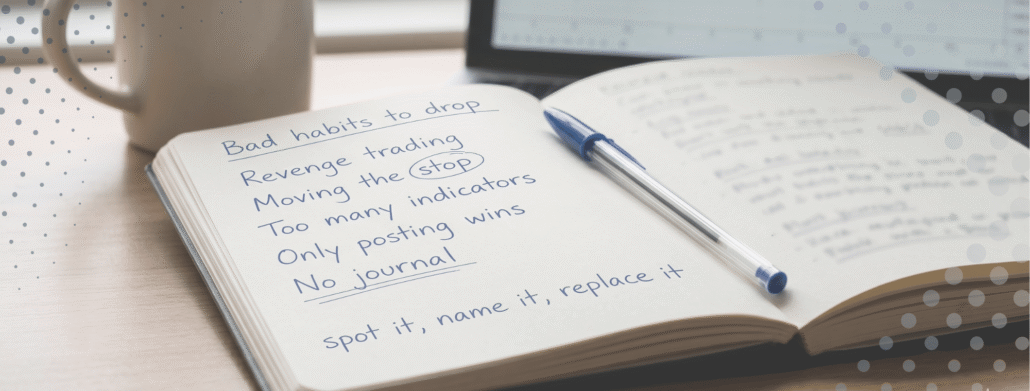
Revenge trading: the most expensive way to feel better
You take a loss. It stings. Instead of closing the laptop, you immediately look for the next trade to win it back.
This is the big one. Revenge trading is what turns a bad trade into a bad day, and a bad day into a bad week.
The logic feels airtight at the time. The market took something from you, so you’re going to take it back. But the market doesn’t know you exist, and it certainly doesn’t owe you a refund. What actually happens is you trade bigger, with less patience, on a worse setup, while your judgement is at its lowest point of the day.
The fix isn’t complicated. It’s just hard. After a loss that gets under your skin, you stop. Not “stop after one more.” Stop.
Collecting indicators like they’re going out of fashion
Here’s the stereotype, and you’ve met him. The chart so crowded with indicators it looks like air traffic control. Three moving averages, two oscillators, a cloud, volume profile, and something with a German name you found on a forum at 2am.
You’re not reading the market. You’re waiting for all eleven things to agree, which they never do, because half of them are measuring the same price action in slightly different colours.
More inputs don’t make a clearer decision. They just make more noise. The trader who watches structure and one or two clean levels usually sees more than the one drowning in confluence. A chart should help you think, not hide the thinking.
The trader who watches structure and one or two clean levels usually sees more than the one drowning in confluence.
Moving the stop loss because “it’ll come back”
You set a stop. Price moves towards it. And right before it hits, you drag it a little further away. Just to give the trade room.
It usually does come back, the first few times. That’s the trap. The market teaches you the worst possible lesson by occasionally rewarding the worst possible behaviour.
Then one day it doesn’t come back, and the loss you’ve been avoiding arrives all at once, several times larger than the one you originally agreed to take. A stop loss you move isn’t a stop loss. It’s a suggestion you make to yourself and then ignore.
The whole point of deciding your risk before the trade is that the version of you placing the trade is calmer than the version of you watching it go wrong.
Only ever posting the wins
This one is more of a culture problem than a personal one, but it shapes how everybody else behaves.
Scroll through any trading feed and you’ll see an unbroken stream of green. +400%. Account up. Another clean win. Funny how nobody seems to post the day they blew up and gave it all back.
The selective screenshot is the dishonest heart of trading culture. It sells a version of the job that doesn’t exist, where every entry is a winner and the equity curve only points one way. New traders see it, assume that’s normal, and then quietly panic when their own results look like real results, which is to say lumpy, occasionally red, and slow.
I’d rather see someone’s losing month than their best ever day. The losing month tells me how they handle the part of trading that actually decides whether they last.
Funny how nobody seems to post the day they blew up and gave it all back.
Trading without a journal, then wondering what went wrong
If you don’t write down what you did, you can’t learn from it. You can only remember it, and memory is a generous liar.
Ask a trader without a journal why they lost last week and you’ll get a feeling, not an answer. “I think I was overtrading.” Maybe. Or maybe you took the same B-grade setup eleven times and it lost eight, and you’d know that for certain if it were written down.
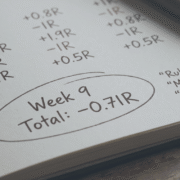
A journal turns vague guilt into specific evidence. It’s the difference between “I need to be more disciplined” and “I lose money every time I trade the first ten minutes of the session, so I’ll stop doing that.” One is a New Year’s resolution. The other is a rule.
It doesn’t need to be fancy. A notebook and an honest sentence about each trade beats a spreadsheet you never open.
The habit underneath all the habits
Look closely and most of these share a root. They’re all ways of avoiding a small, uncomfortable thing now, in exchange for a larger, worse thing later. Skip the loss, skip the discipline, skip the honest record, skip the boredom etc
Good trading is mostly the willingness to be a bit bored and a bit uncomfortable on purpose. Not careless or reckless, but controlled. The best habits aren’t exciting. They’re just the unglamorous things, done again and again, on the days you don’t feel like it.
The best habits aren’t exciting. They’re just the unglamorous things, done again and again
That’s the whole job, really. Spot the habit, name it honestly, and replace it with something duller and better.
Trade well. Stay ordinary.