
When Correlation Breaks: An example SMT Divergence Setup using NQ and ES
This morning started like most sessions. I was marking out liquidity, watching structure, nothing dramatic. Then something subtle happened at the lows that made me pause.
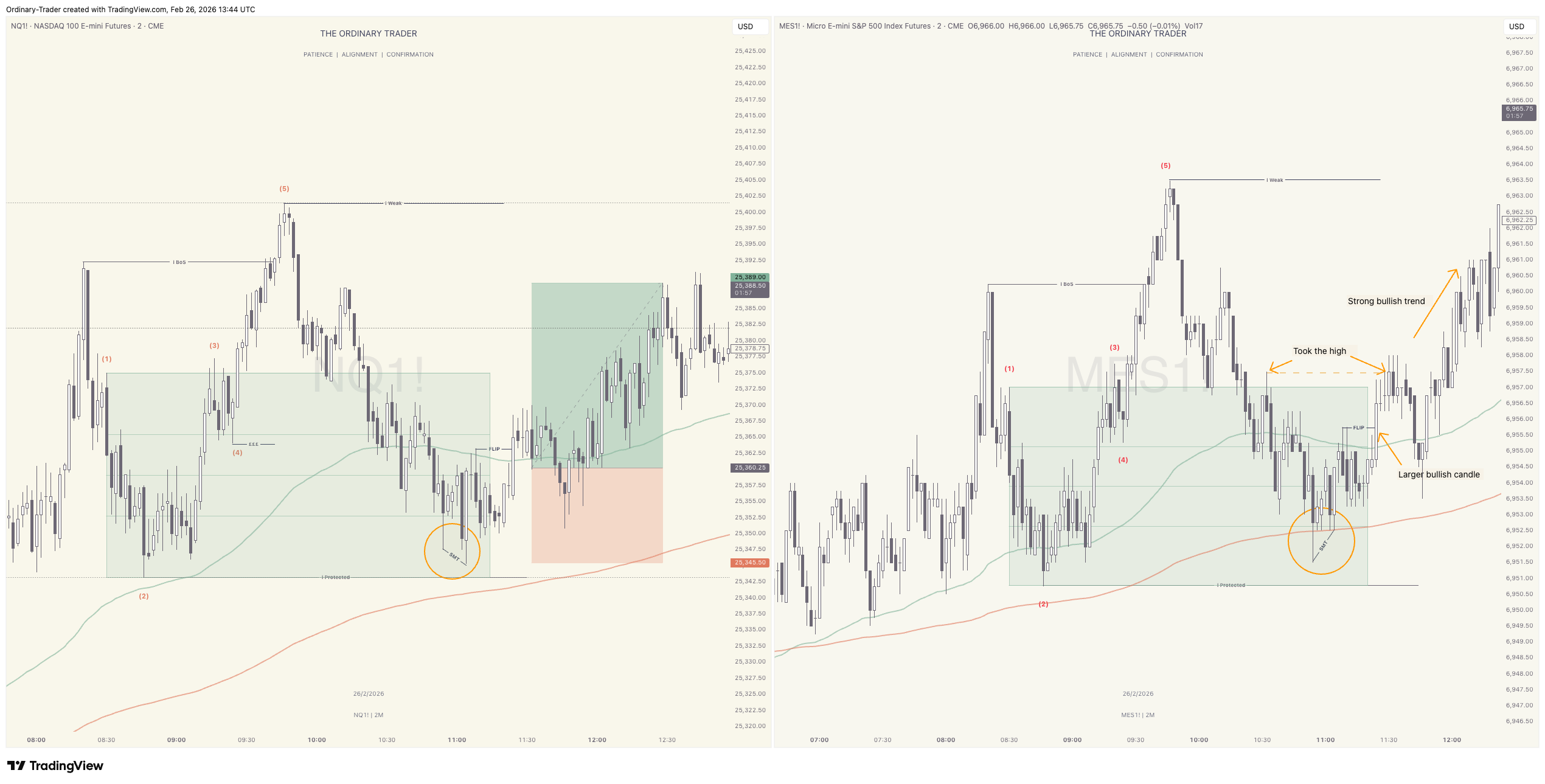
NQ swept the low. ES did not.
That small disagreement between the two is what put me on red alert.
That small disagreement between the two is what put me on red alert.
I have been working on integrating SMT divergences into my trade setups, so I am actively looking for these moments. Not forcing them, just noticing them. And this one stood out.
What I Saw at the Lows
On NQ, price traded below the prior low. It was a clean sweep. Liquidity taken.
On ES, the equivalent low held. It did not break. It did not trade through. It simply respected the level.
When two highly correlated markets behave differently at a key level, I pay attention. I am not assuming reversal at that point. I am asking a question.
Why is ES holding while NQ is sweeping?
To me, that immediately suggested relative strength in ES.
If both were weak, both should have broken. But they did not.
Relative Strength and the First Shift in Bias
Once I saw that divergence, my bias shifted slightly. I was no longer looking for continuation lower with confidence. I was thinking about the possibility that NQ had just taken liquidity while ES quietly held structure.
That is where SMT becomes useful for me. It does not tell me to buy. It tells me to reassess direction.
Around the area I marked as the flip, ES printed a strong bullish candle. It was decisive. It was not slow grind price action. That added confluence.
I was not trying to predict a massive move. I was simply looking for a rebalancing of correlation. If ES led higher, NQ might play catch up.
At that point, I had two things:
- NQ had swept liquidity.
- ES was holding structure and now showing displacement to the upside.
That combination made me consider the long.
My Working Hypothesis
In real time, this is how I framed it to myself:
- NQ sweeps liquidity.
- ES holds structure and shows strength.
- If ES continues higher, NQ will likely follow.
I was not trying to predict a massive move. I was simply looking for a rebalancing of correlation. If ES led higher, NQ might play catch up.
That was the idea.
The Entry Decision
Based on that, I set a limit order to get long.
Before placing it, I asked myself a few things.
- Has ES actually broken short term structure?
- Is there a clear invalidation level?
- Am I entering into a logical area rather than chasing price?
I did not want SMT alone to justify the trade. I needed structure to support it.
Once ES showed that strong bullish push at the flip area, I felt comfortable that buyers were stepping in with intent. That was enough for me to define risk and execute.
Could I have waited for more confirmation? Yes.
I could have waited for NQ to shift structure more clearly. I could have waited for a deeper pullback after the displacement.
But waiting also reduces the reward to risk. There is always a trade off. In that moment, I felt the balance was acceptable.
Managing the Trade While Watching Correlation
Once I was in the trade, I did not stop watching ES.
If the entire thesis was based on ES leading, then ES had to continue leading.
At one point, ES made a new high while NQ had not yet done so. That actually increased my confidence. It showed that strength was still present in ES.
If ES had stalled or broken back down, I would have reassessed quickly. The divergence only matters if it persists.
Eventually, NQ did catch up. Correlation restored to the upside. The trade played out cleanly.
Nothing dramatic. Just structure unfolding.
Would I Have Framed It Or Done Things Differently?
Looking back, I do not think I would have framed the idea differently. The logic felt sound.
What I might experiment with is waiting for a confirmed market structure shift on the instrument I am trading, even if the correlated pair has already shown strength.
That would likely reduce frequency but increase clarity.
Then again, trading is always a balance between early positioning and confirmed positioning. There is no perfect entry. There is only consistency in how I apply my rules.
Final Thoughts
This trade was not about being clever. It was about paying attention.
I saw divergence at the lows.
I saw relative strength in ES.
I formed a hypothesis.
I defined risk.
I monitored leadership while in the trade.
That is the process I want to build.
SMT, for me, is not a standalone edge. It is a layer. A way to read disagreement between correlated markets and adjust bias accordingly.
If I keep applying it this way, calmly and without forcing it, I think it can become a valuable part of my framework.
Quietly. Repeatedly. Session after session.