Tag Archive for: Decision Making

There are some weeks where trading feels unusually clean. Not easy, exactly, but clean. The decisions are clearer. The setups stand out. Losses do not sting in the same way because everything sits inside the process.

Week 11 felt like that.

From Monday through Wednesday, the rhythm was strong. The week started green, stayed calm, and carried that tone through the first half of the session block. By Wednesday, it genuinely felt like things were clicking. Trades were being selected with more care. Marginal setups were passed on without much internal debate. There was less noise, less forcing, less need to be involved in every move.

In other words, I was sticking to the plan.

That showed up in a few obvious ways. There were fewer trades overall. Adherence to the trade planner was better. The early-week win rate was strong. More importantly, losing trades were handled without frustration. They happened, they were accepted, and then the focus returned to the next decision.

That emotional shift matters more than it might seem.

When a strategy has a real edge across a large sample size, individual trades lose a lot of their emotional weight. They still matter, of course, but they stop feeling personal. A loss becomes a business expense rather than a verdict. That was probably the biggest improvement this week. There was less attachment to each outcome and more trust in the process itself.

For the first few days, everything felt controlled. Measured. Ordinary, in the best sense of the word. That kind of trading is rarely dramatic, but it is usually where the best work gets done. It fits closely with the broader philosophy behind The Ordinary Trader: calm, process-led execution without hype or emotional exaggeration. 

Discipline is never permanent. It has to be renewed in real time.

The day discipline slipped

Then Thursday arrived and offered a useful reminder: discipline is never permanent. It has to be renewed in real time.

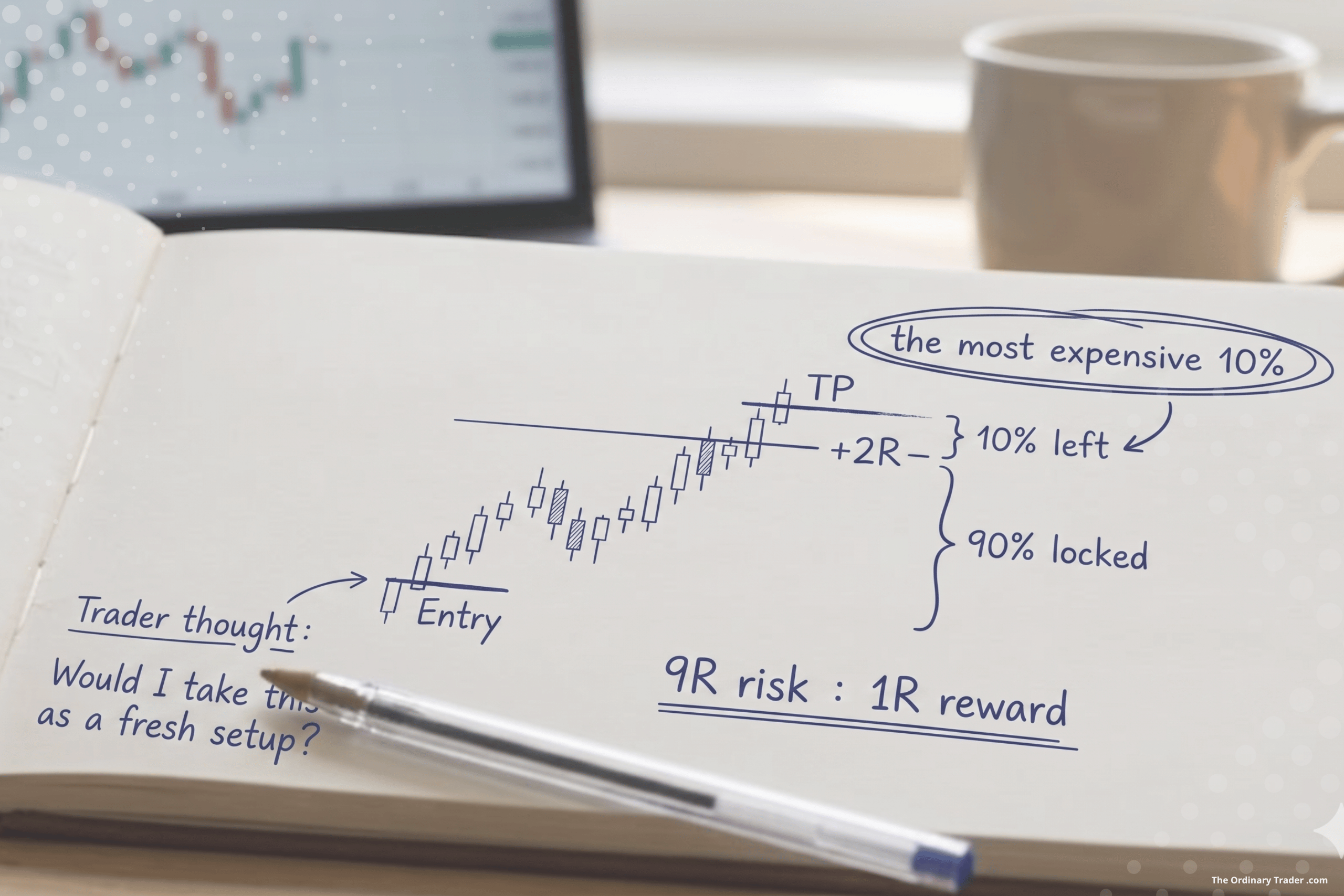
At around 9am, I had taken one trade and was already up +2.2R for the day. My daily target is 2R. So the correct decision was not complicated. The day had done its job. My job was to close the laptop and walk away.

I did not do that.

Instead, I started negotiating with myself. There was still plenty of session left. More movement might come. Another good setup could appear. None of that sounds especially reckless on paper, which is partly why this kind of mistake is so common. It rarely arrives as a dramatic impulse. More often, it shows up as a small, reasonable-sounding exception to a rule you already made for yourself.

By the end of the session, I had turned a strong day into -2.37R.

That is a swing of more than  4R in the wrong direction, caused entirely by ignoring the framework that was supposed to protect the day once the target had been met.

That is the frustrating part. Not the loss itself, but how unnecessary it was.


Overconfidence rarely looks loud

While journaling the losses later that day, another pattern became clearer. Some of the decisions were sloppy. Not wildly reckless. Not completely detached from the plan. Just a little looser than they should have been.
That distinction matters.

The biggest trading mistakes are not always explosive. Sometimes they are subtle. A setup that is almost good enough. A management decision that is almost justified. A trade that gets taken not because it is clearly there, but because you have been in rhythm all week and quietly start to trust yourself a little too much.

That was probably the real issue on Thursday: overconfidence.

After several green days and a strong win streak, there was likely a slight relaxation in standards. Nothing dramatic. Just enough to matter. And in trading, just enough to matter is more than enough to do damage.

Honestly, that is one of the stranger parts of this work. Good performance can create its own risk. When you have been seeing the market well, the temptation is to believe that the next decision will also be sharp. But markets do not reward confidence on its own. They reward discipline, and discipline often means stopping while you still feel good.

Friday’s reset: protect the week

Friday felt different. Not because the market was easier, but because the lesson from Thursday was still close enough to shape the decisions.

Two strong trades appeared and both delivered more than 3R. In another mood, there might have been a temptation to squeeze more from them, trail more aggressively, and try to extract every last bit of movement available. And yes, in hindsight, they may have gone further.

But that was not the point.

After what happened the day before, the better decision was to lock in the profits and close the laptop.

Sometimes protecting the week matters more than maximising the day.

That can feel slightly unsatisfying in the moment. Traders are conditioned to think in terms of missed potential. Could it have run further? Could more have been made? Maybe. But that line of thinking is not always helpful. A well-managed green day does not become a bad one simply because a market moved further after you exited.

There is a lot of freedom in accepting that.

The real lesson from Week 11

Week 11 closed at +11.16R, which is super encouraging. But the most useful takeaway had very little to do with entries, analysis, or market reads.

It was about protecting gains.

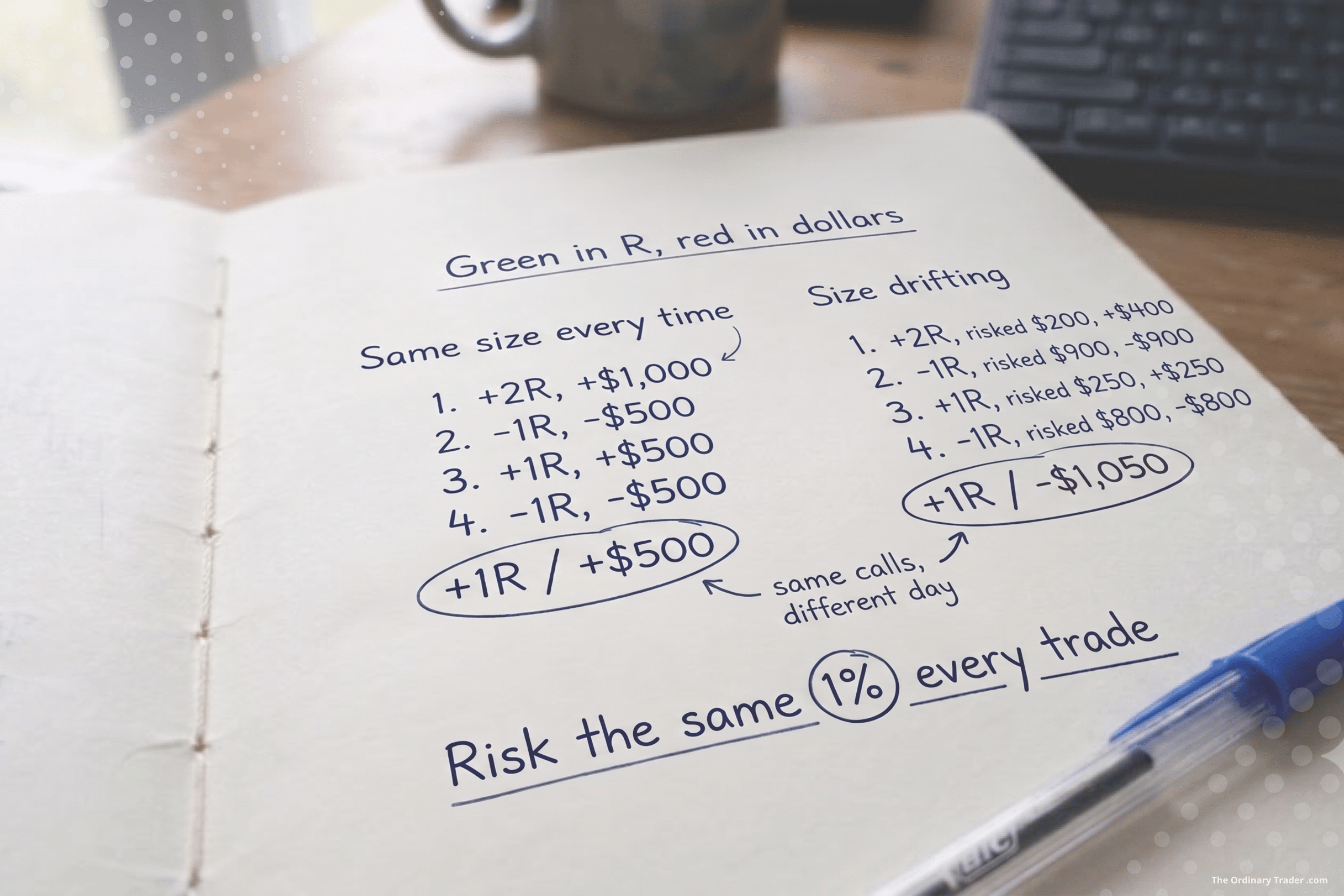
Growing a trading account is not only about finding winning trades. It is about keeping the money when it is made. It is about refusing to turn good days into average ones, and average ones into red ones. It is about letting the positive asymmetry work in your favour over time.

That is not flashy, but it is the work.

Minimise losses. Protect gains. Let the edge compound.

The equity curve becomes more stable when losses stay contained and green days are allowed to remain green. Not every opportunity needs to be taken. Not every move needs to be captured. And not every strong day needs to be pushed further.

That last part is easy to forget. A lot of trading advice focuses on pressing advantage, scaling up, or making the most of momentum. There is a place for that. But there is also a quieter skill that matters just as much: knowing when enough is enough.

That was the lesson this week.

Not how to chase more, but how to keep what was already earned.

Minimise losses. Protect gains. Let the edge compound.

A real trade journal example of SMT divergence using NQ and ES. See how correlation breaks, liquidity shifts, and market structure alignment create high probability setups.

Have you ever watched a clean breakout on NQ, felt that surge of confidence, clicked in… and then watched it snap back like it never meant it?

It happens. And when it does, it feels personal.

Here’s the thing. Sometimes the breakout isn’t wrong. It’s just lonely.

That’s where SMT comes in.

SMT, or Smart Money Technique divergence, is a concept popularised by Michael J. Huddleston. Strip away the branding and what you’re left with is simple: when two markets that usually move together stop agreeing, pay attention.

It’s not prediction. It’s not a crystal ball. It’s context.

And when you’re trading sweeps, displacement, and structure shifts on 15m and 1m, context is everything.

First, Why ES and NQ Even Matter Together

We’re talking about S&P 500 Index futures (ES) and NASDAQ-100 futures (NQ).

These two are close cousins. Different personalities, same family.

They move together because:

Same Macro Drivers

Both respond to:

  • Interest rates
  • Inflation data
  • Fed commentary
  • Risk on / risk off flows
  • US economic data

If the market is broadly buying equities, both rise.

If fear hits, both sell.

Simple.

Heavy Tech Overlap

Mega cap tech dominates both indices. When Apple, Microsoft, or Nvidia move, both ES and NQ feel it. Big money flows hit them at the same time.

So most of the time, they confirm each other.

Which is exactly why it matters when they don’t.

But They’re Not Identical, And That’s The Opportunity

Here’s where it gets interesting.

  • NQ moves faster
  • NQ respects structure differently
  • NQ overshoots more
  • ES is smoother

NQ is like the energetic sibling. Quick. Emotional. Aggressive. It runs highs and sweeps lows with conviction. ES is steadier. Broader. It grinds levels instead of exploding through them.

If you trade 15m for bias and 1m for entries, you’ve probably felt this already.

In practical terms:

  • ES tends to give cleaner higher timeframe structure
  • NQ tends to give sharper lower timeframe reactions
  • NQ rewards precision more but punishes size harder

A lot of traders use ES for bias and execute on NQ. Not because it’s clever. Because it makes sense. One gives clarity. The other gives movement.

And movement is where your edge lives.

So What Is SMT, Really?

SMT shows up at liquidity.

Equal highs. Equal lows. Session extremes. Obvious 15m levels where everyone can see the stops sitting.

Now imagine both ES and NQ approach equal highs.

One breaks.

The other doesn’t.

That’s SMT.

In a bearish scenario, one index makes a higher high while the other fails to confirm. Buy side liquidity gets swept in one market, but not the other. If the broader equity complex were genuinely strong, both should expand together.

When only one runs the stops, something feels off. That breakout might be distribution.

In a bullish scenario, one index sweeps sell side liquidity below prior lows, and the other refuses to break. That relative strength hints that the breakdown may be engineered.

It’s subtle. But it’s powerful.

SMT isn’t the entry. It’s the raised eyebrow before the move.

Bringing It Into A 15m / 1m Model

Let me explain how this fits into a structured approach.

On the 15m chart, you mark liquidity on both ES and NQ. Equal highs. Equal lows. Protected highs and lows. Clean swing points. That’s your map.

When price approaches those areas, you watch behaviour.

If one index sweeps liquidity and the other doesn’t confirm, you don’t jump in. You wait.

Then you drop to the 1m.

You look for:

  • Change of character
  • Displacement
  • Clear structure shift
  • Defined risk in premium or discount

Now your trade isn’t just a sweep. It’s a sweep plus divergence plus structure.

That’s different.

That’s layered probability.

How Do You Know Which Index Is Leading?

This is the part most traders skip.

If one index breaks and the other doesn’t, how do you know which one to trust?

Keep it simple.

Ask yourself:

  • Which index has been trending cleaner during the session?
  • Which index is showing stronger displacement?
  • Which index is respecting structure better?
  • Which index holds above a breakout level instead of instantly rejecting?

The stronger index tends to confirm real moves.

The weaker index tends to produce failed breaks and liquidity sweeps.

It’s not about who moved first.

It’s about who holds.

That distinction often decides whether you trade continuation or fade the move.

What SMT Is Not

SMT is not:

  • A standalone strategy
  • A guaranteed reversal signal
  • A reason to trade against trend blindly
  • A shortcut around confirmation

It is context layered onto structure.

Without structure, it’s just observation.

A Final Thought

Incorporating SMT into your strategy can feel like a glimpse into the future.

When a sweep occurs in one index and is rejected by the other, reversal probability increases. Not always. But often enough to matter.

That extra layer of context often turns average setups into A+ opportunities.

You’re still trading structure. You’re still managing risk. You’re still waiting for confirmation.

But now you’re asking a better question before you commit:

Is this move confirmed?

Should You Take 1R or Let It Run?

Most new traders focus almost entirely on entries. They refine confirmations, tweak structure rules, and optimise timing. But very quickly you realise something more important. Your exit strategy determines your expectancy.

Let’s walk through a clean example using simple numbers. No complicated formulas. Just clear logic.

We will assume the same core distribution throughout so every strategy is compared fairly.

The Starting Distribution

Across a large sample of trades:

  • 40% lose and hit full stop at -1R
  • 30% reach 1R but fail to extend further
  • 30% extend beyond 1R and can reach 1.5R

This is the raw behaviour of your system before deciding how to exit.

Now let’s compare four exit strategies using this same base data.

Strategy 1: Fixed 1R Take Profit

In this model you close the entire position at 1R. No partials. No trailing. No runners.

Using the base distribution:

  • 60% of trades reach at least 1R
  • 40% lose -1R

So expectancy is:

  • 60% × +1R = +0.60R
  • 40% × -1R = -0.40R

Total = +0.20R per trade

This is clean and efficient. Your edge here is accuracy. You monetise the fact that most trades reach 1R.

Strategy 2: 50% Partial at 1R, Runner to 1.5R

This is the classic hybrid approach.

When price hits 1R:

  • Close 50% for +0.5R
  • Move stop to break even

If the trade extends to 1.5R:

  • Remaining half earns +0.75R
  • Total win = +1.25R

If price reverses after 1R:

  • Remaining half stops at break even
  • Total win = +0.5R

Using our distribution:

  • 30% hit 1.5R → +1.25R
  • 30% stall after 1R → +0.5R
  • 40% lose → -1R

Now calculate:

  • 30% × 1.25R = +0.375R
  • 30% × 0.5R = +0.15R
  • 40% × -1R = -0.40R

Total = +0.125R per trade

Still profitable. But lower than the simple 1R model.

Why? Because only 30% of trades meaningfully extend. The runner frequency is not high enough to compensate for halving position size.

Strategy 3: Full Position Runner to 1.5R

Now we remove partials. The entire position aims for 1.5R.

If price reaches 1R but fails to continue, you move stop to break even and make nothing.

Distribution becomes:

  • 30% hit 1.5R → +1.5R
  • 30% reach 1R but reverse → 0R
  • 40% lose → -1R

Expectancy:

  • 30% × 1.5R = +0.45R
  • 30% × 0R = 0
  • 40% × -1R = -0.40R

Total = +0.05R per trade

You increased reward size but reduced realised wins. That trade off reduced expectancy.

Strategy 4: Structure Based Trailing

Now we remove the artificial 1.5R cap. Instead of targeting a fixed multiple, you trail behind structure and allow the market to decide.

To keep assumptions realistic, let’s use this distribution:

  • 40% lose → -1R
  • 30% reach 1R and then stop at break even → 0R
  • 20% trend moderately → +1.5R
  • 10% become strong runners → +2.5R

Now calculate:

  • 20% × 1.5R = +0.30R
  • 10% × 2.5R = +0.25R
  • 30% × 0R = 0
  • 40% × -1R = -0.40R

Total = +0.15R per trade

This improves on partials and fixed 1.5R runners, but still does not beat the simple 1R model under these conditions.

Comparing All Four

Using consistent assumptions:

  • Fixed 1R → +0.20R
  • Partials + 1.5R cap → +0.125R
  • Full 1.5R runner → +0.05R
  • Structure trailing → +0.15R

Under this distribution, the simplest strategy wins.

What This Teaches a New Trader

Risk reward ratio alone means nothing. A 1:1.5 target is not automatically superior to 1:1. What matters is how often price actually extends.

Your optimal exit depends on the behaviour of your market.

In rotational conditions:

  • Moves stall quickly
  • Pullbacks are deep
  • Extensions are limited

That profile favours harvesting 1R consistently.

In strong trending conditions:

  • Pullbacks are shallow
  • Structure stair steps cleanly
  • Large extensions are common

That profile favours structure based trailing and uncapped runners.

The mistake is using the same exit logic in both environments.

How to Decide With Data

Track one simple metric over your next 50 trades:

Maximum favourable excursion measured in R.

If most trades rarely exceed 1.5R before reversing, fixed 1R exits are likely optimal.

If a meaningful percentage regularly reach 2R or more, you may be capping your distribution too early.

The goal is not to maximise reward on a single trade. The goal is to optimise your overall distribution.

Sometimes the ordinary 1R is the most efficient solution.

Sometimes the market is offering a trend and you need to step aside and let it pay you.

The numbers will tell you which environment you are in.

There is solid science behind the idea that your ability to make good decisions changes across the day. It is one of the most studied topics in psychology, behavioural economics, and neuroscience.

Put simply:

  • The brain has limited self-regulation resources
  • Using them repeatedly makes them temporarily weaker
  • Fatigue changes risk perception and impulse control

For traders, that is not abstract theory. That is revenge trading. That is FOMO. That is dropping your entry standard from A+ to “this will do.”

Let’s unpack it.

Ego Depletion and Decision Fatigue

Researchers like Roy Baumeister proposed that willpower and disciplined thinking draw from a finite mental resource.

Every act of:

  • Resisting impulse
  • Analysing uncertainty
  • Managing emotion
  • Waiting for confirmation
  • Passing on a mediocre setup

…uses some of that fuel.

As the day progresses, the tank runs lower. When depleted, people tend to:

  • Choose easier options
  • Avoid complex thinking
  • Act more emotionally
  • Seek immediate reward
  • Abandon previously agreed rules

Not because they want to. Because the brain is tired. In trading terms, that shift is subtle but dangerous.

An A+ setup becomes an A.

An A becomes a B+.

A B+ becomes “close enough.”

And “close enough” is where consistency dies.

System 1 vs System 2

In Thinking, Fast and Slow, psychologist Daniel Kahneman describes two modes of thinking:

System 1 → fast, automatic, emotional

System 2 → slow, effortful, logical

Trading well requires System 2.

Waiting. Calculating. Filtering. Ignoring noise.

But as mental energy drops, the brain defaults to System 1.

Which means later in the session you are more likely to:

  • Revenge trade after a loss
  • Close winners early out of fear
  • Oversize to “make it back”
  • Ignore missing confirmation
  • Rationalise weak entries

It feels justified in the moment.

It rarely is.

The Judge Study

One of the most famous demonstrations of decision fatigue looked at Israeli judges.

Researchers found:

  • Early in the day → more thoughtful, favourable rulings
  • Right before breaks → harsher, default decisions
  • After food and rest → decision quality improved again

Judgement changed based on mental fatigue.

Not morality. Not intelligence. Not experience.

Energy.

Now apply that to a trader four hours into screen time, three trades in, slightly red, watching price move without them.

The conditions are perfect for a poor decision.

What Happens Biologically?

As cognitive load builds:

  • Attention declines
  • Emotional regulation weakens
  • The prefrontal cortex (responsible for discipline and planning) becomes less effective
  • Impulse systems become louder

So discipline literally becomes harder.

You do not suddenly become reckless.

You become slightly less precise.

And in trading, slight erosion compounds.

How This Shows Up On Your Chart

This is what mental fatigue looks like in practice:

  • Patience drops
  • Rule adherence softens
  • Risk taking increases
  • Urgency appears where none exists
  • Entry standards slip

You do not say, “I am fatigued.”

You say:

“Maybe this one is ok.”

That sentence has probably cost more traders money than any indicator ever has.

The Uncomfortable Truth

By the time most traders take their worst trade…

They are already mentally depleted.

It is rarely the first trade of the day.

It is often the third.

Or the one taken after trying to claw back -2R.

Not a strategy problem.

An energy problem.

How Professionals Protect Themselves

Professionals do not rely on motivation.

They design around biology.

They:

  • Limit decisions per day
  • Use a daily trading planner.
  • Pre-plan actions before the session
  • Use checklists
  • Automate exits where possible
  • Stop at fixed loss limits
  • Trade fewer, higher quality opportunities

They reduce how often System 2 has to fire.

They preserve decision energy for when it matters most.

Why This Matters If You’re Building Consistency

If you are building a structured, rules-based approach to trading, this is gold.

Performance deterioration is often biological, not intellectual.

You do not need more knowledge.

You need fewer decisions.

Fewer trades.

Higher standards.

Defined stop times.

Hard daily limits.

Because consistency is not just about strategy.

It is about protecting your brain from itself.

Friday evening, platinum, around 7–8pm UK time.

It was the second time price had traded back into the same zone. I almost ignored it out of habit. I rarely take a second trade from the same level.

But this one looked different.

Price pushed back down into the zone with intent, swept liquidity deeper than before, then failed to make a new low. On the lower timeframes, bullish fair value gaps began to form. The reaction was clean. Controlled. It didn’t feel random.

So I took it.

Because it was a second opportunity from the same zone, I sized the expectations differently. I didn’t think it would have the same energy as the first move. Less gas. Less conviction. That assumption shaped everything that followed.

I managed the trade with a tight trailing stop almost immediately.

Part of that came from context. It was late on a Friday. Markets were approaching the close. Time left in the trade mattered. I didn’t want to give much back, especially if liquidity thinned and price turned erratic.

But part of it was something else.

After entry, I noticed the bearish candles were larger and more impulsive than the bullish ones. When price pushed against my position, it did so with more force than when it moved in my favour. That imbalance stuck in my head. It felt like pressure. Like a warning.

So I kept tightening the stop.

The trade worked. It was a winner.

It just didn’t do what it was capable of doing.

Price continued higher after I was taken out, moving cleanly through areas I’d originally mapped. Nothing invalidated the idea. Nothing structurally changed. I was right on direction and location.

I just didn’t stay in the trade long enough to let it express itself.

The lesson isn’t about trailing stops being bad. It’s about when they’re appropriate and why they’re being used.

On lower timeframes, structure often invites tighter management. It makes sense intellectually. You see micro higher lows, small pullbacks, clean continuation. It feels disciplined to lock things down quickly.

But discipline isn’t the same as fear dressed up as precision.

I was managing risk based on assumptions I hadn’t fully tested.

In this case, I was managing risk based on assumptions I hadn’t fully tested. That a second trade from the same zone should underperform. That late Friday trades need to be protected aggressively. That stronger bearish candles automatically reduce the validity of a long.

None of those are rules in my plan. They’re interpretations layered on top of it, in real time, under subtle pressure.

The irony is that the strategy worked exactly as designed. The location held. The sweep mattered. The failure to make a new low mattered. The bullish fair value gaps mattered.

What didn’t work was my willingness to accept a normal pullback in exchange for the full move.

Trailing stops are powerful when they’re used deliberately. They’re dangerous when they’re used reactively.

Especially late in the week, when time becomes part of the decision-making, it’s easy to start optimising for comfort instead of expectancy. You tell yourself you’re being prudent, when really you’re trying to avoid the feeling of watching unrealised profit retrace.

That’s not a moral failing. It’s just something to be aware of.

The real adjustment here isn’t mechanical. It’s situational.

Second trades from the same zone don’t automatically deserve tighter managemen

Second trades from the same zone don’t automatically deserve tighter management. Late Friday trades don’t automatically require fear-based exits. And lower timeframe structure doesn’t override higher timeframe intent.

If the plan calls for allowing a pullback, then the pullback has to be allowed. Otherwise the trade is never really being tested.

The simple takeaway I’m carrying forward is this:

If I’ve trusted the location and taken the trade, I need to be just as intentional about how I manage it as I was about why I entered. Tight stops should be a decision, not a reflex.

Sometimes the hardest part of trading isn’t getting in.

It’s staying in long enough to let being right actually matter.