Tag Archive for: Emotions

The last trade is still in the room

You take a loss. A clean one, within your rules, nothing you did wrong. Then a valid setup appears twenty minutes later and you hesitate, because the last one stung and you do not want to feel that again. Or worse, you jump on it too hard, too big, because you want the loss back and this looks like the way to get it.

Either way, the trade you just took is being shaped by the trade before it. And that is the problem. On paper, each trade is independent. The market has no memory of your last position and does not care whether you are up or down on the day. But you have a memory, and it does care, and that mismatch is where a lot of accounts quietly bleed out.

The last outcome tells you nothing about the next one.

Statistically independent, emotionally connected

Your strategy works, if it works, across a run of trades. Any single one is a roll of the dice with an edge. The last outcome tells you nothing about the next one.

Your nervous system did not get that memo. A loss lands as a small threat, and the body responds the way it responds to threats: it wants to either avoid the thing that hurt or attack it. A win lands as reward, and the body wants more of it, faster. Neither of those instincts has anything to do with whether the next setup on your chart is worth taking. They are reactions to the previous trade, bleeding forward into a decision that should have been made fresh.

Left unmanaged, that carryover is what turns one loss into three, and one good win into a giveback. Not because the setups were bad, but because you were still trading the last one.

The two ways it goes wrong

After a loss, you get one of two failure modes. The first is timidity. You freeze on the next valid setup, or you take it at half size, or you talk yourself out of it entirely, because the fresh memory of losing makes the risk feel bigger than it is. You miss the trade that would have paid you back, precisely because the last one hurt.

The second is revenge. You come in hot, size up, and take something marginal because you need the money back now and patience feels unbearable. This is the more expensive of the two, and it never feels like revenge in the moment. It feels like conviction. It feels like you have spotted the trade that fixes everything. It is worth being honest that a sudden surge of certainty right after a loss is almost always the loss talking.

After a win, the failure mode is looseness. You feel sharp, the account is padded, and the discipline slackens. You take a setup that is not quite there because you can afford to be wrong, you size up because you are playing with the market’s money, and you hand a chunk of the win back to a trade you would never have taken cold. The win contaminated the next decision just as surely as the loss did.

Close the trade before you open the next

Detaching is not about feeling nothing. It is about having a deliberate gap between one trade and the next, so the emotional residue does not leak across.

The simplest version is a small closing ritual. When a trade is done, log it. Write down what the setup was, whether you followed your plan, and what actually happened, kept separate from each other on purpose. The act of writing it down marks it as finished. It is on the page now, not rattling around in your head. The trade is closed, in both senses.

Then put a real gap between that and the next click. Stand up. Leave the desk. Let the heart rate come down. The urge to immediately get back in is the residue itself, demanding to be acted on, and stepping away is how you refuse it. The trader who takes two minutes away from the screen after a result is usually the one who comes back able to see the next setup clearly.

When you sit back down, judge the next trade on its own merits and nothing else. Does this setup meet the checklist, right now, as if the last trade never happened? If yes, take it at your normal size, whatever just happened. If no, you do not take it, no matter how badly you want the loss back or how invincible the win made you feel. The previous trade gets no vote.

Detaching is not about feeling nothing. It is about having a deliberate gap between one trade and the next, so the emotional residue does not leak across.

The clean slate is the skill

Nobody talks about this as a skill, but it is one, and it is trainable. Every trade you close properly and start fresh is a rep. Over time the gap between trades stops feeling like willpower and starts feeling like routine.

The market gives you a clean slate on every trade whether you use it or not. It has already forgotten your last position. The only thing standing between you and that same clean slate is the residue you are still carrying. Put the last trade down. The next one deserves a decision made from scratch.
You told them you were a trader

It usually slips out somewhere ordinary. A dinner, a group chat, a catch-up with someone you have not seen in a while. They ask what you have been up to, and you say it: you have got into trading. Maybe you dress it up as a side thing, maybe you do not. Either way, it is out now.

And it felt good to say. It sounded like you were building something, taking control, doing the kind of thing most people only talk about. The problem is that the words went out long before the results did. You claimed the identity on credit.

From that moment, every trade has an audience. Not a real one, mostly. An imagined one, made of the people you told, sitting quietly in the back of your head, waiting to see whether the thing you announced actually works.

An audience raises the stakes on outcomes you were already struggling to hold loosely.

What the audience does to your decisions

An audience raises the stakes on outcomes you were already struggling to hold loosely.

A losing trade is just a losing trade until other people know you trade. Then it becomes a small piece of evidence that you might have been wrong about yourself, in front of everyone who heard you say it. That is a heavier thing to carry into the next click. You start needing trades to work, not just wanting them to, and needing a trade to work is one of the most reliable ways to trade badly.

It shows up as trades you take to have something to report. It shows up as a loss you will not close because closing it makes the story you told feel false. It shows up as the itch, after a family member half-jokingly asks how the trading is going, to go and prove them right with a session that gets the number back. None of that is coming from the chart. All of it is coming from the audience you invited in.

The account cannot tell the difference between a trade you took because it was there and a trade you took because you had told your brother-in-law you were a trader. But your equity curve feels the second kind eventually.

Trading in public before you are ready

There is a version of this that goes further. Posting the wins. Sharing the screenshots. Letting people watch.

It is tempting because it feels like accountability, and because attention is pleasant. But doing it before your process is solid does something specific and unhelpful: it ties your trading to how you look. Once an audience is watching in real time, the pull to keep up appearances competes directly with the pull to follow your plan. You take the trade that makes a good post instead of the trade that makes sense. You avoid logging the loss because the loss is now public. You are performing being a trader instead of learning to be one, and those two jobs pull in opposite directions.

The early phase of this is quiet, unglamorous, and full of mistakes you would rather nobody saw. That is exactly as it should be. Learning in the open is a fine thing once you have something honest to show. Doing it before then just adds a spotlight to the part of the journey that most needs privacy.

A losing trade is just a losing trade until other people know you trade.

Why silence protects the process

Keeping it to yourself is not about secrecy or shame. It is about protecting a fragile process from pressure it does not need yet.

When nobody knows, a loss is just information. You log it, you learn from it, you move on, and the only person who has to make peace with it is you. When nobody knows, you can change your approach, take a month off, size down to almost nothing while you rebuild, without explaining any of it to anyone. You keep the freedom to be a beginner, which is the freedom to get things wrong cheaply.

There is a difference between “I am a trader” and “I am learning to trade.” The first is a claim about results. The second is a description of the work. Early on, the second one is both more accurate and less costly to hold. It does not put anything on the line that a normal losing streak can threaten.

What to do with the urge to say it

The urge to tell people is really an urge to feel like the thing is real before it is. That is understandable, and it is worth resisting for a while longer than feels comfortable.

Let the results arrive first. Let there be a track record, a stretch of consistency, an actual body of work behind the word before you hand the word to anyone. When it is backed by something, saying it costs you nothing, because a bad week can no longer make you a liar.

Until then, the quiet is doing you a favour. It keeps the audience out of your decisions and leaves you alone with the chart, the plan, and the slow, unwitnessed work of getting good. That is the only place the results were ever going to come from anyway.

The day was green, so you felt like a good person

You closed the platform up on the day and something in your chest loosened. You were kinder at dinner. You slept well. You felt, quietly, like you had earned your place.

Then a red day arrived, and the whole thing inverted. Short with your family. Replaying the trades in the shower. A low, familiar feeling that you are not cut out for this, that everyone else has figured out something you never will.

If that swing sounds familiar, the problem is not really your trading. It is that you have made the P&L a verdict on you as a person. A green day says you are competent, disciplined, worth something. A red day says the opposite. And once that link is in place, every session is quietly loaded with far more than money.

When your self-worth is riding on that daily number, you are pinning how you feel about yourself to something close to a coin flip.

What you have actually done

You have taken a number that is mostly outside your control on any given day and turned it into a scoreboard for your character.

This matters because trading outcomes are noisy. You can follow your plan perfectly and lose. You can break every rule you have and win. Over a large enough sample the process shows up in the results, but on any single day the connection between “did I trade well” and “did I make money” is loose at best. When your self-worth is riding on that daily number, you are pinning how you feel about yourself to something close to a coin flip.

So you end up feeling like a failure on days you traded well and lost, and feeling great on days you got lucky doing something stupid. Neither of those feelings is telling you the truth. Both of them are teaching you the wrong lesson.

How it leaks into the trading itself

Here is the part that actually damages the account.

When a green day means you are a good person, you start protecting the feeling instead of the process. You bank a winner far too early because you cannot bear to hand back the gain that is currently making you feel worthy. You refuse to take a valid loss because closing red feels like admitting something about yourself. You trade to defend an identity, not to follow a plan.

And after a red day, the need to fix the feeling takes over. You come back the next morning not to trade your setups but to get the number green again, because green is where you feel okay. That is where revenge trading is born. Not from greed, but from a person trying to feel like themselves again.

The moment your identity is on the line in every trade, you cannot make calm decisions. Nobody can. The stake is too high, and it is the wrong stake.

Separate the two things that got tangled

You are not your equity curve. The account measures the outcome of your decisions across changing conditions, luck included. It does not measure whether you are disciplined, intelligent, or worth respecting.

The thing worth being proud of is the process. Did you wait for your setup? Did you size it properly? Did you take the loss where you said you would? Did you leave when you had done enough? Those are the things you control, and those are the things that actually predict whether you make it. Judge yourself on those, and a losing day where you did everything right becomes what it actually is: a good day.

This is not a mindset trick to feel better about losses. It is a more accurate way of keeping score. A trader who follows the plan and loses has done their job. A trader who abandons the plan and wins has not. If your internal scoreboard cannot tell those two apart, it is measuring the wrong thing.

A trader who follows the plan and loses has done their job. A trader who abandons the plan and wins has not.

What this looks like in practice

At the end of the session, ask a different question first. Not “how much did I make,” but “did I trade the way I said I would.” Grade the process before you look at the number. Some days those two answers will disagree, and learning to sit with that gap is most of the work.

Keep the numbers in the journal, where they belong, over a sample long enough to mean something. A single day tells you almost nothing about you. A month of process notes tells you plenty.

And notice the mood swing when it happens. The evening you feel quietly superior because the day was green is the same evening you are one bad session away from feeling worthless. Both of those are the same mistake wearing different clothes. The goal is not to feel great on green days. It is to feel roughly the same on both, because your worth was never the thing being traded.

At the end of the session, ask a different question first. Not “how much did I make,” but “did I trade the way I said I would.”

The account will do what it does. Some days green, some days red, hopefully drifting up over time. You get to be the same person through all of it. That steadiness is not a nice-to-have. It is the thing that lets you keep showing up long enough for the process to pay.

The story you tell yourself

You’ve just taken a loss. Clean setup, sensible risk, nothing reckless. But the market did what markets do, and you’re down.

You close the trade and scan the chart again. Another setup appears. Clear structure, a level that holds, everything pointing in the right direction. You size up slightly to recover ground. You enter.

That is the moment. Not obviously revenge trading. Not a red-mist doubling down. Just a trade. Justified. Logical. Backed by analysis.

Or was it?

The disguise

Most traders think they’d recognise revenge trading if it showed up. The obvious version is easy to spot: tripling size, ignoring every rule you built, entering on impulse and calling it a hunch. That failure mode gets talked about.

The harder version looks nothing like that.

It looks like patience. Like carefully reading the chart and finding what you were looking for. The position size is only slightly larger. The entry makes sense. You could walk someone through it and they’d probably nod along.

But underneath all of that, the question you were actually answering was not “is this a good trade?” It was “how do I get that money back?”

The analysis was real. The justification was real. The conviction felt real. But the thing driving the decision was not analysis at all.

most emotional decisions happen in the first twenty minutes after a losing trade.

The tells

There is no clean single diagnostic for this. But there are patterns worth watching.

You entered faster than usual. Normally you wait for a specific condition – a close through a level, a retest, some form of confirmation. On this one, you moved quicker. The reason felt sound. But if you’re honest, you were looking for permission rather than evidence.

The position size changed. Not dramatically. But it went up. And the reason you gave yourself – strong setup, good R – would apply to most of your trades. Size doesn’t usually move for good setups. It moved because you needed more on the line.

You skipped a step. The Daily Trading Planner didn’t get filled in. Or it was filled in after the trade was already open. Or you glanced at it and decided the trade had already passed the check. There’s a difference between working through the checklist and working around it.

You felt better after entering. This one is subtle. Good trades usually come with calm. You’ve done the work, you’re in the trade, now you wait. This one felt like relief. Like something had been repaired. That shift in feeling is worth noticing.

None of these individually disqualifies a trade. But when several arrive together, shortly after a loss, they’re worth pausing for.

The self-check

Before the next entry, try three things.

Write down why you’re taking the trade in a single sentence. Not a paragraph, not a bullet list. One sentence. If that sentence contains anything about the previous trade – recovering a loss, proving a read was right, getting back to flat – the trade isn’t ready.

Then write down the R. Not what you hope it will be. What it actually is, based on where your stop sits right now. If that number is larger than your usual position, ask why. If the answer is anything other than “the setup calls for it,” step away.

Finally, check how long it has been since the loss. There’s no magic number. But most emotional decisions happen in the first twenty minutes after a losing trade. Most sound ones happen after you’ve had time to reset. Entering again quickly isn’t always wrong, but it deserves more scrutiny, not less.

Before the account shows you

The account has no patience for this distinction. It doesn’t know whether you were trading from conviction or from frustration. It just records the outcome.

That’s part of what makes this pattern hard to break. You might take a revenge trade dressed as conviction and win. The justification gets reinforced. The process that generated the decision feels validated. And the next time a loss arrives, the same pattern runs again with a little more confidence behind it.

Catching it early isn’t about doubting every trade you place after a loss. It’s about being honest with yourself about the question you’re actually trying to answer when you enter.

Analysis asks: does this setup meet my criteria?

Revenge asks: can this trade undo what just happened?

They can produce the same entry. But only one of them is a repeatable process.

Starting the day with a win feels good. Quietly so.

There’s a small lift you can sometimes feel after a clean trade closes in profit – confidence settling in, the day already feeling productive, the rest of the session looking easier than it did an hour ago.

That feeling is the problem.

Not the feeling itself. The way it nudges the next decision.

The win you didn’t earn the next trade with

A losing streak gets a lot of attention in trading education, and rightly so. Drawdown is loud. You notice it. The account balance flashes the warning at you, and most traders have at least one rule about stepping away when losses pile up.

An early win is quieter. It hides behind the fact that you did the right thing. You followed the plan, the setup played out, the entry was valid, and the trade closed in profit. There’s nothing to flag, nothing to log as a mistake.

But what often follows is a version of you that’s slightly more relaxed. Slightly more willing. The next setup looks a bit better than it should. The next stop sits a bit wider. The size creeps. You’re still doing the work, but the work is being done by someone who already feels like the day is going their way.

That’s where the damage starts.

The asymmetry nobody flags

Most traders are trained, by experience, to expect emotional drift after losses. Frustration, the urge to revenge trade, the temptation to chase. There are whole books on managing the downside of the emotional curve.

The upside of the curve gets much less attention. Overconfidence doesn’t feel like a problem in the moment. It feels like momentum. It feels like a green day in motion. And it often delivers a second decent trade before it delivers a stupid one.

Wins don’t feel like a risk. That’s exactly why they are one.

What I actually do after a clean morning trade

I treat an early win the same way I treat a string of losses.

Same protocol. Step away from the desk. Let the moment settle. Come back to the chart with the same eyes I started the session with.

A few specifics, because the abstract version of this is too easy to nod along to and then ignore:

  • I close the chart. Not minimise. Close.
  • I leave the room for at least fifteen minutes. Coffee, a walk, anything that isn’t a screen.
  • I don’t review the winning trade until the session is over. Reviewing it mid-session can quietly turn into validating it, and validating it can quietly turn into pattern-matching the next setup against it.
  • When I come back, I open the Daily Trading Planner first, not the chart. The plan for the day hasn’t changed. My state has. The plan is what will keep me honest during the rest of the session.

It’s a small set of actions. It works because it’s the same set of actions I use after a bad sequence. The brain doesn’t get to vote on whether the day is going well or badly. The protocol just runs.

The trade isn’t where the damage happens

A useful frame: most blow-up days don’t begin with a single bad trade. They begin with a slightly emotional trader making slightly worse decisions for a slightly longer stretch. The drift is the problem, not any one entry.

That’s true on the downside, where revenge trading is well-documented. It’s also true on the upside, where overconfidence does the same job with a friendlier face. By the time the giving-back trade hits, the conditions that caused it were set up trades earlier, when a win felt like permission.

The point of stepping away isn’t to dampen the win. The win is on the books. It already happened. The point is to protect the next decision from being shaped by a state that has nothing to do with the chart in front of you.

Sit with it

There’s a quiet bit of work in trading that nobody finds glamorous: noticing your own state and treating it as data. Not analysing it for an hour. Not journalling three pages about it. Just noticing, and then doing the small thing that the noticing demands.

After an early win, the small thing is to stop. Same as after losses. The session can wait. The market will still be there in fifteen minutes, and so will the next valid setup. If anything, you’ll see it more clearly.

The win is on the books. That’s enough for now.

There are some weeks where trading feels unusually clean. Not easy, exactly, but clean. The decisions are clearer. The setups stand out. Losses do not sting in the same way because everything sits inside the process.

Week 11 felt like that.

From Monday through Wednesday, the rhythm was strong. The week started green, stayed calm, and carried that tone through the first half of the session block. By Wednesday, it genuinely felt like things were clicking. Trades were being selected with more care. Marginal setups were passed on without much internal debate. There was less noise, less forcing, less need to be involved in every move.

In other words, I was sticking to the plan.

That showed up in a few obvious ways. There were fewer trades overall. Adherence to the trade planner was better. The early-week win rate was strong. More importantly, losing trades were handled without frustration. They happened, they were accepted, and then the focus returned to the next decision.

That emotional shift matters more than it might seem.

When a strategy has a real edge across a large sample size, individual trades lose a lot of their emotional weight. They still matter, of course, but they stop feeling personal. A loss becomes a business expense rather than a verdict. That was probably the biggest improvement this week. There was less attachment to each outcome and more trust in the process itself.

For the first few days, everything felt controlled. Measured. Ordinary, in the best sense of the word. That kind of trading is rarely dramatic, but it is usually where the best work gets done. It fits closely with the broader philosophy behind The Ordinary Trader: calm, process-led execution without hype or emotional exaggeration. 

Discipline is never permanent. It has to be renewed in real time.

The day discipline slipped

Then Thursday arrived and offered a useful reminder: discipline is never permanent. It has to be renewed in real time.

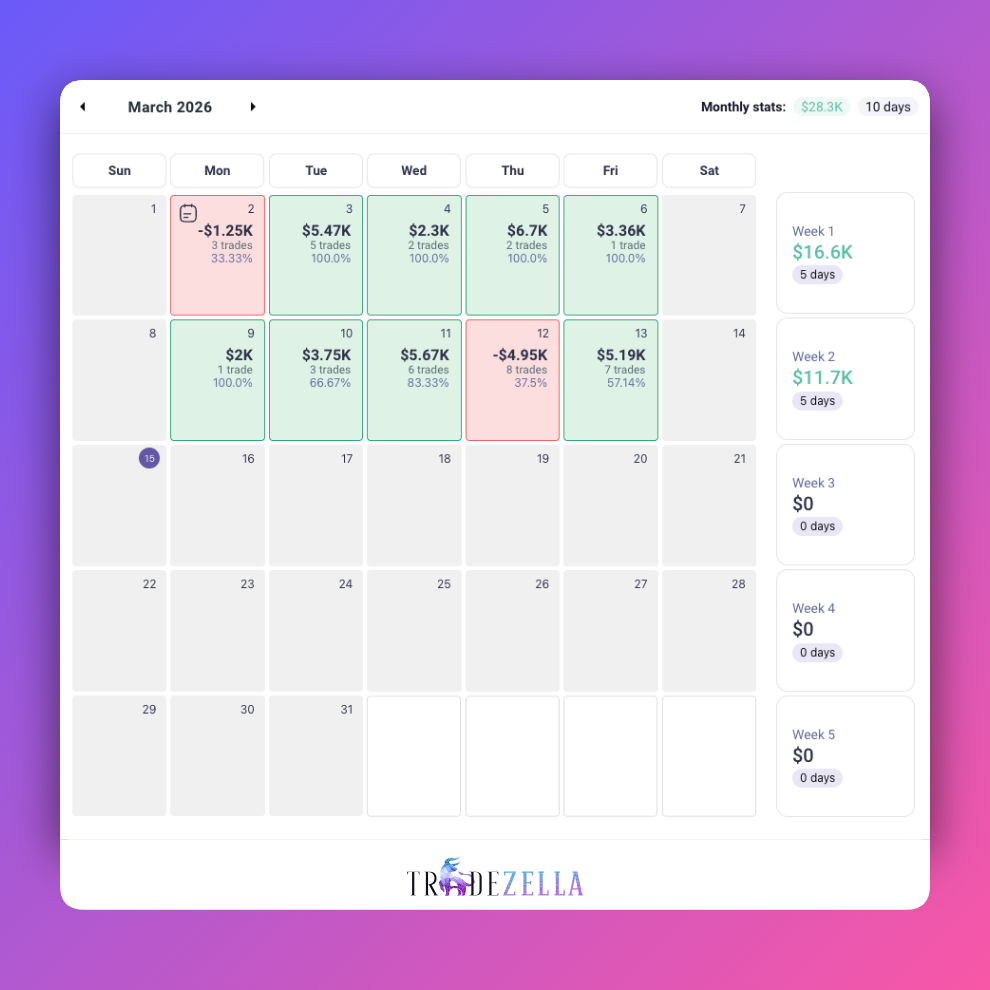
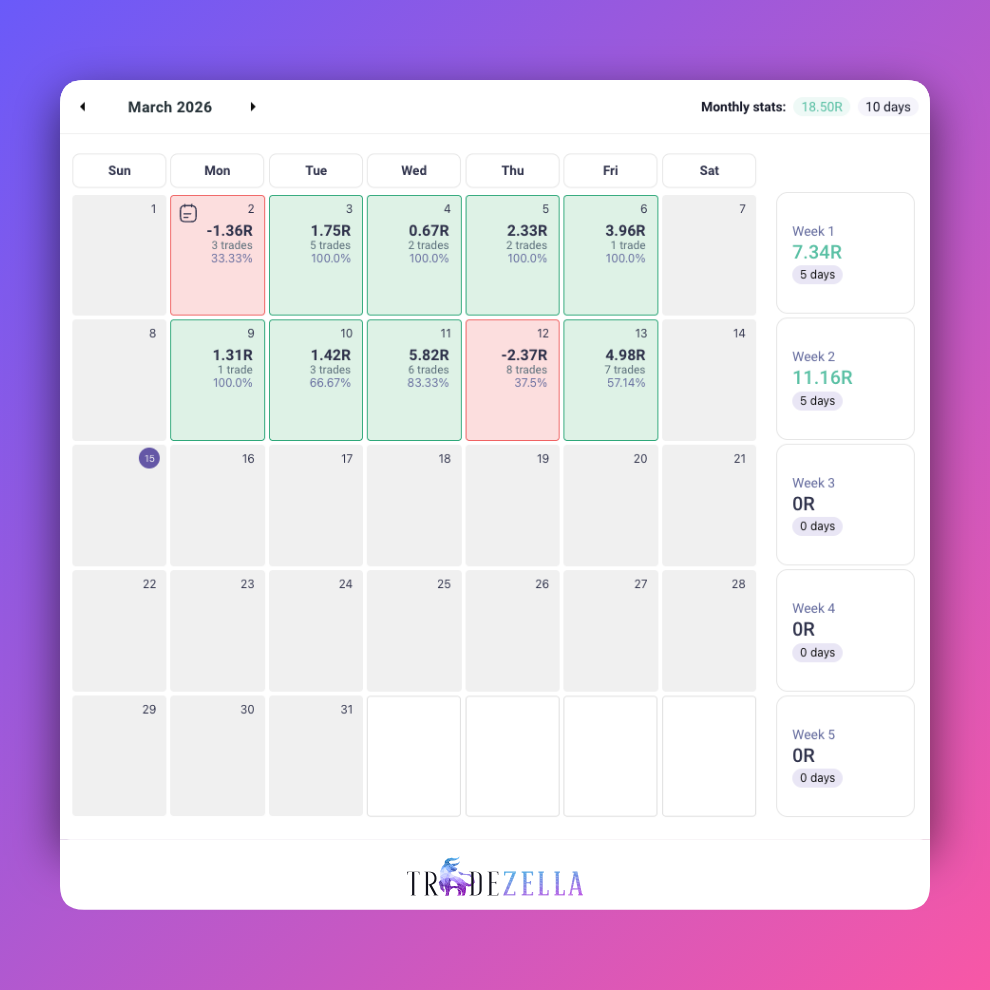
At around 9am, I had taken one trade and was already up +2.2R for the day. My daily target is 2R. So the correct decision was not complicated. The day had done its job. My job was to close the laptop and walk away.

I did not do that.

Instead, I started negotiating with myself. There was still plenty of session left. More movement might come. Another good setup could appear. None of that sounds especially reckless on paper, which is partly why this kind of mistake is so common. It rarely arrives as a dramatic impulse. More often, it shows up as a small, reasonable-sounding exception to a rule you already made for yourself.

By the end of the session, I had turned a strong day into -2.37R.

That is a swing of more than  4R in the wrong direction, caused entirely by ignoring the framework that was supposed to protect the day once the target had been met.

That is the frustrating part. Not the loss itself, but how unnecessary it was.


Overconfidence rarely looks loud

While journaling the losses later that day, another pattern became clearer. Some of the decisions were sloppy. Not wildly reckless. Not completely detached from the plan. Just a little looser than they should have been.
That distinction matters.

The biggest trading mistakes are not always explosive. Sometimes they are subtle. A setup that is almost good enough. A management decision that is almost justified. A trade that gets taken not because it is clearly there, but because you have been in rhythm all week and quietly start to trust yourself a little too much.

That was probably the real issue on Thursday: overconfidence.

After several green days and a strong win streak, there was likely a slight relaxation in standards. Nothing dramatic. Just enough to matter. And in trading, just enough to matter is more than enough to do damage.

Honestly, that is one of the stranger parts of this work. Good performance can create its own risk. When you have been seeing the market well, the temptation is to believe that the next decision will also be sharp. But markets do not reward confidence on its own. They reward discipline, and discipline often means stopping while you still feel good.

Friday’s reset: protect the week

Friday felt different. Not because the market was easier, but because the lesson from Thursday was still close enough to shape the decisions.

Two strong trades appeared and both delivered more than 3R. In another mood, there might have been a temptation to squeeze more from them, trail more aggressively, and try to extract every last bit of movement available. And yes, in hindsight, they may have gone further.

But that was not the point.

After what happened the day before, the better decision was to lock in the profits and close the laptop.

Sometimes protecting the week matters more than maximising the day.

That can feel slightly unsatisfying in the moment. Traders are conditioned to think in terms of missed potential. Could it have run further? Could more have been made? Maybe. But that line of thinking is not always helpful. A well-managed green day does not become a bad one simply because a market moved further after you exited.

There is a lot of freedom in accepting that.

The real lesson from Week 11

Week 11 closed at +11.16R, which is super encouraging. But the most useful takeaway had very little to do with entries, analysis, or market reads.

It was about protecting gains.

Growing a trading account is not only about finding winning trades. It is about keeping the money when it is made. It is about refusing to turn good days into average ones, and average ones into red ones. It is about letting the positive asymmetry work in your favour over time.

That is not flashy, but it is the work.

Minimise losses. Protect gains. Let the edge compound.

The equity curve becomes more stable when losses stay contained and green days are allowed to remain green. Not every opportunity needs to be taken. Not every move needs to be captured. And not every strong day needs to be pushed further.

That last part is easy to forget. A lot of trading advice focuses on pressing advantage, scaling up, or making the most of momentum. There is a place for that. But there is also a quieter skill that matters just as much: knowing when enough is enough.

That was the lesson this week.

Not how to chase more, but how to keep what was already earned.

Minimise losses. Protect gains. Let the edge compound.

23rd – 27th February

Week 9 was a quieter week. Not dramatic. Not explosive. Just controlled.

Coming into it, the focus was very specific. I wanted to double down on discipline. That meant sticking to my trading planner rules without exception:

  • Maximum 5 trades per day
  • Maximum loss of 2R
  • Profit target of 2R
  • No deviation from 1 percent risk

In terms of execution, this was genuinely an A+ week. I followed the rules. I did not oversize. I did not chase. I did not break daily limits out of frustration or excitement. That might sound basic, but consistency in rule adherence is still the foundation of everything.

Now for the honest part.

The week closed slightly red at -0.71R.

There is no dressing that up. It was a losing week. But context matters. The loss was small. It was contained. It stayed well within predefined limits. That is what risk management is supposed to do.

If the model is working correctly, losing weeks will happen. The key is ensuring they are controlled, while winning weeks are allowed to expand.

If the model is working correctly, losing weeks will happen. The key is ensuring they are controlled, while winning weeks are allowed to expand. By that definition, this was what I would call a good loss.

What makes it more interesting is that I actually had more wins than losses. Six wins. Five losses. A 54.55 percent win rate.

Accuracy was not the issue.

The issue was upside. Many of the winning trades were under 1R. There were fewer runners. Without extended moves, the expectancy tightens quickly. When you cap downside effectively but fail to capture larger upside, the edge compresses.

That leads directly into the work I am doing behind the scenes.

Exit strategy testing continues. I am comparing different models, including fixed targets, partials, extended targets, and trailing approaches. Some early patterns are already emerging, but it is still too soon to draw firm conclusions.

Right now the objective is simple:

  • Log every trade consistently
  • Apply the same rules each session
  • Remove discretion from exits where possible
  • Build a meaningful sample size

Once I have tracked around 50-100 trades under consistent conditions, the data will start to speak clearly and I’m looking forward to sharing.

Week 9 was not about big numbers. It was about professional behaviour. The PnL was slightly red. The execution was green.

Over time, that combination is what compounds.

15th – 21st February

Week 8 felt different.

Not explosive.
Not dramatic.
Just steady.

After the turbulence of previous weeks, the focus coming into this one was simple: tighten execution, reduce noise, and behave like a professional.

The Plan

Going into the week, I set five clear rules:

  • Maximum 5 trades per day. Use the trade planner properly.

  • Only take true A+ zones.

  • Keep risk fixed at 1 percent. No oversizing. If resizing, it must be down, never up.

  • Validate structure on at least one timeframe higher before committing.

  • Reassess trailing stop placement relative to the timeframe of entry.

Nothing new. Nothing revolutionary.
Just better discipline.

The Reality

For the first time in a while, I felt genuine alignment between higher timeframe and lower timeframe structure.

Instead of marking up charts mechanically, I began to see how they overlapped.

A protected low on the higher timeframe could also serve as a shared protected low inside a lower timeframe zone. When those two lined up, the setup carried more weight. More confluence. More confidence.

That shift alone changed the quality of trades I was willing to take.

Fewer Trades, Better Decisions

I did not oversize once this week.

That matters more than it sounds.

Keeping risk fixed at 1 percent created emotional stability. There was no internal pressure to “make it back faster.” No temptation to lean heavier on volatile instruments.

Trade frequency also improved. I passed on many setups that I would have taken a few weeks ago. Patience is starting to feel less like restraint and more like strategy.

Ironically, I also identified multiple setups that went on to be great winners without me.

That is an important lesson.

There is a difference between patience and being too demanding on the pullback. If price does not retrace perfectly into your preferred level, sometimes the market simply moves without you. That is an area to refine moving forward. Not by lowering standards, but by avoiding greed in the entry refinement.

Performance Overview

In R terms, Week 8 closed +8.22R across 5 trading days.

In dollar terms, that translated to approximately +$5.18K.

After a difficult Week 7, that kind of rebound feels significant. Not because of the number itself, but because of how it was achieved.

  • No oversized positions

  • Reduced trade count

  • Better structural alignment

  • Cleaner execution

The process improved first. The results followed.

That is the order it should always be in.

Exit Strategy Experiments

One of the most valuable developments this week has been the start of structured exit testing.

I’ve begun comparing:

  • Fixed 1R

  • Partials

  • 1.5R targets

  • Full runners

  • Trailing scenarios

Instead of guessing, I’m running the data.

The goal is not to find the most exciting outcome.
It is to find the most consistent, repeatable one.

Over time, this testing should remove another layer of emotional decision making. Exits should be predefined, not improvised.

Bonus: A Milestone

Quietly, and slightly unbelievably, I passed three prop firm challenges this week.

Not one.
Not two.
Three.

Current funded capital now sits at $250K.

That is real progress.

It is easy to get distracted by daily PnL swings, but zooming out shows something else entirely. Structure is improving. Risk management is tightening. Emotional reactions are decreasing.

Funding is increasing.

The Bigger Picture

Week 8 was not about chasing big numbers.

It was about:

  • Respecting higher timeframe structure

  • Trusting confluence

  • Keeping risk consistent

  • Letting the edge play out

Ordinary discipline produced extraordinary stability.

And that is the direction this project needs to continue.

Trade well. Stay ordinary.

There is solid science behind the idea that your ability to make good decisions changes across the day. It is one of the most studied topics in psychology, behavioural economics, and neuroscience.

Put simply:

  • The brain has limited self-regulation resources
  • Using them repeatedly makes them temporarily weaker
  • Fatigue changes risk perception and impulse control

For traders, that is not abstract theory. That is revenge trading. That is FOMO. That is dropping your entry standard from A+ to “this will do.”

Let’s unpack it.

Ego Depletion and Decision Fatigue

Researchers like Roy Baumeister proposed that willpower and disciplined thinking draw from a finite mental resource.

Every act of:

  • Resisting impulse
  • Analysing uncertainty
  • Managing emotion
  • Waiting for confirmation
  • Passing on a mediocre setup

…uses some of that fuel.

As the day progresses, the tank runs lower. When depleted, people tend to:

  • Choose easier options
  • Avoid complex thinking
  • Act more emotionally
  • Seek immediate reward
  • Abandon previously agreed rules

Not because they want to. Because the brain is tired. In trading terms, that shift is subtle but dangerous.

An A+ setup becomes an A.

An A becomes a B+.

A B+ becomes “close enough.”

And “close enough” is where consistency dies.

System 1 vs System 2

In Thinking, Fast and Slow, psychologist Daniel Kahneman describes two modes of thinking:

System 1 → fast, automatic, emotional

System 2 → slow, effortful, logical

Trading well requires System 2.

Waiting. Calculating. Filtering. Ignoring noise.

But as mental energy drops, the brain defaults to System 1.

Which means later in the session you are more likely to:

  • Revenge trade after a loss
  • Close winners early out of fear
  • Oversize to “make it back”
  • Ignore missing confirmation
  • Rationalise weak entries

It feels justified in the moment.

It rarely is.

The Judge Study

One of the most famous demonstrations of decision fatigue looked at Israeli judges.

Researchers found:

  • Early in the day → more thoughtful, favourable rulings
  • Right before breaks → harsher, default decisions
  • After food and rest → decision quality improved again

Judgement changed based on mental fatigue.

Not morality. Not intelligence. Not experience.

Energy.

Now apply that to a trader four hours into screen time, three trades in, slightly red, watching price move without them.

The conditions are perfect for a poor decision.

What Happens Biologically?

As cognitive load builds:

  • Attention declines
  • Emotional regulation weakens
  • The prefrontal cortex (responsible for discipline and planning) becomes less effective
  • Impulse systems become louder

So discipline literally becomes harder.

You do not suddenly become reckless.

You become slightly less precise.

And in trading, slight erosion compounds.

How This Shows Up On Your Chart

This is what mental fatigue looks like in practice:

  • Patience drops
  • Rule adherence softens
  • Risk taking increases
  • Urgency appears where none exists
  • Entry standards slip

You do not say, “I am fatigued.”

You say:

“Maybe this one is ok.”

That sentence has probably cost more traders money than any indicator ever has.

The Uncomfortable Truth

By the time most traders take their worst trade…

They are already mentally depleted.

It is rarely the first trade of the day.

It is often the third.

Or the one taken after trying to claw back -2R.

Not a strategy problem.

An energy problem.

How Professionals Protect Themselves

Professionals do not rely on motivation.

They design around biology.

They:

  • Limit decisions per day
  • Use a daily trading planner.
  • Pre-plan actions before the session
  • Use checklists
  • Automate exits where possible
  • Stop at fixed loss limits
  • Trade fewer, higher quality opportunities

They reduce how often System 2 has to fire.

They preserve decision energy for when it matters most.

Why This Matters If You’re Building Consistency

If you are building a structured, rules-based approach to trading, this is gold.

Performance deterioration is often biological, not intellectual.

You do not need more knowledge.

You need fewer decisions.

Fewer trades.

Higher standards.

Defined stop times.

Hard daily limits.

Because consistency is not just about strategy.

It is about protecting your brain from itself.

Trading Should Be Ordinary

There is a quiet misconception at the heart of modern trading culture. Many people arrive at the markets searching for something different from ordinary life. They want fast moves, big wins, and the rush of adrenaline that comes from watching price surge in their favour. Trading is marketed as excitement. As freedom. As a shortcut to something extraordinary.

That expectation does more damage than most beginners realise.

Because the moment trading feels exciting, something has usually already gone wrong.

In the early stages, excitement feels harmless. You place a trade and price starts moving quickly. Your heart rate rises. A win feels incredible. A loss feels personal. The emotional swing creates the illusion of engagement. It feels like focus. It feels like intensity.

But it is neither.

It is noise.

Excitement does not sharpen decision making. It distorts it. Under its influence, traders begin to deviate from plans they carefully built when calm. They hold positions longer than their rules allow. They increase size without fully acknowledging the added risk. They take setups that do not meet their usual standards.

the moment trading feels exciting, something has usually already gone wrong.

Nothing about the strategy changed. Only the feeling did.

And feelings are unreliable risk managers.

The traders who endure for years tend to describe their sessions very differently. There is no drama in their routine. No rush. No theatre. They sit down at the same time each day. They review the same markets. They execute within the same framework. Most trading days look remarkably similar to the one before.

To an outsider, it can seem repetitive. Even dull.

It is not a lack of passion. It is professionalism.

When a trade works, there is no surge of triumph. The outcome was always part of the statistical expectation. When a trade fails, it is recorded, reviewed, and filed away. There is no spiral of frustration and no grand story attached to it. It is simply another data point in a long series.

This emotional neutrality is not accidental. It is cultivated.

Excitement is expensive in trading. It encourages impatience. It fuels reactive decisions. It creates the illusion that this trade, right now, is more important than the next hundred that will follow. It convinces you that you must act, that you must participate, that you must prove something.

You do not.

Consistency in trading is not built on intensity. It is built on repetition. The same preparation. The same criteria. The same risk management. Over and over again.

From the outside, ordinary trading does not make compelling headlines. There are no dramatic screenshots. No wild equity swings. No visible emotional highs and lows. There is simply process. Structure. Restraint.

But boring is stable.

Boring is repeatable.

Boring is where edge lives.

Trading should not feel like a performance. It is not a game and it is not a test of confidence or intelligence. It is work. Quiet work, done methodically, without seeking emotional stimulation.

Trading should not feel like a performance. It is not a game and it is not a test of confidence or intelligence. It is work. Quiet work, done methodically, without seeking emotional stimulation.

That may sound less glamorous than the promises that pull people into the markets. It is meant to.

Trading should be ordinary.

Not because ordinary is small, but because ordinary is sustainable.