Tag Archive for: Take Profit

You placed your final take profit at a level that made sense. A structural high, a measured target, a clean R-multiple. You had a reason for it.

Then the trade went your way. It moved, it built, it looked exactly like it was supposed to. And you closed the whole position. Not a partial — everything. You told yourself it was the right call, that locking in the gain was disciplined, that you were protecting the account.

Then you watched the trade carry on and hit your original target anyway.

This is not a discipline problem. It is not even really a psychology problem. It is a sizing problem, working in reverse.

The same issue as position sizing, wearing a different mask

Last week’s post was about what happens when your position is too large going into a trade. The nerves. The inability to hold a stop calmly. The way a losing trade feels catastrophic when the size is wrong.

The same mechanic applies on the way up.

When your position is oversized, you do not just feel the losses more intensely. You feel the gains more intensely too. A trade that is running in your favour starts to show you a number in green that feels real and meaningful and, critically, fragile. The thought arrives quietly: what if it turns? What if I give all of this back?

So you close it all. You take the full profit early. And you call it sensible.

The trade did not fail. The size made it impossible to sit in.

When your position is oversized, you do not just feel the losses more intensely. You feel the gains more intensely too.

You do not fully trust where your TP is or why

The second reason traders close too early is that they placed a target at a level they do not really believe in.

If you understand market structure, your final TP is at a structural level for a reason. It is where the previous high sits, where liquidity will be drawn, where the market is likely to reach before it decides what to do next. You placed it there because the chart told you to.

But if you placed it there because it looked like a round number, or because someone else suggested it, or because it was “about right,” you will not trust it when the trade is mid-run. The doubt arrives the moment the price pauses or consolidates, and the easiest way to resolve doubt is to exit.

Understanding why your target is where it is makes it much easier to stay in the trade long enough to hit it. The structure holds the stop in place. It holds the target in place too.

Markets move in waves. Pullbacks are not reversals.

Price does not go from your entry to your final TP in a straight line. It pushes, pulls back, consolidates, and then continues. This is normal. It is how markets move.

But when you are watching a trade tick by tick, a pullback mid-run feels like the trade is breaking. You were up a meaningful amount. Now that number is smaller. The instinct is to protect what is left before it disappears entirely.

Most of the time, what you are watching is just the trade breathing. The structure is still intact. The original reason for the trade is still valid. The pullback is not an exit signal. It is the market doing what it always does before continuing.

Stepping away from the screen during a live trade is one of the most underrated skills in trading. The trader who is not watching every tick is usually the one who is still in the trade when the final TP hits.

The part that actually helps: partials and break even

Taking some profit off the table is not the same as closing the whole trade early.

If you have sized correctly and the trade is moving your way, taking a partial at an intermediate level changes the emotional equation. You have locked in something real. The remaining position is now smaller. And if you move your stop to break even at the same time, what is left cannot lose.

That combination – a partial taken at a reasonable point and a stop moved to entry – gives you a guaranteed outcome on the trade. You have already won something. What is left can run to the final TP without the same weight of anxiety sitting on it.

This is not the same as closing everything early. It is managing the trade in a way that lets you hold the rest of it calmly.

The pullback is not an exit signal. It is the market doing what it always does before continuing.

The calculation came before the emotions

Your final take profit was set before the trade opened. You looked at the chart with no position on, no money at risk, no emotional stake in the outcome. You found the level that made sense.

Then the trade opened, money went on the line, and the feelings arrived. The number in green started talking.

The decision to close everything early is made by someone who is inside the trade, watching every tick, feeling the weight of potential loss on a gain that has not yet been secured. The original TP was set by someone who was none of those things.

When those two decisions conflict, trust the one that was made from the outside.
I’m not talking about your daily target, or the line you draw in your trading plan before the session starts. I have those too. Mine is 2% a day, with a soft trigger at 80% that asks me whether I’d rather lock it in and walk.

That question is easy compared to the one I actually want to talk about.

The one that gets asked mid-trade.

The moment

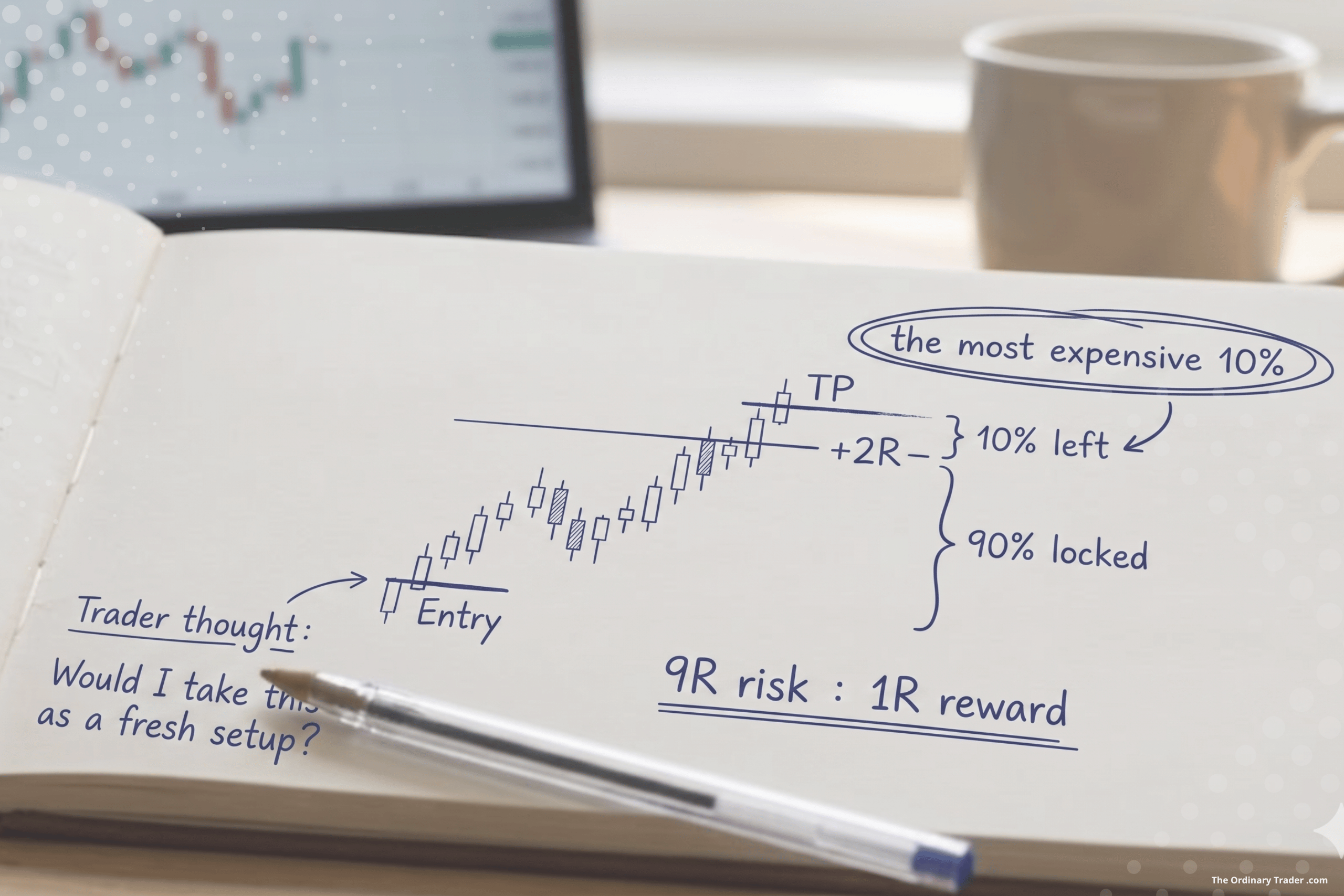
You’re in. Stop placed, target set, risk defined. The trade moves. Then it really moves. Suddenly you’re +2R. The candles are doing what you said they would do. You’re 90% of the way to TP and the only thing left is the final push over the line.

You wait for it.

And then, without warning, the market swings violently back the other way. Not all the way to your stop. Just enough to give back most of what was on the table. By the time you’ve registered what happened, you’re closer to break even than to your target.

Now you’ve got nothing to do but sit there and ask yourself the question you should have asked five candles ago.

When you’re 90% of the way to your TP, the last 10% is the most expensive bit of the trade.

We treat the target as a finish line

This is the trap. The plan said TP at this level. So anything short of it feels like quitting early. Like cheating ourselves. Like the version of us that took +1R last week and then watched the trade run for another 3R is going to show up and tut.

But the target was never a finish line. It was a hypothesis. A best guess at where price might go if the structure played out the way we read it. The market hasn’t read the plan. It doesn’t owe us the last 10%.

We know this. We say it back to ourselves all the time. Then we hold anyway.

The most expensive 10% in trading

Here’s the maths that always feels uncomfortable.

When you’re 90% of the way to your TP, the last 10% is the most expensive bit of the trade. You’re risking 90% of locked profit to capture another 10% of move. The reward-to-risk inside that final stretch is upside down. You wouldn’t take that as a fresh setup. You’d never enter a trade with 9R of risk for 1R of upside.

But because you’re already in, and because the profit feels like it isn’t yours yet, you accept the trade-off without noticing you’ve taken it.

That’s the part we miss. We tell ourselves we’re being patient. We’re actually taking a brand new, badly priced trade on top of the one we already won.

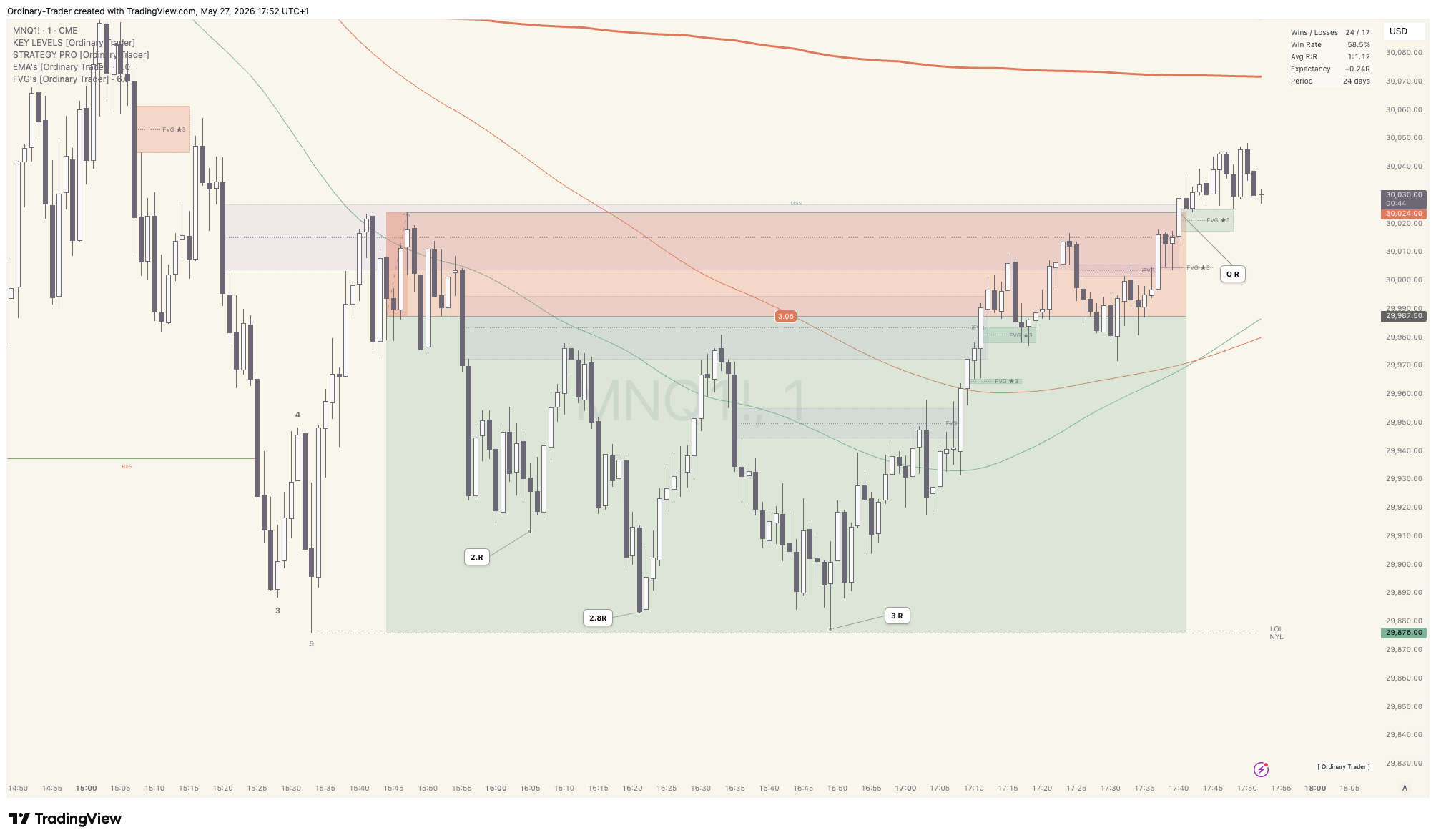
3 Opportunities to take profit before getting stopped out.

Base hits add up

There’s an idea trading culture borrows from elsewhere. That every entry has to be the big one. The full extension. The screenshot trade. The home run that makes the week.

It doesn’t.

A run of clean base hits at +1R, +1.2R, +0.8R is a perfectly good week. It’s a great year. Most of the equity curves I respect were built on base hits, not on the chase for the occasional 5R that gets posted.

Taking the partial isn’t selling yourself short. It’s collecting on the work the trade has already done. The next one is allowed to be ordinary too.

Some exits are mapped before the trade starts

A lot of this work happens before the trade is even live.

If you’ve done the Path to Profit work, you already know what sits between your entry and your target. The FVGs that might cause a stall. The opposing liquidity sitting just before TP. The big opposing candles where prior intent is still visible.

Those aren’t just risks. They’re also the most honest places to take something off. A partial at the FVG. A move to break even before the opposing liquidity. A full exit when the path beyond looks crowded.

The decision is always calmer when the chart is.

Trailing helps, when it can

The honest answer is that trailing the stop is what we should be doing. Locking in some of the move as structure gives us room to. Moving to break even when the trade clears the first leg. Tucking the stop behind a new swing low when one forms.

This works. Some of the time.

The rest of the time, structure doesn’t give us anything to trail to. The leg is too clean, the move is too vertical, the next swing point is further behind than we’d ever want our stop. Trailing in that situation either gives back all the profit or sits in a place that does nothing useful.

In those trades, the trail isn’t an answer. It’s just a comfort blanket that hasn’t been put to work yet.

The question we’re actually avoiding

What we don’t ask ourselves, in that moment when we’re +2R and the candle is looking heavy, is the only question that matters.

What does this trade still owe me?

Not what’s on the chart. Not what the plan said. Not what the screenshot of the winning version would look like if it played out perfectly.

What does it still owe me, from here, with the information I now have?

Sometimes the answer is real. Structure is building, momentum hasn’t broken, the next level is right there. Hold.

Other times the answer is uncomfortable. The move has already happened. The candles are smaller and rounder. There’s no obvious reason for the next leg. Price has done what we asked of it, and we are now just hoping.

The trade doesn’t owe us anything else. We are the ones still asking.


Sitting with it

I don’t have a clean rule for this. I’m not sure a clean rule exists.

Some days I take the partial too early and watch the trade run without me. Some days I hold past the point of reason and give it all back. Both feel bad. Neither feels like progress on the day it happens.

What I’m trying to do, slowly, is just notice the moment. The one where I stop watching the trade and start willing it forward. That moment is the answer to the question, even if I don’t always act on it.

Enough profit is enough when the trade has done what I asked it to do, and I’m now asking for more than the chart is willing to give.

I don’t always get that right. I’d rather get it wrong honestly than dress it up as a system.

Should You Take 1R or Let It Run?

Most new traders focus almost entirely on entries. They refine confirmations, tweak structure rules, and optimise timing. But very quickly you realise something more important. Your exit strategy determines your expectancy.

Let’s walk through a clean example using simple numbers. No complicated formulas. Just clear logic.

We will assume the same core distribution throughout so every strategy is compared fairly.

The Starting Distribution

Across a large sample of trades:

  • 40% lose and hit full stop at -1R
  • 30% reach 1R but fail to extend further
  • 30% extend beyond 1R and can reach 1.5R

This is the raw behaviour of your system before deciding how to exit.

Now let’s compare four exit strategies using this same base data.

Strategy 1: Fixed 1R Take Profit

In this model you close the entire position at 1R. No partials. No trailing. No runners.

Using the base distribution:

  • 60% of trades reach at least 1R
  • 40% lose -1R

So expectancy is:

  • 60% × +1R = +0.60R
  • 40% × -1R = -0.40R

Total = +0.20R per trade

This is clean and efficient. Your edge here is accuracy. You monetise the fact that most trades reach 1R.

Strategy 2: 50% Partial at 1R, Runner to 1.5R

This is the classic hybrid approach.

When price hits 1R:

  • Close 50% for +0.5R
  • Move stop to break even

If the trade extends to 1.5R:

  • Remaining half earns +0.75R
  • Total win = +1.25R

If price reverses after 1R:

  • Remaining half stops at break even
  • Total win = +0.5R

Using our distribution:

  • 30% hit 1.5R → +1.25R
  • 30% stall after 1R → +0.5R
  • 40% lose → -1R

Now calculate:

  • 30% × 1.25R = +0.375R
  • 30% × 0.5R = +0.15R
  • 40% × -1R = -0.40R

Total = +0.125R per trade

Still profitable. But lower than the simple 1R model.

Why? Because only 30% of trades meaningfully extend. The runner frequency is not high enough to compensate for halving position size.

Strategy 3: Full Position Runner to 1.5R

Now we remove partials. The entire position aims for 1.5R.

If price reaches 1R but fails to continue, you move stop to break even and make nothing.

Distribution becomes:

  • 30% hit 1.5R → +1.5R
  • 30% reach 1R but reverse → 0R
  • 40% lose → -1R

Expectancy:

  • 30% × 1.5R = +0.45R
  • 30% × 0R = 0
  • 40% × -1R = -0.40R

Total = +0.05R per trade

You increased reward size but reduced realised wins. That trade off reduced expectancy.

Strategy 4: Structure Based Trailing

Now we remove the artificial 1.5R cap. Instead of targeting a fixed multiple, you trail behind structure and allow the market to decide.

To keep assumptions realistic, let’s use this distribution:

  • 40% lose → -1R
  • 30% reach 1R and then stop at break even → 0R
  • 20% trend moderately → +1.5R
  • 10% become strong runners → +2.5R

Now calculate:

  • 20% × 1.5R = +0.30R
  • 10% × 2.5R = +0.25R
  • 30% × 0R = 0
  • 40% × -1R = -0.40R

Total = +0.15R per trade

This improves on partials and fixed 1.5R runners, but still does not beat the simple 1R model under these conditions.

Comparing All Four

Using consistent assumptions:

  • Fixed 1R → +0.20R
  • Partials + 1.5R cap → +0.125R
  • Full 1.5R runner → +0.05R
  • Structure trailing → +0.15R

Under this distribution, the simplest strategy wins.

What This Teaches a New Trader

Risk reward ratio alone means nothing. A 1:1.5 target is not automatically superior to 1:1. What matters is how often price actually extends.

Your optimal exit depends on the behaviour of your market.

In rotational conditions:

  • Moves stall quickly
  • Pullbacks are deep
  • Extensions are limited

That profile favours harvesting 1R consistently.

In strong trending conditions:

  • Pullbacks are shallow
  • Structure stair steps cleanly
  • Large extensions are common

That profile favours structure based trailing and uncapped runners.

The mistake is using the same exit logic in both environments.

How to Decide With Data

Track one simple metric over your next 50 trades:

Maximum favourable excursion measured in R.

If most trades rarely exceed 1.5R before reversing, fixed 1R exits are likely optimal.

If a meaningful percentage regularly reach 2R or more, you may be capping your distribution too early.

The goal is not to maximise reward on a single trade. The goal is to optimise your overall distribution.

Sometimes the ordinary 1R is the most efficient solution.

Sometimes the market is offering a trend and you need to step aside and let it pay you.

The numbers will tell you which environment you are in.

How was your week?

Mine finished green. But it did not start that way.

Week 6 closed at +1.27R (+$2.49K). A positive week on paper. But the journey there was far from smooth.

After finishing the previous week on a red Friday, the weakness carried straight into this one. Monday was modestly green at +0.38R, but Tuesday and Wednesday did real damage. By the end of Wednesday I was sitting at -6.65R for the week.

Too many basic mistakes.

There were trades that offered profit. I had opportunities to pay myself. Instead, I held for extended targets that were not aligned with structure. Winners came back. Stops were hit. Frustration crept in.

It was time to pause and reset.

From Thursday onward the shift was obvious.

Structure was simplified.
Zones were tighter.
EMA alignment came back into the decision process.
Profit expectations became practical again.

No hero trades. No forcing it.

Thursday printed +2.09R.
Friday followed with +5.82R.

Two strong, controlled days turned a deep hole into a positive week. Not through aggression. Not through revenge trading. Through discipline.

Nothing new was added. I simply returned to the framework that already works.

There is also an important context point. I had surgery on Monday and traded the early part of the week while still under medication. Unsurprisingly, decision quality was not sharp. Consider that lesson learned. If I am not physically or mentally 100%, I do not trade. Simple.

Action Items Going Forward

  • Pay myself sooner. Take sensible partials when offered.

  • Keep zones tight. Mark entries on M1, validate structure on M15.

  • Require clear EMA alignment across timeframes.

  • Slow down. If journaling slips, I am trading too much.

  • No trading unless physically and mentally sharp.

Boring fixes.

Immediate improvement.

Exactly how it should be.