Why your decision-making gets worse as the trading day goes on
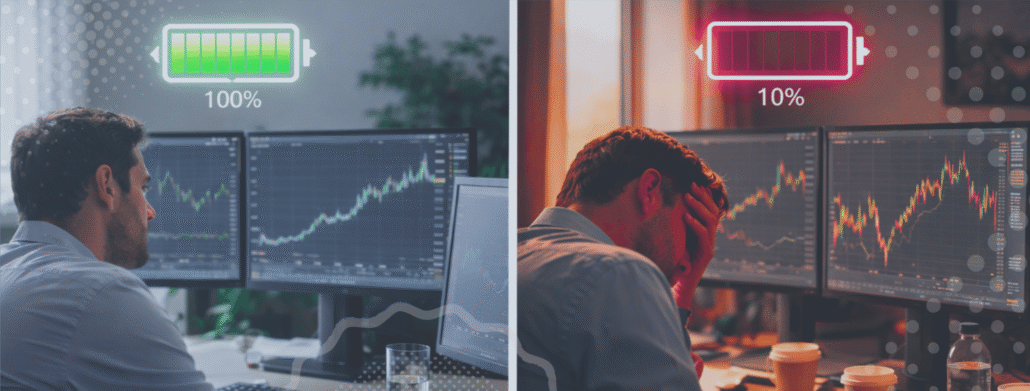
There is solid science behind the idea that your ability to make good decisions changes across the day. It is one of the most studied topics in psychology, behavioural economics, and neuroscience.
Put simply:
- The brain has limited self-regulation resources
- Using them repeatedly makes them temporarily weaker
- Fatigue changes risk perception and impulse control
For traders, that is not abstract theory. That is revenge trading. That is FOMO. That is dropping your entry standard from A+ to “this will do.”
Let’s unpack it.
Ego Depletion and Decision Fatigue
Researchers like Roy Baumeister proposed that willpower and disciplined thinking draw from a finite mental resource.
Every act of:
- Resisting impulse
- Analysing uncertainty
- Managing emotion
- Waiting for confirmation
- Passing on a mediocre setup
…uses some of that fuel.
As the day progresses, the tank runs lower. When depleted, people tend to:
- Choose easier options
- Avoid complex thinking
- Act more emotionally
- Seek immediate reward
- Abandon previously agreed rules
Not because they want to. Because the brain is tired. In trading terms, that shift is subtle but dangerous.
An A+ setup becomes an A.
An A becomes a B+.
A B+ becomes “close enough.”
And “close enough” is where consistency dies.
System 1 vs System 2
In Thinking, Fast and Slow, psychologist Daniel Kahneman describes two modes of thinking:
System 1 → fast, automatic, emotional
System 2 → slow, effortful, logical
Trading well requires System 2.
Waiting. Calculating. Filtering. Ignoring noise.
But as mental energy drops, the brain defaults to System 1.
Which means later in the session you are more likely to:
- Revenge trade after a loss
- Close winners early out of fear
- Oversize to “make it back”
- Ignore missing confirmation
- Rationalise weak entries
It feels justified in the moment.
It rarely is.
The Judge Study
One of the most famous demonstrations of decision fatigue looked at Israeli judges.
Researchers found:
- Early in the day → more thoughtful, favourable rulings
- Right before breaks → harsher, default decisions
- After food and rest → decision quality improved again
Judgement changed based on mental fatigue.
Not morality. Not intelligence. Not experience.
Energy.
Now apply that to a trader four hours into screen time, three trades in, slightly red, watching price move without them.
The conditions are perfect for a poor decision.
What Happens Biologically?
As cognitive load builds:
- Attention declines
- Emotional regulation weakens
- The prefrontal cortex (responsible for discipline and planning) becomes less effective
- Impulse systems become louder
So discipline literally becomes harder.
You do not suddenly become reckless.
You become slightly less precise.
And in trading, slight erosion compounds.
How This Shows Up On Your Chart
This is what mental fatigue looks like in practice:
- Patience drops
- Rule adherence softens
- Risk taking increases
- Urgency appears where none exists
- Entry standards slip
You do not say, “I am fatigued.”
You say:
“Maybe this one is ok.”
That sentence has probably cost more traders money than any indicator ever has.
The Uncomfortable Truth
By the time most traders take their worst trade…
They are already mentally depleted.
It is rarely the first trade of the day.
It is often the third.
Or the one taken after trying to claw back -2R.
Not a strategy problem.
An energy problem.
How Professionals Protect Themselves
Professionals do not rely on motivation.
They design around biology.
They:
- Limit decisions per day
- Use a daily trading planner.
- Pre-plan actions before the session
- Use checklists
- Automate exits where possible
- Stop at fixed loss limits
- Trade fewer, higher quality opportunities
They reduce how often System 2 has to fire.
They preserve decision energy for when it matters most.
Why This Matters If You’re Building Consistency
If you are building a structured, rules-based approach to trading, this is gold.
Performance deterioration is often biological, not intellectual.
You do not need more knowledge.
You need fewer decisions.
Fewer trades.
Higher standards.
Defined stop times.
Hard daily limits.
Because consistency is not just about strategy.
It is about protecting your brain from itself.
Trade well. Stay ordinary.