Month 1 Recap : What Real Progress Actually Looks Like

This is the first post in a new monthly series where I share my real trading results.
Not highlights. Not best days only. Not a sales pitch.
Just the numbers, the behaviour behind them, and what I am learning as I go.
The aim is simple. To track progress over time, stay accountable to my own rules, and hopefully provide something more realistic than the polished versions of trading that usually get shared.
This is Month 1.
How to Read the Images
Before getting into the results, a quick note on how to interpret the screenshots.
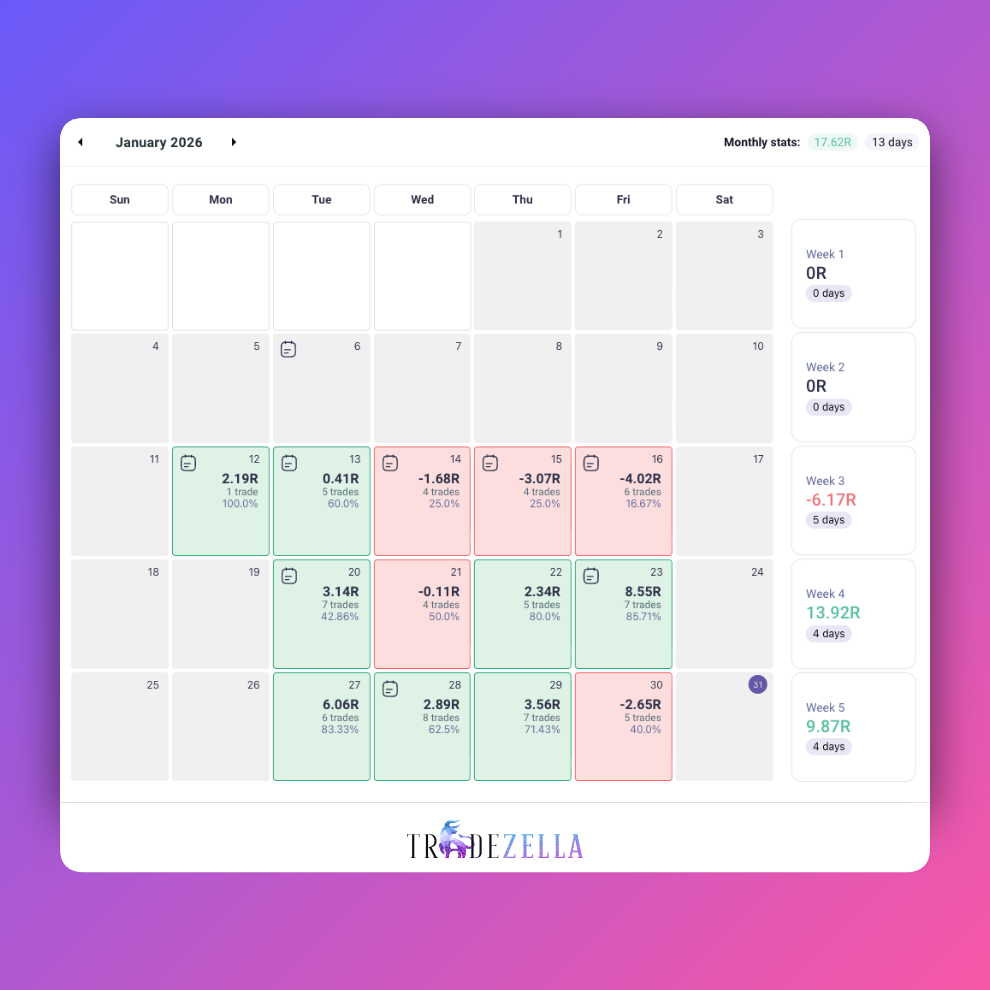
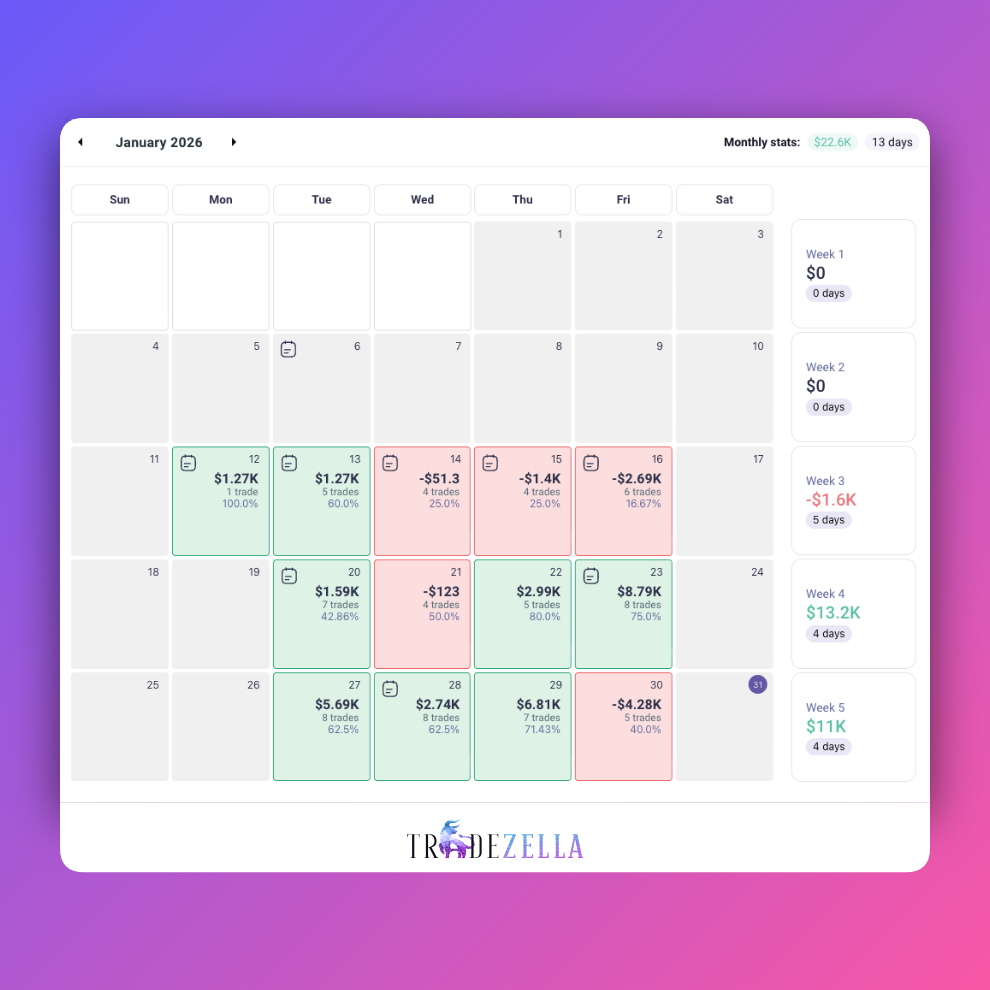
Each day shows both R and dollar PnL.
R measures performance relative to risk. Dollars show the real-world impact of those decisions.
Green and red days are not the story on their own. What matters more is trade count, win rate, and how losses behave when things are not going well.
If you are new to this, think of R as the decision-making lens, and dollars as the consequence.
Both matter, but they play different roles.
Why I Still Think in R First
R remains my primary metric because it keeps the focus on process rather than outcome.
It standardises risk, removes position size bias, and makes performance comparable across days, weeks, and months. A +3R day achieved cleanly is far more useful information than a random dollar figure taken out of context.
The dollar view exists to keep things honest. It reminds me that risk is real and that behaviour has consequences. But it is not what drives decisions in the moment.
R governs the process. Dollars reflect the result.
The worst red days tend to follow periods of over-engagement, often driven by trying to make something back within the same session.
The Big Picture
This month was uneven, but instructive.
Firstly, I only started journalling from Monday the 12th. The 19th was a stock market holiday, and I took the 26th off to attend a person training course. So this was not a full, uninterrupted trading month.
Even so, clear patterns emerged.
There was one difficult drawdown week early on, followed by two strong weeks where execution, discipline, and consistency improved noticeably. The contrast between those periods is the most important takeaway from this review.
The Difficult Start
Week 3 finished down -6.17R, or roughly -$1.6K.
More important than the number is how it happened.
This was before I was properly journalling, and it shows. Win rates were low, trade counts were high, and patience was thin. Losses clustered, not because the strategy stopped working, but because behaviour slipped.
There was some overtrading, some forcing, and a tendency to try to recover losses within the same session. In hindsight, the red days were not surprising.
At the time it felt frustrating. In review, it feels useful.
What Changed
From the 12th onwards, things began to stabilise.
Not perfectly, and not immediately, but enough to notice. Journalling introduced friction. It forced me to slow down, articulate reasons for entries, and reflect on exits rather than rushing to the next setup.
Even later red days still finished negative, but the damage was contained. Losses did not spiral, and trade behaviour stayed more deliberate.
That shift alone feels like progress.
The Stronger Weeks
Weeks 4 and 5 were the most encouraging.
Together they produced +23.79R, or just over $24K, with win rates regularly in the 60 to 80 percent range. These were not single outsized trades or lucky spikes. They came from multiple trades executed reasonably well, without stretching size or forcing targets.
What stood out most was not the PnL, but how repeatable those sessions felt. The process was clearer, entries were more selective, and exits were more disciplined.
When I slow down, the edge shows up.
A Few Honest Observations
One ongoing issue is trade volume.
On several green days I exceeded my own five trades per day rule. It worked out this time, but that does not make it good behaviour. The data suggests my best days tend to come from fewer, higher-quality trades rather than maximum participation.
Another clear pattern is how losses cluster. The worst red days tend to follow periods of over-engagement, often driven by trying to make something back within the same session.
Again, this is behavioural, not technical.
Common Misreads of the Dollar View
A few things are worth addressing directly.
This was not a straight line up.
The dollar results reflect both good weeks and difficult ones.
The strong days did not come from oversized risk.
Position sizing stayed consistent. The gains came from execution, not leverage.
The red weeks were not failures.
They were part of the learning curve, and they exposed issues that are now being addressed.
If anything, the dollar view reinforces why discipline matters. Behaviour shows up very quickly when the numbers are real.
What This Month Reinforced
This first month made a few things very clear.
- Journalling improves execution.
- Slowing down improves win rate.
- Drawdowns are usually behavioural.
- Consistency comes from repetition, not intensity.
None of that is exciting. All of it matters.
Why I’m Sharing This
I’m sharing these posts partly for accountability, but also because trading often lacks transparency.
Most people only ever see the best days or the biggest months. Real progress looks different. It includes red weeks, missed sessions, rule breaks, and gradual improvement rather than sudden breakthroughs.
If this series shows anything over time, I hope it is that progress is possible without hype, without shortcuts, and without pretending the hard parts do not exist.
This was Month 1.
On to the next, with fewer trades, better notes, and more patience.
Trade well. Stay ordinary.