Tag Archive for: Journaling

February wasn’t a headline month.
It was a character month.

On paper, the summary looks simple:

  • Monthly P&L: -$6.45K
  • Monthly R: +0.95R
  • Trading days: 20
  • Green weeks: 3 out of 4
  • Red weeks: 1 significant (Week 2)

Depending on the lens you use, this month tells two different stories.

In dollars, it’s red.
In R, it’s slightly green.

That disconnect matters more than it first appears.

As I’ve written before, this project isn’t about performance theatre. It’s about documenting ordinary work done consistently over time . February fits that philosophy perfectly.

The Bigger Picture: When One Week Tries to Define the Month

Here’s the R breakdown:

  • Week 1: +1.27R
  • Week 2: -8.10R
  • Week 3: +8.49R
  • Week 4: -0.71R

Week 2 did the damage. A concentrated drawdown. No drama, but real impact.

Week 3, though, showed what happens when structure, patience, and selectivity align. +8.49R across five days isn’t noise. That’s execution.

Week 4? A “good loss.” -0.71R. Contained. Controlled. Boring, almost.

And boring is often good.

If you’ve followed the previous updates, you’ll recognise the theme. This wasn’t about chasing big weeks. It was about containment. When risk stayed defined, the account stabilised. When discipline slipped, losses clustered.

That’s not a revelation. It’s just reinforcement.

What Went Well (And Why It Matters)

1. Risk Containment Improved

There were red days. Several.

But very few spirals.

The guardrails held up better than earlier months:

  • Max 5 trades per day
  • Max 2R daily loss

February could have turned messy. It didn’t.

The -8R week stayed in its lane. It didn’t bleed into Weeks 3 and 4. That separation is growth. Not flashy growth. Structural growth.

And in trading, structural growth compounds faster than excitement ever will.

2. Recovery Without Revenge

Week 3 delivered +8.49R. That wasn’t emotional trading. It wasn’t trying to “get back” at the market.

It was alignment.

When conditions suited the strategy, execution was clean:

  • Higher-timeframe bias was clear
  • Lower-timeframe entries were defined
  • Liquidity sweeps made sense
  • Trade frequency dropped

The recovery wasn’t dramatic. It was mechanical. Follow the plan. Let it work.

This is something I’ve talked about before — the idea that most mistakes don’t come from bad analysis, but from trying to improve a trade that’s already working . The same applies at the weekly level. Over-managing a drawdown often causes more damage than the drawdown itself.

3. Selective Days Were the Strongest Days

Some of the best sessions in February were single-trade days.

  • One trade. 100% win rate.
  • $4.31K on one position.
  • 0.99R, clean and simple.

That’s not volume. That’s precision.

There’s a quiet lesson here: more trades rarely equal more profit. In fact, the opposite is often true. The higher trade-count days were statistically weaker — lower win rates, more mid-range losses, less clarity.

Fewer trades. Better structure.

It keeps repeating for a reason.

What Needs Tightening Up

February wasn’t a setback. But it wasn’t flawless either.

1. Drawdown Clustering

Week 2 came in at -8.10R. Not catastrophic. But concentrated.

Looking at those losing days, the pattern is clear:

  • Mid-range losses between -1R and -4R
  • Win rates around 20–40%
  • Higher trade counts

Translation? Forcing flow in less optimal conditions.

It’s likely discretion crept in — over-trusting continuation without enough higher-timeframe confirmation. The setups weren’t terrible. They just weren’t strong enough to justify the frequency.

The solution isn’t complexity. It’s patience.

2. Dollar Volatility vs R Consistency

Here’s the uncomfortable part.

The month finished slightly positive in R but negative in dollars.

That suggests uneven sizing. Possibly scaling inconsistently on higher-conviction days. Or exposure spread across multiple accounts in a way that diluted R-to-dollar alignment.

For Project 1 Million, R is the anchor. R defines expectancy. Dollars follow.

But the gap is a reminder: structure first. Size second.

Scaling should reflect edge strength, not confidence level.

3. Neutral Days That Could Have Been Zero

There were a handful of small bleed days:

  • -0.59R
  • -0.06R
  • -1.17R
  • -1.65R

Individually small. Collectively meaningful.

The question is simple: did those sessions require participation?

Not every day needs action. Some days are better observed than traded. The discipline to sit out is often harder than the discipline to cut a loss.

And yet, it may be the more important skill.

Statistical Observations: What the Data Actually Says

Looking across the calendar, a few patterns stand out:

  • High win-rate days were often green — but not always large.
  • Some strong green days had moderate win rates, supported by solid R:R.
  • The worst days combined higher trade counts and lower win rates.
  • One strong week can offset a poor week — if risk stays stable.

Win rate alone is irrelevant.

Structure and R:R define survival.

That’s not new information. But it’s easy to forget when a week goes red.

The Honest Summary

February did not materially move Project 1 Million forward.

But it didn’t erode the structure either.

The account absorbed:

  • An -8R week
  • Multiple red days
  • Uneven market conditions

And still finished roughly flat in R.

That matters.

This is the middle phase. No hero months. No implosions. Just process under pressure.

And if the philosophy is to treat trading as ordinary work — done consistently, without hype or drama — then February fits.

No celebration. No panic. Just review.

Focus for March: Quiet Adjustments

March doesn’t require reinvention. It requires refinement.

The priorities are clear:

  • Protect against clustered drawdowns
  • Be willing not to trade
  • Scale only with clean higher-timeframe alignment
  • Continue prioritising structure over frequency

The goal isn’t explosive growth.

It’s asymmetry:

  • Small red
  • Contained flat
  • Occasional strong green

That’s how compounding works. Not through heroics. Through containment.

February was not impressive.

But it was controlled.

And sometimes, control is the most underrated edge in trading.
23rd – 27th February

Week 9 was a quieter week. Not dramatic. Not explosive. Just controlled.

Coming into it, the focus was very specific. I wanted to double down on discipline. That meant sticking to my trading planner rules without exception:

  • Maximum 5 trades per day
  • Maximum loss of 2R
  • Profit target of 2R
  • No deviation from 1 percent risk

In terms of execution, this was genuinely an A+ week. I followed the rules. I did not oversize. I did not chase. I did not break daily limits out of frustration or excitement. That might sound basic, but consistency in rule adherence is still the foundation of everything.

Now for the honest part.

The week closed slightly red at -0.71R.

There is no dressing that up. It was a losing week. But context matters. The loss was small. It was contained. It stayed well within predefined limits. That is what risk management is supposed to do.

If the model is working correctly, losing weeks will happen. The key is ensuring they are controlled, while winning weeks are allowed to expand.

If the model is working correctly, losing weeks will happen. The key is ensuring they are controlled, while winning weeks are allowed to expand. By that definition, this was what I would call a good loss.

What makes it more interesting is that I actually had more wins than losses. Six wins. Five losses. A 54.55 percent win rate.

Accuracy was not the issue.

The issue was upside. Many of the winning trades were under 1R. There were fewer runners. Without extended moves, the expectancy tightens quickly. When you cap downside effectively but fail to capture larger upside, the edge compresses.

That leads directly into the work I am doing behind the scenes.

Exit strategy testing continues. I am comparing different models, including fixed targets, partials, extended targets, and trailing approaches. Some early patterns are already emerging, but it is still too soon to draw firm conclusions.

Right now the objective is simple:

  • Log every trade consistently
  • Apply the same rules each session
  • Remove discretion from exits where possible
  • Build a meaningful sample size

Once I have tracked around 50-100 trades under consistent conditions, the data will start to speak clearly and I’m looking forward to sharing.

Week 9 was not about big numbers. It was about professional behaviour. The PnL was slightly red. The execution was green.

Over time, that combination is what compounds.

15th – 21st February

Week 8 felt different.

Not explosive.
Not dramatic.
Just steady.

After the turbulence of previous weeks, the focus coming into this one was simple: tighten execution, reduce noise, and behave like a professional.

The Plan

Going into the week, I set five clear rules:

  • Maximum 5 trades per day. Use the trade planner properly.

  • Only take true A+ zones.

  • Keep risk fixed at 1 percent. No oversizing. If resizing, it must be down, never up.

  • Validate structure on at least one timeframe higher before committing.

  • Reassess trailing stop placement relative to the timeframe of entry.

Nothing new. Nothing revolutionary.
Just better discipline.

The Reality

For the first time in a while, I felt genuine alignment between higher timeframe and lower timeframe structure.

Instead of marking up charts mechanically, I began to see how they overlapped.

A protected low on the higher timeframe could also serve as a shared protected low inside a lower timeframe zone. When those two lined up, the setup carried more weight. More confluence. More confidence.

That shift alone changed the quality of trades I was willing to take.

Fewer Trades, Better Decisions

I did not oversize once this week.

That matters more than it sounds.

Keeping risk fixed at 1 percent created emotional stability. There was no internal pressure to “make it back faster.” No temptation to lean heavier on volatile instruments.

Trade frequency also improved. I passed on many setups that I would have taken a few weeks ago. Patience is starting to feel less like restraint and more like strategy.

Ironically, I also identified multiple setups that went on to be great winners without me.

That is an important lesson.

There is a difference between patience and being too demanding on the pullback. If price does not retrace perfectly into your preferred level, sometimes the market simply moves without you. That is an area to refine moving forward. Not by lowering standards, but by avoiding greed in the entry refinement.

Performance Overview

In R terms, Week 8 closed +8.22R across 5 trading days.

In dollar terms, that translated to approximately +$5.18K.

After a difficult Week 7, that kind of rebound feels significant. Not because of the number itself, but because of how it was achieved.

  • No oversized positions

  • Reduced trade count

  • Better structural alignment

  • Cleaner execution

The process improved first. The results followed.

That is the order it should always be in.

Exit Strategy Experiments

One of the most valuable developments this week has been the start of structured exit testing.

I’ve begun comparing:

  • Fixed 1R

  • Partials

  • 1.5R targets

  • Full runners

  • Trailing scenarios

Instead of guessing, I’m running the data.

The goal is not to find the most exciting outcome.
It is to find the most consistent, repeatable one.

Over time, this testing should remove another layer of emotional decision making. Exits should be predefined, not improvised.

Bonus: A Milestone

Quietly, and slightly unbelievably, I passed three prop firm challenges this week.

Not one.
Not two.
Three.

Current funded capital now sits at $250K.

That is real progress.

It is easy to get distracted by daily PnL swings, but zooming out shows something else entirely. Structure is improving. Risk management is tightening. Emotional reactions are decreasing.

Funding is increasing.

The Bigger Picture

Week 8 was not about chasing big numbers.

It was about:

  • Respecting higher timeframe structure

  • Trusting confluence

  • Keeping risk consistent

  • Letting the edge play out

Ordinary discipline produced extraordinary stability.

And that is the direction this project needs to continue.

Trade well. Stay ordinary.

This is the first post in a new monthly series where I share my real trading results.

Not highlights. Not best days only. Not a sales pitch.

Just the numbers, the behaviour behind them, and what I am learning as I go.

The aim is simple. To track progress over time, stay accountable to my own rules, and hopefully provide something more realistic than the polished versions of trading that usually get shared.

This is Month 1.

How to Read the Images

Before getting into the results, a quick note on how to interpret the screenshots.

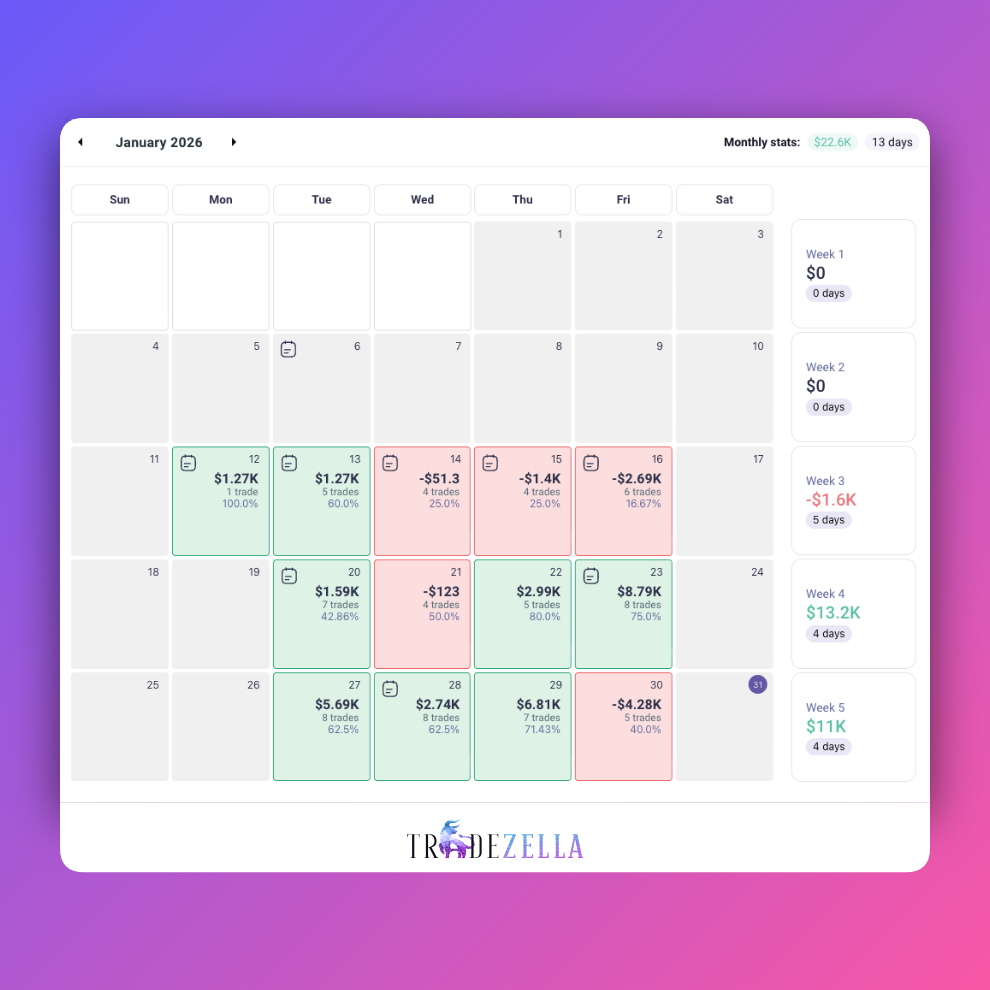
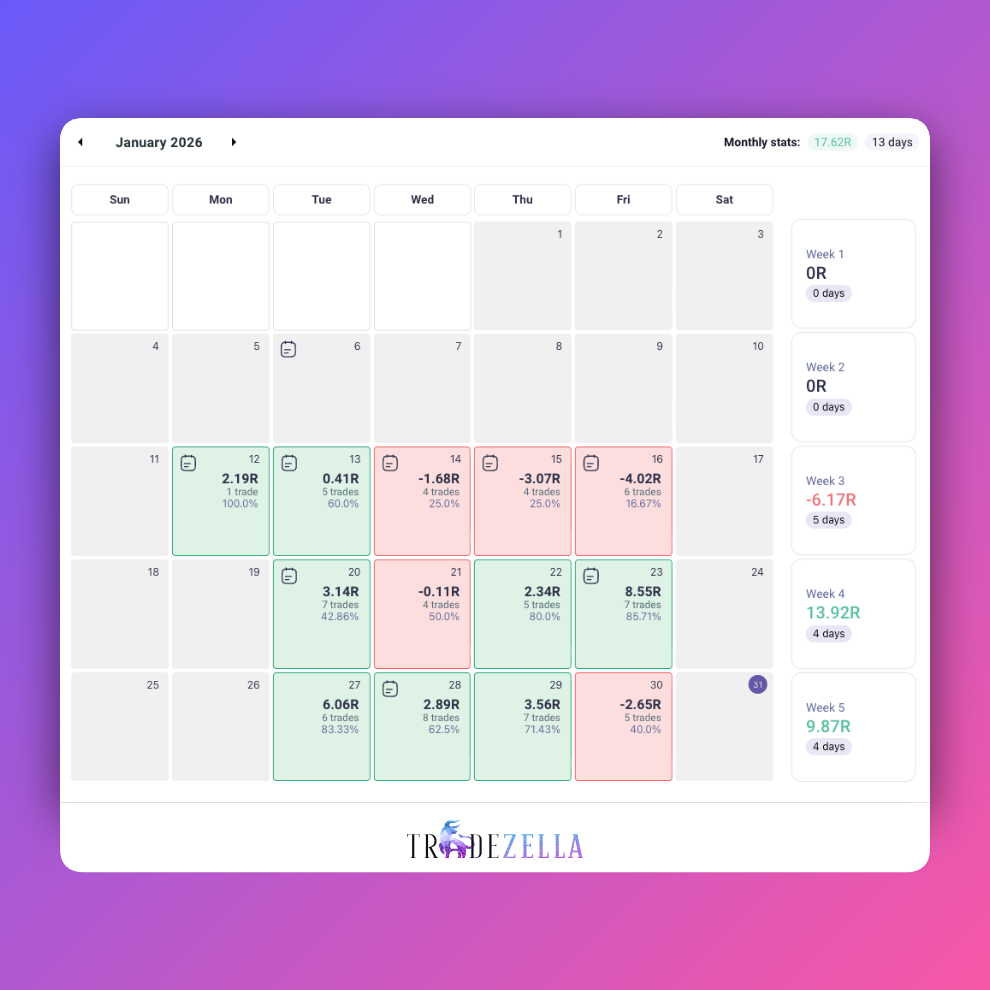
Each day shows both R and dollar PnL.
R measures performance relative to risk. Dollars show the real-world impact of those decisions.

Green and red days are not the story on their own. What matters more is trade count, win rate, and how losses behave when things are not going well.

If you are new to this, think of R as the decision-making lens, and dollars as the consequence.

Both matter, but they play different roles.

Why I Still Think in R First

R remains my primary metric because it keeps the focus on process rather than outcome.

It standardises risk, removes position size bias, and makes performance comparable across days, weeks, and months. A +3R day achieved cleanly is far more useful information than a random dollar figure taken out of context.

The dollar view exists to keep things honest. It reminds me that risk is real and that behaviour has consequences. But it is not what drives decisions in the moment.

R governs the process. Dollars reflect the result.

The worst red days tend to follow periods of over-engagement, often driven by trying to make something back within the same session.

The Big Picture

This month was uneven, but instructive.

Firstly, I only started journalling from Monday the 12th. The 19th was a stock market holiday, and I took the 26th off to attend a person training course. So this was not a full, uninterrupted trading month.

Even so, clear patterns emerged.

There was one difficult drawdown week early on, followed by two strong weeks where execution, discipline, and consistency improved noticeably. The contrast between those periods is the most important takeaway from this review.

The Difficult Start

Week 3 finished down -6.17R, or roughly -$1.6K.

More important than the number is how it happened.

This was before I was properly journalling, and it shows. Win rates were low, trade counts were high, and patience was thin. Losses clustered, not because the strategy stopped working, but because behaviour slipped.

There was some overtrading, some forcing, and a tendency to try to recover losses within the same session. In hindsight, the red days were not surprising.

At the time it felt frustrating. In review, it feels useful.

What Changed

From the 12th onwards, things began to stabilise.

Not perfectly, and not immediately, but enough to notice. Journalling introduced friction. It forced me to slow down, articulate reasons for entries, and reflect on exits rather than rushing to the next setup.

Even later red days still finished negative, but the damage was contained. Losses did not spiral, and trade behaviour stayed more deliberate.

That shift alone feels like progress.

The Stronger Weeks

Weeks 4 and 5 were the most encouraging.

Together they produced +23.79R, or just over $24K, with win rates regularly in the 60 to 80 percent range. These were not single outsized trades or lucky spikes. They came from multiple trades executed reasonably well, without stretching size or forcing targets.

What stood out most was not the PnL, but how repeatable those sessions felt. The process was clearer, entries were more selective, and exits were more disciplined.

When I slow down, the edge shows up.

A Few Honest Observations

One ongoing issue is trade volume.

On several green days I exceeded my own five trades per day rule. It worked out this time, but that does not make it good behaviour. The data suggests my best days tend to come from fewer, higher-quality trades rather than maximum participation.

Another clear pattern is how losses cluster. The worst red days tend to follow periods of over-engagement, often driven by trying to make something back within the same session.

Again, this is behavioural, not technical.

Common Misreads of the Dollar View

A few things are worth addressing directly.

This was not a straight line up.
The dollar results reflect both good weeks and difficult ones.

The strong days did not come from oversized risk.
Position sizing stayed consistent. The gains came from execution, not leverage.

The red weeks were not failures.
They were part of the learning curve, and they exposed issues that are now being addressed.

If anything, the dollar view reinforces why discipline matters. Behaviour shows up very quickly when the numbers are real.

What This Month Reinforced

This first month made a few things very clear.

  • Journalling improves execution.
  • Slowing down improves win rate.
  • Drawdowns are usually behavioural.
  • Consistency comes from repetition, not intensity.

None of that is exciting. All of it matters.

Why I’m Sharing This

I’m sharing these posts partly for accountability, but also because trading often lacks transparency.

Most people only ever see the best days or the biggest months. Real progress looks different. It includes red weeks, missed sessions, rule breaks, and gradual improvement rather than sudden breakthroughs.

If this series shows anything over time, I hope it is that progress is possible without hype, without shortcuts, and without pretending the hard parts do not exist.

This was Month 1.

On to the next, with fewer trades, better notes, and more patience.

For a long time, I believed my edge would come from better charts. Cleaner levels. Tighter entries. More confluence. If I refined the technicals enough, consistency would follow.

What actually changed my trading wasn’t on the chart at all.

I started journaling properly when I realised I was making the same mistakes across different markets. Different instruments. Different days. The outcomes kept repeating.

The chart had changed but my behaviour hadn’t.

The chart had changed but my behaviour hadn’t.

At first, my journal was basic. Entry. Stop. Target. Result. It was useful, but shallow. It told me what happened, not why it happened.

The real shift came when I started writing how the trade felt.

Not emotions in a dramatic sense. Just simple observations. Rushed. Hesitant. Confident but distracted. Forcing it. Nothing profound on its own, but over time, patterns emerged.

I noticed something uncomfortable. Many of my worst trades looked fine technically. Structure was there. Levels made sense. On paper, they were valid.

My state wasn’t.

I was taking trades when I was bored. Or slightly annoyed. Or trying to make the session feel productive. None of that shows up on a chart.

The journal also revealed something unexpected. My best trades were quiet. No adrenaline. No urgency. Just execution. When a trade felt exciting, it was often because I was bending something without admitting it.

Over time, the journal became a mirror. Not of the market, but of me. It showed when I ignored my rules. When I sized up. When I traded after I should have stopped.

The chart never told me that story.

My best trades were quiet. No adrenaline. No urgency. Just execution.

One of the clearest lessons was this: most mistakes happen before the entry. In the mindset. In the intention. By the time I click buy or sell, the damage is often already done.

Now, some of my most important journal entries don’t include screenshots at all. They include sentences like trading to prove something, didn’t like the loss before this, should have stopped after the first win.

The journal taught me what no indicator ever could. That consistency isn’t about being right more often. It’s about recognising yourself in real time.

Charts are objective. They don’t lie. But they’re also incomplete.

The journal fills in the missing half. The human half.

If I could only keep one tool as a trader, it wouldn’t be a strategy or an indicator. It would be the journal.

The market keeps changing. My patterns repeat.

Friday evening, platinum, around 7–8pm UK time.

It was the second time price had traded back into the same zone. I almost ignored it out of habit. I rarely take a second trade from the same level.

But this one looked different.

Price pushed back down into the zone with intent, swept liquidity deeper than before, then failed to make a new low. On the lower timeframes, bullish fair value gaps began to form. The reaction was clean. Controlled. It didn’t feel random.

So I took it.

Because it was a second opportunity from the same zone, I sized the expectations differently. I didn’t think it would have the same energy as the first move. Less gas. Less conviction. That assumption shaped everything that followed.

I managed the trade with a tight trailing stop almost immediately.

Part of that came from context. It was late on a Friday. Markets were approaching the close. Time left in the trade mattered. I didn’t want to give much back, especially if liquidity thinned and price turned erratic.

But part of it was something else.

After entry, I noticed the bearish candles were larger and more impulsive than the bullish ones. When price pushed against my position, it did so with more force than when it moved in my favour. That imbalance stuck in my head. It felt like pressure. Like a warning.

So I kept tightening the stop.

The trade worked. It was a winner.

It just didn’t do what it was capable of doing.

Price continued higher after I was taken out, moving cleanly through areas I’d originally mapped. Nothing invalidated the idea. Nothing structurally changed. I was right on direction and location.

I just didn’t stay in the trade long enough to let it express itself.

The lesson isn’t about trailing stops being bad. It’s about when they’re appropriate and why they’re being used.

On lower timeframes, structure often invites tighter management. It makes sense intellectually. You see micro higher lows, small pullbacks, clean continuation. It feels disciplined to lock things down quickly.

But discipline isn’t the same as fear dressed up as precision.

I was managing risk based on assumptions I hadn’t fully tested.

In this case, I was managing risk based on assumptions I hadn’t fully tested. That a second trade from the same zone should underperform. That late Friday trades need to be protected aggressively. That stronger bearish candles automatically reduce the validity of a long.

None of those are rules in my plan. They’re interpretations layered on top of it, in real time, under subtle pressure.

The irony is that the strategy worked exactly as designed. The location held. The sweep mattered. The failure to make a new low mattered. The bullish fair value gaps mattered.

What didn’t work was my willingness to accept a normal pullback in exchange for the full move.

Trailing stops are powerful when they’re used deliberately. They’re dangerous when they’re used reactively.

Especially late in the week, when time becomes part of the decision-making, it’s easy to start optimising for comfort instead of expectancy. You tell yourself you’re being prudent, when really you’re trying to avoid the feeling of watching unrealised profit retrace.

That’s not a moral failing. It’s just something to be aware of.

The real adjustment here isn’t mechanical. It’s situational.

Second trades from the same zone don’t automatically deserve tighter managemen

Second trades from the same zone don’t automatically deserve tighter management. Late Friday trades don’t automatically require fear-based exits. And lower timeframe structure doesn’t override higher timeframe intent.

If the plan calls for allowing a pullback, then the pullback has to be allowed. Otherwise the trade is never really being tested.

The simple takeaway I’m carrying forward is this:

If I’ve trusted the location and taken the trade, I need to be just as intentional about how I manage it as I was about why I entered. Tight stops should be a decision, not a reflex.

Sometimes the hardest part of trading isn’t getting in.

It’s staying in long enough to let being right actually matter.