
You take a trade. It works. The screen shows +$600 gross. You close, feel good about it, log it in the journal, and move on.
Except you didn’t make $600.
You made closer to $525. The other $75 went to commissions, exchange fees, and clearing costs. Not in some hidden, suspicious way. They were always going to be there. But if you’ve never sat down and worked out what you actually pay per trade, that gap can be a quiet drag on expectancy that doesn’t show up until months later, when you wonder why the numbers don’t quite match what the chart said they should be.
The example below is specific to TradeStation US and MES (the Micro E-mini S&P 500), but the principle applies to any retail broker and any micro futures contract.
What the costs actually are
Three things come out of every futures trade, per contract, per side:
- Broker commission. TradeStation’s standard published rate is $1.50 per contract, per side. Entering 20 MES costs $30 in commission. Exiting costs another $30. That’s $60 round trip for commission alone.
- Exchange and clearing fees. The CME charges roughly $0.30 to $0.37 per micro contract, per side. On 20 contracts, that’s about another $7 each way.
- NFA regulatory fee. Two cents per contract, per side. Small on its own. Adds up at size.
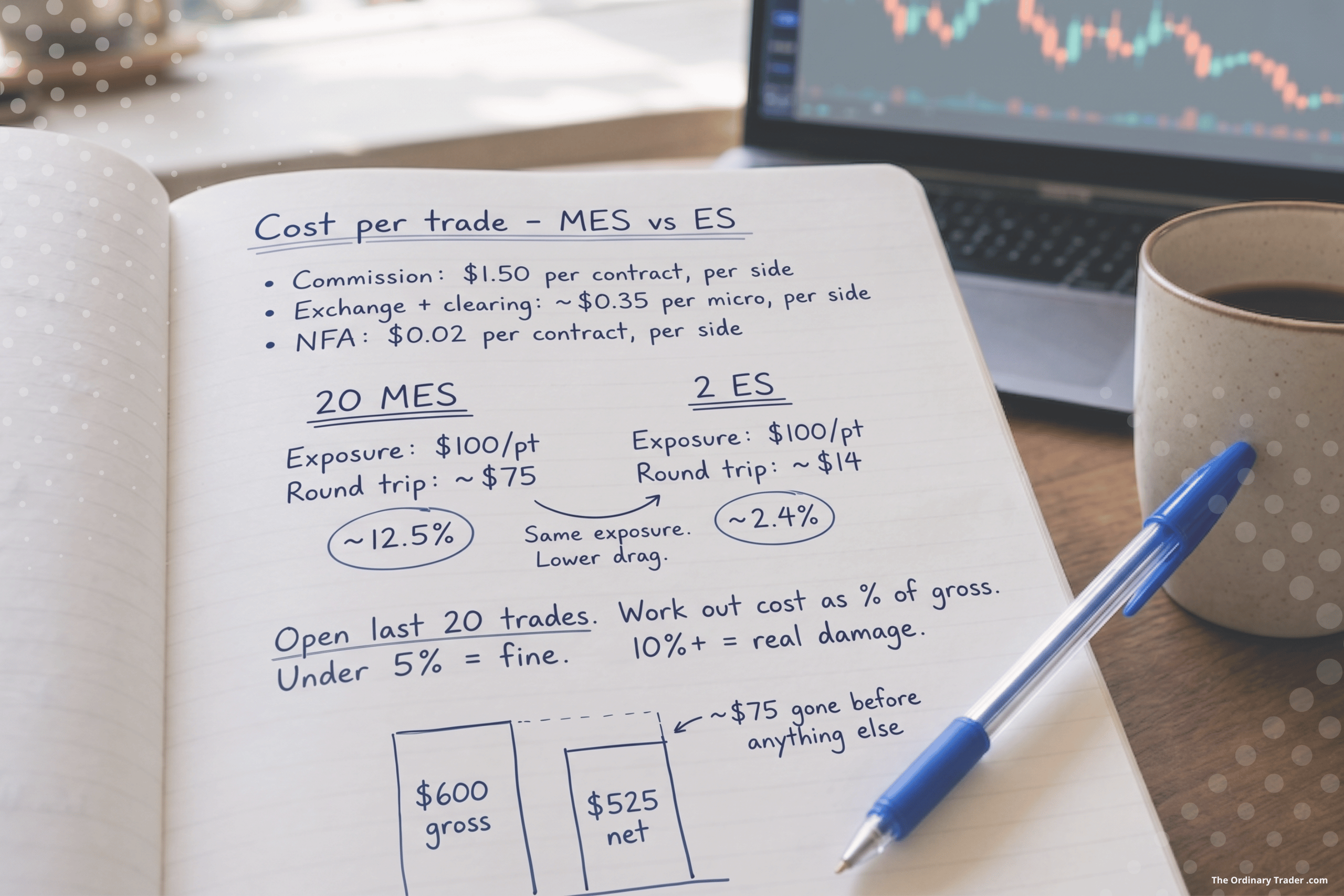
Put it all together and a round trip on 20 MES costs around $75. On a $600 winner, that’s about 12.5% of your gross gone before you’ve done anything else.
The fixed cost trap
Here’s where micros get interesting. The per-contract cost is low, which is why they look cheap. But the cost scales with the number of contracts, not with the size of the move.
A 6-point winner on 20 MES is $600 gross, about $525 net.
A 2-point winner on 20 MES is $200 gross, about $125 net.
Same costs, different percentages. The smaller the win, the more it stings. And the costs don’t care whether you win or lose. A $600 loser is really a $675 loser once you factor in the round trip.
20 micros versus 2 minis
The standard E-mini (ES) is ten times the size of the MES. So 10 MES equals 1 ES in terms of exposure. 20 MES gives you exactly the same exposure as 2 ES: $100 per point on the S&P 500.
Same exposure. Same risk. Very different cost structure.
| 20 MES | 2 ES | |
|---|---|---|
| Point value | $100 per point | $100 per point |
| Commission (round trip) | $60.00 | $6.00 |
| Exchange + clearing + NFA (round trip) | ~$15.00 | ~$8.20 |
| Total round-trip cost | ~$75.00 | ~$14.20 |
| Net on $600 gross winner | ~$525.00 | ~$585.80 |
| Cost as % of gross | ~12.5% | ~2.4% |
The exchange fees on ES are higher per contract (around $2 per side versus $0.35 for MES). But because you’re using far fewer contracts to get the same exposure, the total cost drops sharply.
That’s a $60 difference on a single trade. Run that over 100 trades a year and it’s $6,000 sitting in someone else’s account that could have been in yours.
When micros still earn their place
This isn’t an argument against micros. They serve a real purpose.
Micros are the right tool when:
- You’re new and learning, and the risk per point on ES is too large for your account
- You want finer position sizing, scaling in or out in small increments
- You’re trading a strategy where the maths only works at sub-mini size
- Your account is small enough that one mini is too much risk per trade
Where micros stop making sense is when your typical position size creeps past 6 to 8 contracts and stays there. At that point, you’re paying a real premium for granularity you may not need. The cost of being able to trade 7 contracts instead of 0 or 10 starts to outweigh the benefit.
micros stop making sense is when your typical position size creeps past 6 to 8 contracts and stays there
Run the numbers on your own trades
The point is not to switch to minis tomorrow. The point is to actually know what your costs are.
A simple exercise. Open your last twenty trades. For each one, work out:
- Your gross profit or loss
- Your total round-trip cost (commission, exchange, NFA)
- The percentage of gross your costs represent
If the average is under 5%, you’re probably fine. If it’s pushing 10% or more, the cost structure is doing real damage to your expectancy. Worth a conversation with your broker about volume tiers, or a serious think about whether you’ve outgrown your current contract.
Most brokers, TradeStation included, will negotiate rates for active accounts. The rates aren’t fixed. They’re rarely advertised, and you have to ask.
The boring lesson
There’s no trick here. No secret cost the broker is hiding from you. Just the discipline of sitting down once, working out what each trade actually costs, then making sure that number stays small relative to your average R.
A 12% drag on every win and a 12% surcharge on every loss is the kind of thing that doesn’t feel like much in the moment but quietly compounds against you over a year. The maths is on the screen if you bother to do it.


