Two traders take the same course. Same rules, same instrument, same hours at the screen. Six months later one is flat and the other is down 30%.
The easy conclusion is that the strategy failed for one of them. It didn’t. They were never running the same strategy. They were running the same document.
A written strategy is a set of instructions. An executed strategy is what actually happened at the desk. Nearly all of the difference lives in the gap between them, and most traders never look, because they only ever examine the document.
Here is what really differs, in rough order of damage.
Two traders splitting their trading hours differently but using the same strategy are testing different things, then comparing results as if they were one.
The signals you skip are a strategy decision
Any strategy worth following produces more valid signals than one person will take. You are asleep, at work, or unconvinced. So you filter. Everybody filters.
The question is what your filter selects for.
One trader takes the clean setups and passes on the marginal ones. The level is obvious, the entry sits where the plan says it should. Dull. Dull is the point.
The other passes on the clean ones because they look slow, and takes the marginal ones because something is happening. Faster candles. A level that nearly holds. A move already underway.
Neither has broken a rule. Both would say they follow the strategy. But hand their filled orders to a stranger and they would be read as two different methods. One is taking a subset with better than average characteristics. The other is taking a subset selected for excitement.
Selection is the largest single variable, and it is invisible, because nobody logs the trades they didn’t take.
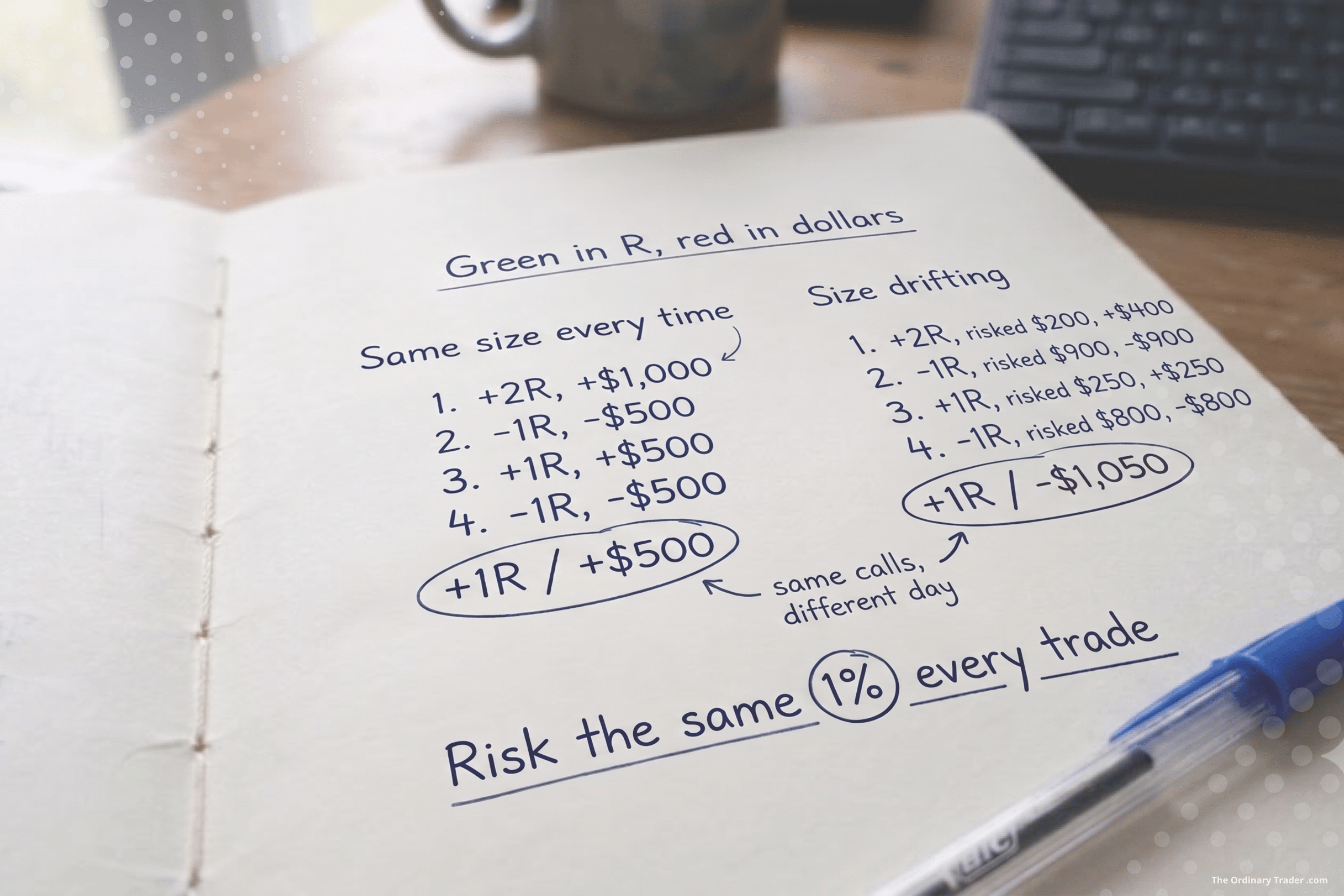
Size changes who you are by week three
Same rules, different risk per trade. Two $50,000 accounts. One trader risks 1%, or $500. The other risks 3%, or $1,500.
Now run six losses in a row, which any honest strategy hands you eventually. The first trader is down about 5.9%. Uncomfortable. The second is down about 16.7%. That isn’t uncomfortable, that is a different emotional state.
And it feeds back. The trader down 16.7% hesitates on the next valid signal, or sizes up to make it back. By week three they are not the trader who wrote the rules. Their sizing has quietly rewritten their selection and their exits.
Risk per trade gets discussed as an arithmetic question. It is a psychology question wearing an arithmetic costume.
The same setup at a different hour is a different setup
Volatility, volume and who is in the market change through the day. A setup taken in the first thirty minutes of the US session and the same setup taken in a quiet midday drift share a shape and little else.
Two traders splitting their trading hours differently but using the same strategy are testing different things, then comparing results as if they were one.
Taking +1R when the plan says +3R
Say the strategy wins 40% of the time and targets +3R. Over a hundred trades: 40 wins at 3R, 60 losses at 1R. That is 120R less 60R: +60R, or +0.6R per trade.
Now exit early. You take +1R when the trade stalls and the screen gets uncomfortable. Your win rate rises, because more trades reach +1R than reach +3R. Say it rises to 55%. That is 55 wins at 1R against 45 losses at 1R: +10R over a hundred trades, or +0.10R each.
Same entries. Same losses. A sixth of the return.
To get back to +0.6R while exiting at +1R, that trader would need to win 80% of the time, and nothing about their entry produces 80%. They have moved themselves to a point on the win rate and risk-reward curve their method cannot support, one sensible-feeling decision at a time.
A strategy followed 80% of the time is a different strategy
Fifty trades is a sequence, not just a sample
Two people run the same positive expectancy strategy for fifty trades. Same edge. Different order.
At a 40% win rate, six losses in a row has a probability of about 4.7% from any given starting point, so across fifty trades you should expect one. Whether it lands at trades 1 to 6 or trades 31 to 36 is luck.
The one who meets it first rarely reaches trade fifty. They adjust something at trade nine, and again at trade seventeen. By trade fifty they have run four strategies for twelve trades each and learnt nothing dependable about any of them.
A strategy followed 80% of the time is a different strategy
The 20% you deviate on is not a rounding error. It is a second, unnamed strategy with unknown properties, and its trades sit in the same account, so your results describe a blend you have never written down and cannot test.
None of this is a story about discipline as a personality trait. Some people are steadier than others, but that is not the useful part. The gap between the written strategy and the executed one can be measured, and measuring it doesn’t need a change of character. It needs a record.
What to log for the next two weeks
Every valid signal the strategy produced. Not just the ones you took.
Four fields for each:
- Taken or skipped
- If skipped, the reason, written at the time
- Session and time of day
- Risk taken, and where you exited versus the plan
By the end you will have two strategies on paper: the one in your Playbook, and the one you ran. Read the skip reasons together and the filter you didn’t know you had becomes obvious. Read the exits together and you will see your real risk-reward.
That log is the difference between the two traders, written down.
Most study time goes on the smaller half of the problem. Another confirmation tool, a tighter entry, a different instrument. The executed version, the one with the skipped signals and the early exits, is the version you are being paid or charged for.
Write both down. Then you can compare them.