Your nerves are a position size indicator

If you feel nervous before you click the button, your position is too big.
That’s not a mindset issue. It’s not something to breathe through or journal away. It’s information. The knot in your stomach is your own risk management telling you that you’ve put more on the line than you can calmly afford to lose. Listen to it.
If you couldn’t accept losing it beforehand, you were never sizing for the trade in front of you. You were sizing for the win you were hoping for.
Most new traders get this backwards. They think the goal is to feel nothing, so they try to suppress the nerves and take the trade anyway. Then they move their stop, or bail at the first wobble, or double down to get even. All of it traced back to one root cause: the size was wrong before the trade ever started.
Position sizing is the quietest topic in trading and the one that decides whether you’re still here in a year. So let’s actually talk about how to get it right.
Accept the loss before you enter
Here’s the test I run before any trade. Can I accept that this money is already gone?
Not “will this trade work.” That’s not up to me. What’s up to me is whether I’ve risked an amount I can lose without it changing anything. If the answer is no – if losing it would sting, or change how I feel about the day, or make me want it back – the position is too large. Full stop.
You have to make peace with the loss before you enter, not after. Once the trade is live, the money is at risk and the outcome is out of your hands. If you couldn’t accept losing it beforehand, you were never sizing for the trade in front of you. You were sizing for the win you were hoping for.
…make peace with the loss before you enter, not after.
Could this trade blow your account?
If a single trade can do real damage to your account, you’re too big.
The whole game is built on the fact that you will lose, often, and in clusters. A good strategy might win 50% of the time, which means strings of losers are not a bug, they’re a given. Four, five, six in a row will happen. If your size can’t absorb that, the strategy never gets the chance to work, because you’re out before the maths turns in your favour.
So the real question isn’t “what if this loses.” It’s “can I lose this eight times in a row and still be fine?” If sizing so that a normal losing streak is survivable feels too small, that feeling is the problem, not the size.
Flex the contracts, fix the dollar risk
This is the piece that ties it all together, and it’s where most people have it inverted. They keep the number of contracts the same and let their risk float around. It should be the other way round.
The dollar amount you risk stays consistent. The number of contracts flexes to keep it there.
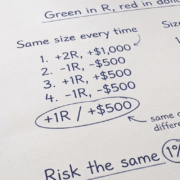
Say I risk $500 a trade. On one setup my stop is 20 points away on MNQ, so I take a smaller number of contracts. On the next, my stop is only 12 points away, so I can take more and still risk the same $500. Same risk, different size. What changed is the stop distance, and the contracts moved to absorb it.
The formula is worth committing to memory:
Contracts = dollar risk ÷ (stop distance in ticks × tick value)
Work out where your stop belongs first, based on the chart and not on the size you want. Then let the formula tell you how many contracts that allows. The stop defines the trade. The contracts are just the dial you turn to keep your risk flat. Never widen a stop to justify a size, and never size up because a setup “feels” good.
Risk a percentage, not a fixed number
A fixed dollar figure is a fine place to start. A percentage is where it should end up.
Risking a consistent slice of your account – usually 1% to 2% per trade – does something a fixed number can’t. It scales down automatically when you’re losing and up as you grow. Lose a few and your 1% is now a smaller dollar figure, so you’re naturally risking less while you’re cold. It’s a built-in brake, and it means a bad run bends your equity curve instead of breaking it.
Watch out for hidden size
Two things quietly make you bigger than you think.
The first is correlation. A position in MNQ and a position in MES aren’t two small trades, they’re one large bet on the same market moving the same way. If both go against you at once, and they will, your real risk is the sum, not the pieces. Size them as the single position they actually are.
The second matters if you trade a prop account. Trailing drawdowns and daily loss limits mean it isn’t only your capital that ends the game, it’s someone else’s rule. When a fixed line can close your account, sizing so you never approach it stops being cautious and starts being the only way to keep the account at all.
The point of all this
Get sizing right and most of the “psychology” noise goes quiet on its own. You stop moving stops because there’s nothing to panic about. You stop revenge trading because no single loss was big enough to need revenge. You sit through the trade calmly, because you already accepted the worst case before you entered.
Get sizing right and most of the “psychology” noise goes quiet on its own.
Position size is the master lever. Not your entry, not your indicator, not your win rate. Size decides whether you survive long enough for the rest of it to matter.
Trade well. Stay ordinary.