Why your win rate matters less than you think
The number that feels like progress
You can win seven trades out of ten and still watch your account shrink.
It sounds wrong the first time you hear it. Win rate is the first number most new traders reach for, because it feels like a school grade. 70% sounds like a pass. 40% sounds like failure.
I spent my early months chasing that number. I wanted a strategy that was right more often than it was wrong, because being right felt like progress. The problem is that being right and making money are not the same thing. They are not even close.
Win rate is only half a sentence
A win rate on its own tells you how often you win. It says nothing about how much you win when you are right, or how much you lose when you are wrong. That second half is where your account is actually decided.
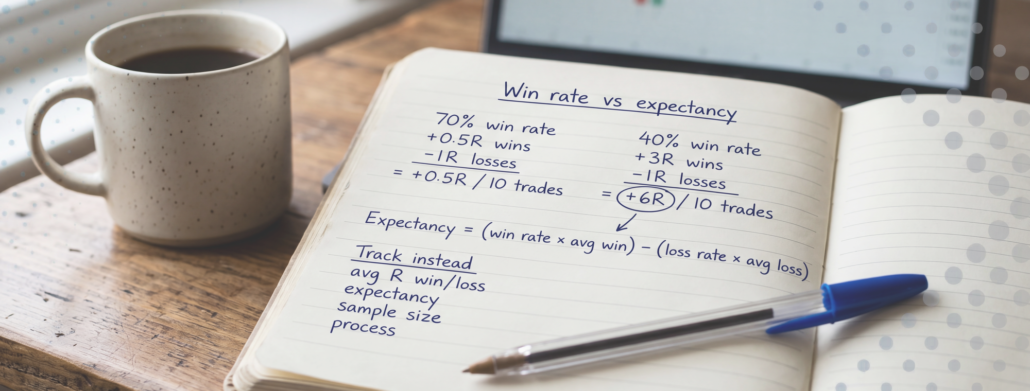
Here is the maths, kept simple. Say you win 70% of your trades, but your winners are small and your losers are large. You bank +0.5R on a win and give back -1R on a loss. Over ten trades, that is seven wins at +0.5R (+3.5R) and three losses at -1R (-3R). Net result: +0.5R across ten trades. A 70% win rate, and you have made almost nothing.
Now flip it. Say you win only 40% of your trades, but you let your winners run to +3R and cut your losers at -1R. Four wins at +3R (+12R) and six losses at -1R (-6R). Net result: +6R across ten trades, from a strategy that is wrong more often than it is right.
The trader who loses more often makes twelve times as much. Win rate did not tell you that. It could not.
The number that actually pays
The figure that matters is expectancy: what you can expect to make, on average, per trade. You work it out from both halves of the sentence.
Expectancy = (win rate x average win) – (loss rate x average loss)
Run the second example through it: (0.4 x 3) – (0.6 x 1) = 1.2 – 0.6 = +0.6R per trade. That is the number to know. It says that every time you place a trade to your plan, you can expect to make six tenths of your risk back, on average, over a large enough sample. Positive expectancy with enough repetitions is the whole game. Everything else is decoration.
This is why I stopped celebrating individual wins and stopped flinching at individual losses. A single trade tells me nothing. The average over a hundred trades tells me everything.
A single trade tells me nothing. The average over a hundred trades tells me everything.
What I track instead
Once you accept that expectancy is the destination, the day-to-day metrics change. These are the ones I keep in my journal now.
Average R per win and average R per loss, tracked separately. If my average loss is creeping above -1R, I am cutting too late, and no win rate will save me.
Expectancy per trade, in R, calculated across a rolling sample rather than a single day. One bad session does not move it much, which is the point.
Sample size. A positive expectancy over twelve trades is noise. Over a hundred and twenty, it is a signal. I do not trust any of my own numbers until the sample is big enough to mean something.
Process adherence, the one that is not about money. For every trade I log whether it was an A+ setup that met my filters, or whether I forced it. A profitable trade that broke my rules is still a bad trade. It just got lucky, and luck is not repeatable.
If you run the STRATEGY indicator, some of this is done for you. It has a stats panel that surfaces win rate, average RR and expectancy as you go, so you are not working the maths out by hand on a Sunday evening. The numbers matter more than where they come from, but having all three in front of you at once makes it harder to fixate on win rate and ignore the half of the sentence you would rather not look at.
Once you accept that expectancy is the destination, the day-to-day metrics change.
Why this is calmer, not just smarter
There is a quieter benefit to this. When your scorecard is win rate, every single loss feels like a mark against you, and you start trading to protect the number. You take profit early to lock in a win. You move your stop to avoid being wrong. Both habits shrink your average win and grow your average loss, which is exactly how a high win rate ends up with a flat account.
When your scorecard is expectancy and process, a loss inside your rules is not a failure. It is one of the six trades out of ten that you already knew would not work, paid for by the four that do. You stop needing to be right. You just need to be consistent.Once you accept that expectancy is the destination, the day-to-day metrics change.
Win rate is not useless. It is one input into expectancy, and a strategy with a dreadful win rate is hard to sit through even when the maths works. But on its own, as a measure of whether you are getting better, it is close to meaningless. Track the full sentence, not half of it.
Trade well. Stay ordinary.