Should you trade on the 4th of July?
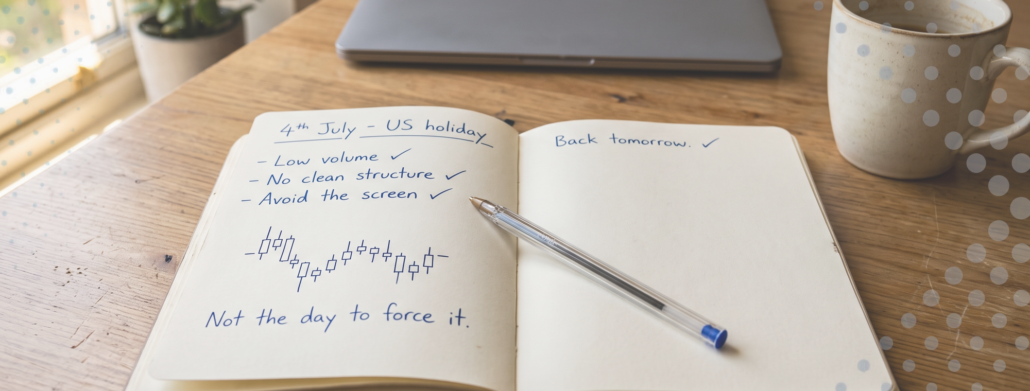
The markets are technically open. The chart is right there. You have time.
That combination is, for a lot of traders, enough to justify sitting down at the desk.
But just because you can trade does not mean you should.
What actually happens on a US holiday
The 4th of July is one of the biggest public holidays in the US calendar. And because the major US indices – the S&P 500, Nasdaq, and Dow – sit at the heart of global market activity, a US holiday ripples outward.
Volume drops. Significantly.
The institutional desks that usually provide the liquidity you rely on are quiet. The participants who create the structure you trade from are away. What’s left is a thinner, lower-participation version of the same market.
Low-volume markets behave differently. Structure that would normally hold becomes unreliable. Levels that usually act as magnets get ignored. Price drifts further than expected, pauses where it shouldn’t, and reverses sharply for no obvious reason.
The technical picture you’ve been watching all week may not apply today.
Structure that would normally hold becomes unreliable. Levels that usually act as magnets get ignored.
The spiral most traders don’t see coming
Here’s where it gets genuinely costly.
You sit down. The market opens quietly. Nothing much is happening. You wait. Still nothing. Then something starts to move – but it doesn’t quite fit your criteria. Not quite. You’ve been sitting there for an hour though, and you want a trade.
So you take it.
That one decision – entering a setup that didn’t fully qualify – is where the session starts to unravel.
The trade goes against you. In a low-volume environment you get a wider spread, a thinner book, and less predictable follow-through. The loss is bigger than it should be.
Now you’re frustrated. You’ve given up part of a holiday to lose money. The next trade feels like it needs to earn that back.
Revenge trading on a slow market day is one of the worst combinations in trading. The conditions are already working against you. Your emotional state is now working against you too. The account takes a hit that takes the rest of the week to recover from.
This is not hypothetical. Most traders have been here. The 4th of July has a habit of delivering exactly the right conditions for it.
Revenge trading on a slow market day is one of the worst combinations in trading.
The returns on sitting out
Taking the day off is not just about avoiding a bad session. It’s about what you get in return.
A mental reset. Trading requires sustained attention, pattern recognition under pressure, and emotional discipline. None of those are unlimited. A day away from the charts is not wasted time. It’s recovery time. The same way rest days are built into any serious training programme.
Time to reflect. A journal review. A re-read of your playbook. A quiet look at last week’s trades without the pressure of an open position. These are the things most traders mean to do but rarely make time for. A quiet holiday is exactly the right moment for them.
Perspective. When you’re watching a chart every single day, it’s easy to lose sight of the bigger picture. A day where you’re not in it – where you’re with family, doing something completely different, reminded that there’s a life outside the screen – recalibrates things. You come back sharper the next morning.
Time with people. This one is simple and worth saying plainly. Trading from home can be isolating. A public holiday is a legitimate reason to be somewhere else, present with someone else. Take it.
The market will be there on the 5th. The same structures, the same levels, the same setups – in a higher-volume, more predictable environment.
Mental capital is financial capital
There’s a version of the discipline narrative that says serious traders show up every day, no excuses, no days off.
I don’t believe that.
Protecting your mental state is as important as protecting your account. A trader who is burnt out, frustrated, or emotionally reactive will cost themselves far more over time than any single missed opportunity.
Sitting out the 4th of July is not a failure of commitment. It’s a deliberate decision to protect the conditions under which you actually trade well.
The market will be there on the 5th. The same structures, the same levels, the same setups – in a higher-volume, more predictable environment.
That is the trade worth waiting for.
Trade well. Stay ordinary.