The quiet damage of telling people you’re a trader before the results back it up
You told them you were a trader
It usually slips out somewhere ordinary. A dinner, a group chat, a catch-up with someone you have not seen in a while. They ask what you have been up to, and you say it: you have got into trading. Maybe you dress it up as a side thing, maybe you do not. Either way, it is out now.
And it felt good to say. It sounded like you were building something, taking control, doing the kind of thing most people only talk about. The problem is that the words went out long before the results did. You claimed the identity on credit.
From that moment, every trade has an audience. Not a real one, mostly. An imagined one, made of the people you told, sitting quietly in the back of your head, waiting to see whether the thing you announced actually works.
An audience raises the stakes on outcomes you were already struggling to hold loosely.
What the audience does to your decisions
An audience raises the stakes on outcomes you were already struggling to hold loosely.
A losing trade is just a losing trade until other people know you trade. Then it becomes a small piece of evidence that you might have been wrong about yourself, in front of everyone who heard you say it. That is a heavier thing to carry into the next click. You start needing trades to work, not just wanting them to, and needing a trade to work is one of the most reliable ways to trade badly.
It shows up as trades you take to have something to report. It shows up as a loss you will not close because closing it makes the story you told feel false. It shows up as the itch, after a family member half-jokingly asks how the trading is going, to go and prove them right with a session that gets the number back. None of that is coming from the chart. All of it is coming from the audience you invited in.
The account cannot tell the difference between a trade you took because it was there and a trade you took because you had told your brother-in-law you were a trader. But your equity curve feels the second kind eventually.
Trading in public before you are ready
There is a version of this that goes further. Posting the wins. Sharing the screenshots. Letting people watch.
It is tempting because it feels like accountability, and because attention is pleasant. But doing it before your process is solid does something specific and unhelpful: it ties your trading to how you look. Once an audience is watching in real time, the pull to keep up appearances competes directly with the pull to follow your plan. You take the trade that makes a good post instead of the trade that makes sense. You avoid logging the loss because the loss is now public. You are performing being a trader instead of learning to be one, and those two jobs pull in opposite directions.
The early phase of this is quiet, unglamorous, and full of mistakes you would rather nobody saw. That is exactly as it should be. Learning in the open is a fine thing once you have something honest to show. Doing it before then just adds a spotlight to the part of the journey that most needs privacy.
A losing trade is just a losing trade until other people know you trade.
Why silence protects the process
Keeping it to yourself is not about secrecy or shame. It is about protecting a fragile process from pressure it does not need yet.
When nobody knows, a loss is just information. You log it, you learn from it, you move on, and the only person who has to make peace with it is you. When nobody knows, you can change your approach, take a month off, size down to almost nothing while you rebuild, without explaining any of it to anyone. You keep the freedom to be a beginner, which is the freedom to get things wrong cheaply.
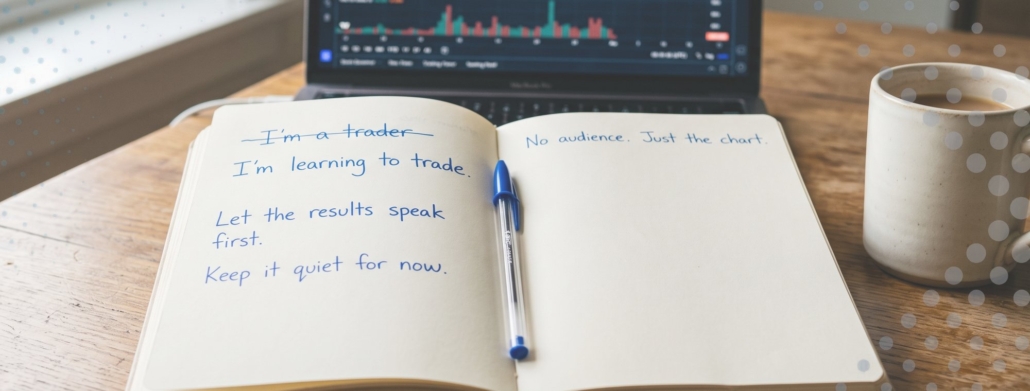
There is a difference between “I am a trader” and “I am learning to trade.” The first is a claim about results. The second is a description of the work. Early on, the second one is both more accurate and less costly to hold. It does not put anything on the line that a normal losing streak can threaten.
What to do with the urge to say it
The urge to tell people is really an urge to feel like the thing is real before it is. That is understandable, and it is worth resisting for a while longer than feels comfortable.
Let the results arrive first. Let there be a track record, a stretch of consistency, an actual body of work behind the word before you hand the word to anyone. When it is backed by something, saying it costs you nothing, because a bad week can no longer make you a liar.
Until then, the quiet is doing you a favour. It keeps the audience out of your decisions and leaves you alone with the chart, the plan, and the slow, unwitnessed work of getting good. That is the only place the results were ever going to come from anyway.
Trade well. Stay ordinary.