What it does to you when you tie your self-worth to a green day
The day was green, so you felt like a good person
You closed the platform up on the day and something in your chest loosened. You were kinder at dinner. You slept well. You felt, quietly, like you had earned your place.
Then a red day arrived, and the whole thing inverted. Short with your family. Replaying the trades in the shower. A low, familiar feeling that you are not cut out for this, that everyone else has figured out something you never will.
If that swing sounds familiar, the problem is not really your trading. It is that you have made the P&L a verdict on you as a person. A green day says you are competent, disciplined, worth something. A red day says the opposite. And once that link is in place, every session is quietly loaded with far more than money.
When your self-worth is riding on that daily number, you are pinning how you feel about yourself to something close to a coin flip.
What you have actually done
You have taken a number that is mostly outside your control on any given day and turned it into a scoreboard for your character.
This matters because trading outcomes are noisy. You can follow your plan perfectly and lose. You can break every rule you have and win. Over a large enough sample the process shows up in the results, but on any single day the connection between “did I trade well” and “did I make money” is loose at best. When your self-worth is riding on that daily number, you are pinning how you feel about yourself to something close to a coin flip.
So you end up feeling like a failure on days you traded well and lost, and feeling great on days you got lucky doing something stupid. Neither of those feelings is telling you the truth. Both of them are teaching you the wrong lesson.
How it leaks into the trading itself
Here is the part that actually damages the account.
When a green day means you are a good person, you start protecting the feeling instead of the process. You bank a winner far too early because you cannot bear to hand back the gain that is currently making you feel worthy. You refuse to take a valid loss because closing red feels like admitting something about yourself. You trade to defend an identity, not to follow a plan.
And after a red day, the need to fix the feeling takes over. You come back the next morning not to trade your setups but to get the number green again, because green is where you feel okay. That is where revenge trading is born. Not from greed, but from a person trying to feel like themselves again.
The moment your identity is on the line in every trade, you cannot make calm decisions. Nobody can. The stake is too high, and it is the wrong stake.
Separate the two things that got tangled
You are not your equity curve. The account measures the outcome of your decisions across changing conditions, luck included. It does not measure whether you are disciplined, intelligent, or worth respecting.
The thing worth being proud of is the process. Did you wait for your setup? Did you size it properly? Did you take the loss where you said you would? Did you leave when you had done enough? Those are the things you control, and those are the things that actually predict whether you make it. Judge yourself on those, and a losing day where you did everything right becomes what it actually is: a good day.
This is not a mindset trick to feel better about losses. It is a more accurate way of keeping score. A trader who follows the plan and loses has done their job. A trader who abandons the plan and wins has not. If your internal scoreboard cannot tell those two apart, it is measuring the wrong thing.
A trader who follows the plan and loses has done their job. A trader who abandons the plan and wins has not.
What this looks like in practice
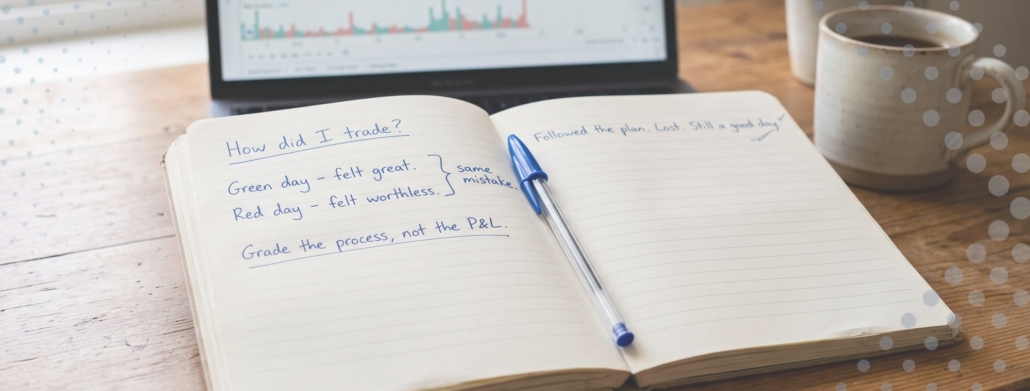
At the end of the session, ask a different question first. Not “how much did I make,” but “did I trade the way I said I would.” Grade the process before you look at the number. Some days those two answers will disagree, and learning to sit with that gap is most of the work.
Keep the numbers in the journal, where they belong, over a sample long enough to mean something. A single day tells you almost nothing about you. A month of process notes tells you plenty.
And notice the mood swing when it happens. The evening you feel quietly superior because the day was green is the same evening you are one bad session away from feeling worthless. Both of those are the same mistake wearing different clothes. The goal is not to feel great on green days. It is to feel roughly the same on both, because your worth was never the thing being traded.
At the end of the session, ask a different question first. Not “how much did I make,” but “did I trade the way I said I would.”
The account will do what it does. Some days green, some days red, hopefully drifting up over time. You get to be the same person through all of it. That steadiness is not a nice-to-have. It is the thing that lets you keep showing up long enough for the process to pay.
Trade well. Stay ordinary.