The loss that has nothing to do with the chart

The worst trades I have taken were not bad setups. They were good setups, taken on bad days. The signal was clean. The structure was there. The problem was the person reading it. Tired, flat, already three hours deep into a screen, looking for something to happen because sitting still felt like falling behind. That is not a trading mistake in the usual sense. It is a fatigue mistake wearing a trading costume.

For a long time I did not see it. A red day got filed under “the market was choppy” or “my entry was early.” Sometimes that was true. But often the real cause sat further upstream, in how I had slept, how long I had been staring, and whether I had any business being at the desk at all.

Real discipline includes the decision not to play.

Burnout does not arrive, it accumulates

Trading burnout is not a single dramatic moment. There is no alarm. It builds quietly, one slightly-too-long session at a time, until the screen stops being a tool and starts being a habit you cannot put down. The early signs are easy to talk yourself out of. You read the same candle five times and still could not say what it is telling you. You feel a small flare of irritation when price does not do what you wanted. You take a trade and feel relief rather than calm, because at least now something is happening. None of these are about the market. All of them are about you.

Screen fatigue compounds it. Hours of watching small movements narrows your view until the five-minute chart feels like the whole world. The longer you sit, the more reasonable a marginal setup starts to look, because your brain wants a reason to justify the time already spent. That is the trap. The cost of the seat makes you more likely to fill it badly.

The tells, named honestly

It helped me to write the signs down, plainly, so I could not pretend not to notice them. I am trading to feel productive rather than because the setup is there. I have moved my stop “just to give it room.” I am annoyed at the market, as if it owes me. I have stopped journaling because I do not want to see what is in there. I am refreshing the chart on my phone between other things. I cannot remember the last time I stepped away from the screen and felt fine about it.

Any one of these on its own is normal. Two or three stacked together is a signal, and it is a louder signal than most of the ones I draw on the chart. It says the edge today is not in the market. It is in not trading the market.

Stepping away is a skill, not a weakness

There is a quiet belief in trading culture that the serious people are the ones always at the desk. More screen time, more hours, more grinding. It sounds like discipline. Often it is the opposite. Real discipline includes the decision not to play. A professional in almost any precise craft knows that working tired produces worse work, and worse work in trading is not just unproductive, it is expensive. Stepping away on a bad day is not laziness or fear. It is risk management applied to the one variable nobody likes to admit is variable: yourself.

The hard part is that the decision has to be made before you sit down, not after the first loss. Once you are in the chair, fatigued and looking for action, you are the last person who should be deciding whether you are fit to trade.

So the question to ask before the session is not “what is the market doing.” It is “should I be here at all.”

Build the rule before you need it

This is where having something written down earns its place. I use the Daily Trading Planner to set the conditions of the day before the market gives me a reason to bend them. Risk limit, profit target, maximum number of trades, and the point at which I stop, full stop. Defined in the calm before, not the heat of during.

The planner is not really about the numbers. It is about removing the decision from the tired version of me. If the rule says two losses and I am done, then a third trade is not a judgement call I get to relitigate at the desk. It is already settled. The same goes for the days I should not start at all. A short pre-session check, an honest read of how I actually feel, and the permission, written in advance, to close the laptop and call it a flat day.

A flat day is not a wasted day. It is a protected account and a clearer head tomorrow. Over a year, the days I talked myself out of trading have saved me more than most of the days I traded well.

The quiet version of professional

None of this is dramatic. There is no breakthrough, no transformation. Just a slightly more honest relationship with my own state, and a rule that holds when I cannot. The market will be there tomorrow. It is open more hours than any person can sensibly trade, and it does not reward attendance. It rewards the trades you take well and punishes the ones you take tired. Knowing the difference, and being willing to act on it, is not a soft skill around the edges of trading. On a lot of days, it is the whole game.

So the question to ask before the session is not “what is the market doing.” It is “should I be here at all.” Some days the most disciplined thing on the screen is the decision to turn it off.
My partner can now tell when I’m about to lose an argument. Not because I raise my voice. Because I go quiet, stare at the middle distance, and clearly start “reading the situation and waiting for a better entry.”

This is what trading does to you. It leaks. You spend enough hours watching charts and managing risk, and the habits stop staying at the desk. They follow you to the dinner table, into the school run, into the small daily negotiations of living with other people. Mostly that is a good thing. Occasionally it is deeply annoying for everyone around you.

Let me poke fun at us for a second before I defend us.

Yes, we are a bit much

We talk in R-multiples. We describe a good day as “low and slow”, and how a trump tweet killed your setup.   We have opinions about candle colours. Some of us have built a command centre of six monitors to trade an instrument that requires roughly one decision a day. We say “it would be interesting to monitor that” about things that are not worth monitoring, like whether the bins go out on a Tuesday or a Wednesday.

The stereotype exists for a reason, and I am not above it. I have absolutely paused a family conversation to “just check one thing.” and then ending up watching candles print for the next hour. I have described my own toddler’s tantrum as “a liquidity grab.” Nobody asked me to. I did it anyway.

So no, I’m not here to tell you trading makes you a better person by default. It does not. But the actual skills, the unglamorous ones underneath the jargon, turn out to travel surprisingly well into family life. Far better than the jargon does.

The old me heard a complaint and fired back instantly, full port, no stop loss.

Patience stops being a trading word

The first thing trading teaches you, if you let it, is that doing nothing is a position.

You wait for the setup. You sit on your hands through twenty moves that look tempting and are not. You learn that the urge to act is not the same as a reason to act.

That single habit has done more for my relationship than any book on communication. The old me heard a complaint and fired back instantly, full port, no stop loss. The newer me has learned to wait for the actual point to form. Most arguments at home are like most setups on the chart. If you wait a beat, the thing you were about to react to turns out not to be the thing that matters.

Not passive. Not avoiding it. Just not entering on the first candle.

Risk management is really just not betting the house on the dishwasher

Here is the unsexy heart of trading: you decide, in advance, how much you are willing to lose on any one idea. Then you stick to it, even when you are convinced you are right.

You are always convinced you are right. That is the point. The rule exists precisely for the moments your conviction is loudest.

Drop that into family life and it changes everything. Is being correct about whose turn it was to load the dishwasher worth risking the whole evening? You can size that position. Small. Tiny, actually. Some disagreements are a 0.25% risk and you treat them that way. Others genuinely matter, and you commit properly. Knowing the difference, and deciding the size before you are emotional rather than during, is the whole game in both places.

The trader who blows the account is the one who turns every trade into the trade. The same person, at home, turns every disagreement into the disagreement. I have been that person. The account and the evening both recover faster when you don’t.

Cutting a loss instead of doubling down

Every trader knows the temptation to add to a losing position to “prove” it will come back. We have a name for the family version. It is called continuing to argue your point after everyone, including you, has quietly realised you are wrong.

Revenge trading and the angry follow-up text are the same instinct wearing different clothes. The discipline that stops me sending the second, worse message at 11pm is the exact discipline that stops me clicking buy again after a stopout. Accept the loss. Log it. Move on. Apologise if the loss was your fault, which, statistically, it often is.

Turns out the people I live with do not care about my win rate or the trump tweet that killed my setup.

The review matters more than the result

The habit I value most is the boring one. After a trading session I write down what happened and why, without flinching, win or lose.

I have started doing a quieter version of this after a rough day at home. Not ruminating too much. Just asking honestly: what was actually going on there, and what would I do differently. Process over outcome. You stop scoring conversations by who won and start scoring them by whether you showed up the way you wanted to.

Turns out the people I live with do not care about my win rate or the trump tweet that killed my setup. They care whether I’m present, steady, and not staring at a phone under the table. Funny how the brand line about ordinary process and real progress applies to a marriage roughly as well as it applies to a chart.

The honest bit

Trading will not fix your relationships. If anything, untreated, it gives you a new vocabulary to be annoying in. But the skills underneath it, patience, sizing your bets, cutting losses, reviewing honestly, are just life skills that happen to be taught very efficiently by a market that charges you money for getting them wrong.

The market made me calmer at home mostly by making me poorer every time I wasn’t. That is a harsh teacher, but an effective one.

Now if you’ll excuse me, I have a family conversation about no phones at the dinner table.

The story you tell yourself

You’ve just taken a loss. Clean setup, sensible risk, nothing reckless. But the market did what markets do, and you’re down.

You close the trade and scan the chart again. Another setup appears. Clear structure, a level that holds, everything pointing in the right direction. You size up slightly to recover ground. You enter.

That is the moment. Not obviously revenge trading. Not a red-mist doubling down. Just a trade. Justified. Logical. Backed by analysis.

Or was it?

The disguise

Most traders think they’d recognise revenge trading if it showed up. The obvious version is easy to spot: tripling size, ignoring every rule you built, entering on impulse and calling it a hunch. That failure mode gets talked about.

The harder version looks nothing like that.

It looks like patience. Like carefully reading the chart and finding what you were looking for. The position size is only slightly larger. The entry makes sense. You could walk someone through it and they’d probably nod along.

But underneath all of that, the question you were actually answering was not “is this a good trade?” It was “how do I get that money back?”

The analysis was real. The justification was real. The conviction felt real. But the thing driving the decision was not analysis at all.

most emotional decisions happen in the first twenty minutes after a losing trade.

The tells

There is no clean single diagnostic for this. But there are patterns worth watching.

You entered faster than usual. Normally you wait for a specific condition – a close through a level, a retest, some form of confirmation. On this one, you moved quicker. The reason felt sound. But if you’re honest, you were looking for permission rather than evidence.

The position size changed. Not dramatically. But it went up. And the reason you gave yourself – strong setup, good R – would apply to most of your trades. Size doesn’t usually move for good setups. It moved because you needed more on the line.

You skipped a step. The Daily Trading Planner didn’t get filled in. Or it was filled in after the trade was already open. Or you glanced at it and decided the trade had already passed the check. There’s a difference between working through the checklist and working around it.

You felt better after entering. This one is subtle. Good trades usually come with calm. You’ve done the work, you’re in the trade, now you wait. This one felt like relief. Like something had been repaired. That shift in feeling is worth noticing.

None of these individually disqualifies a trade. But when several arrive together, shortly after a loss, they’re worth pausing for.

The self-check

Before the next entry, try three things.

Write down why you’re taking the trade in a single sentence. Not a paragraph, not a bullet list. One sentence. If that sentence contains anything about the previous trade – recovering a loss, proving a read was right, getting back to flat – the trade isn’t ready.

Then write down the R. Not what you hope it will be. What it actually is, based on where your stop sits right now. If that number is larger than your usual position, ask why. If the answer is anything other than “the setup calls for it,” step away.

Finally, check how long it has been since the loss. There’s no magic number. But most emotional decisions happen in the first twenty minutes after a losing trade. Most sound ones happen after you’ve had time to reset. Entering again quickly isn’t always wrong, but it deserves more scrutiny, not less.

Before the account shows you

The account has no patience for this distinction. It doesn’t know whether you were trading from conviction or from frustration. It just records the outcome.

That’s part of what makes this pattern hard to break. You might take a revenge trade dressed as conviction and win. The justification gets reinforced. The process that generated the decision feels validated. And the next time a loss arrives, the same pattern runs again with a little more confidence behind it.

Catching it early isn’t about doubting every trade you place after a loss. It’s about being honest with yourself about the question you’re actually trying to answer when you enter.

Analysis asks: does this setup meet my criteria?

Revenge asks: can this trade undo what just happened?

They can produce the same entry. But only one of them is a repeatable process.

Most blown accounts don’t die from a single dramatic loss. They die quietly, from one bad habit repeated until the balance runs out.

The frustrating part is that none of these habits feel like mistakes in the moment. They feel like instinct. They feel like you’re doing something. And that is exactly why they’re so hard to spot in yourself.

So here are the worst of them. Some are genuinely expensive. Some are just a bit silly. I’ve been guilty of most, which is the only reason I can describe them so precisely.

Revenge trading: the most expensive way to feel better

You take a loss. It stings. Instead of closing the laptop, you immediately look for the next trade to win it back.

This is the big one. Revenge trading is what turns a bad trade into a bad day, and a bad day into a bad week.

The logic feels airtight at the time. The market took something from you, so you’re going to take it back. But the market doesn’t know you exist, and it certainly doesn’t owe you a refund. What actually happens is you trade bigger, with less patience, on a worse setup, while your judgement is at its lowest point of the day.

The fix isn’t complicated. It’s just hard. After a loss that gets under your skin, you stop. Not “stop after one more.” Stop.

Collecting indicators like they’re going out of fashion

Here’s the stereotype, and you’ve met him. The chart so crowded with indicators it looks like air traffic control. Three moving averages, two oscillators, a cloud, volume profile, and something with a German name you found on a forum at 2am.

You’re not reading the market. You’re waiting for all eleven things to agree, which they never do, because half of them are measuring the same price action in slightly different colours.

More inputs don’t make a clearer decision. They just make more noise. The trader who watches structure and one or two clean levels usually sees more than the one drowning in confluence. A chart should help you think, not hide the thinking.

The trader who watches structure and one or two clean levels usually sees more than the one drowning in confluence.

Moving the stop loss because “it’ll come back”

You set a stop. Price moves towards it. And right before it hits, you drag it a little further away. Just to give the trade room.

It usually does come back, the first few times. That’s the trap. The market teaches you the worst possible lesson by occasionally rewarding the worst possible behaviour.

Then one day it doesn’t come back, and the loss you’ve been avoiding arrives all at once, several times larger than the one you originally agreed to take. A stop loss you move isn’t a stop loss. It’s a suggestion you make to yourself and then ignore.

The whole point of deciding your risk before the trade is that the version of you placing the trade is calmer than the version of you watching it go wrong.

Only ever posting the wins

This one is more of a culture problem than a personal one, but it shapes how everybody else behaves.

Scroll through any trading feed and you’ll see an unbroken stream of green. +400%. Account up. Another clean win. Funny how nobody seems to post the day they blew up and gave it all back.

The selective screenshot is the dishonest heart of trading culture. It sells a version of the job that doesn’t exist, where every entry is a winner and the equity curve only points one way. New traders see it, assume that’s normal, and then quietly panic when their own results look like real results, which is to say lumpy, occasionally red, and slow.

I’d rather see someone’s losing month than their best ever day. The losing month tells me how they handle the part of trading that actually decides whether they last.

Funny how nobody seems to post the day they blew up and gave it all back.

Trading without a journal, then wondering what went wrong

If you don’t write down what you did, you can’t learn from it. You can only remember it, and memory is a generous liar.

Ask a trader without a journal why they lost last week and you’ll get a feeling, not an answer. “I think I was overtrading.” Maybe. Or maybe you took the same B-grade setup eleven times and it lost eight, and you’d know that for certain if it were written down.

A journal turns vague guilt into specific evidence. It’s the difference between “I need to be more disciplined” and “I lose money every time I trade the first ten minutes of the session, so I’ll stop doing that.” One is a New Year’s resolution. The other is a rule.

It doesn’t need to be fancy. A notebook and an honest sentence about each trade beats a spreadsheet you never open.

The habit underneath all the habits

Look closely and most of these share a root. They’re all ways of avoiding a small, uncomfortable thing now, in exchange for a larger, worse thing later. Skip the loss, skip the discipline, skip the honest record, skip the boredom etc

Good trading is mostly the willingness to be a bit bored and a bit uncomfortable on purpose. Not careless or reckless, but controlled. The best habits aren’t exciting. They’re just the unglamorous things, done again and again, on the days you don’t feel like it.

The best habits aren’t exciting. They’re just the unglamorous things, done again and again

That’s the whole job, really. Spot the habit, name it honestly, and replace it with something duller and better.

I’m not talking about your daily target, or the line you draw in your trading plan before the session starts. I have those too. Mine is 2% a day, with a soft trigger at 80% that asks me whether I’d rather lock it in and walk.

That question is easy compared to the one I actually want to talk about.

The one that gets asked mid-trade.

The moment

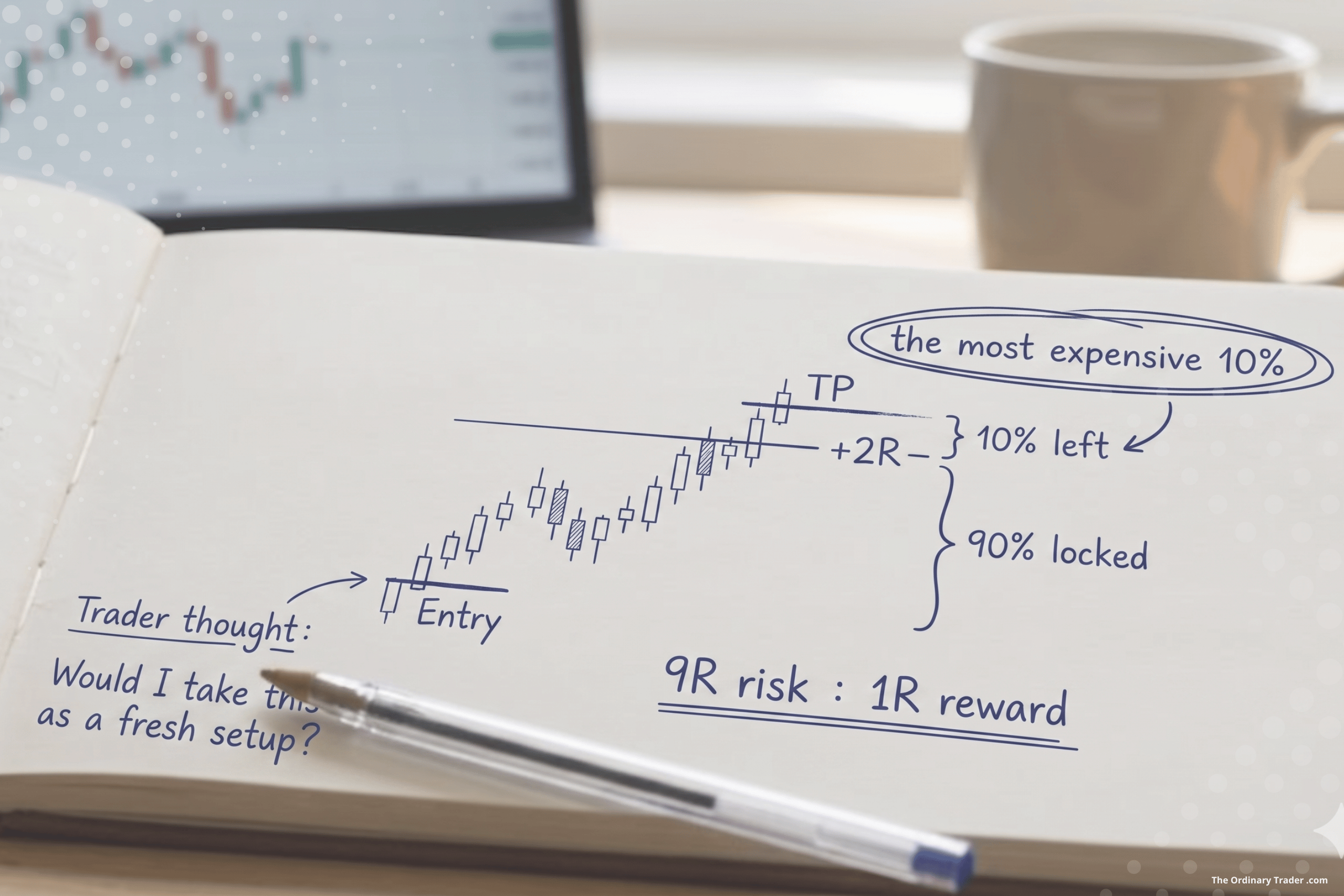
You’re in. Stop placed, target set, risk defined. The trade moves. Then it really moves. Suddenly you’re +2R. The candles are doing what you said they would do. You’re 90% of the way to TP and the only thing left is the final push over the line.

You wait for it.

And then, without warning, the market swings violently back the other way. Not all the way to your stop. Just enough to give back most of what was on the table. By the time you’ve registered what happened, you’re closer to break even than to your target.

Now you’ve got nothing to do but sit there and ask yourself the question you should have asked five candles ago.

When you’re 90% of the way to your TP, the last 10% is the most expensive bit of the trade.

We treat the target as a finish line

This is the trap. The plan said TP at this level. So anything short of it feels like quitting early. Like cheating ourselves. Like the version of us that took +1R last week and then watched the trade run for another 3R is going to show up and tut.

But the target was never a finish line. It was a hypothesis. A best guess at where price might go if the structure played out the way we read it. The market hasn’t read the plan. It doesn’t owe us the last 10%.

We know this. We say it back to ourselves all the time. Then we hold anyway.

The most expensive 10% in trading

Here’s the maths that always feels uncomfortable.

When you’re 90% of the way to your TP, the last 10% is the most expensive bit of the trade. You’re risking 90% of locked profit to capture another 10% of move. The reward-to-risk inside that final stretch is upside down. You wouldn’t take that as a fresh setup. You’d never enter a trade with 9R of risk for 1R of upside.

But because you’re already in, and because the profit feels like it isn’t yours yet, you accept the trade-off without noticing you’ve taken it.

That’s the part we miss. We tell ourselves we’re being patient. We’re actually taking a brand new, badly priced trade on top of the one we already won.

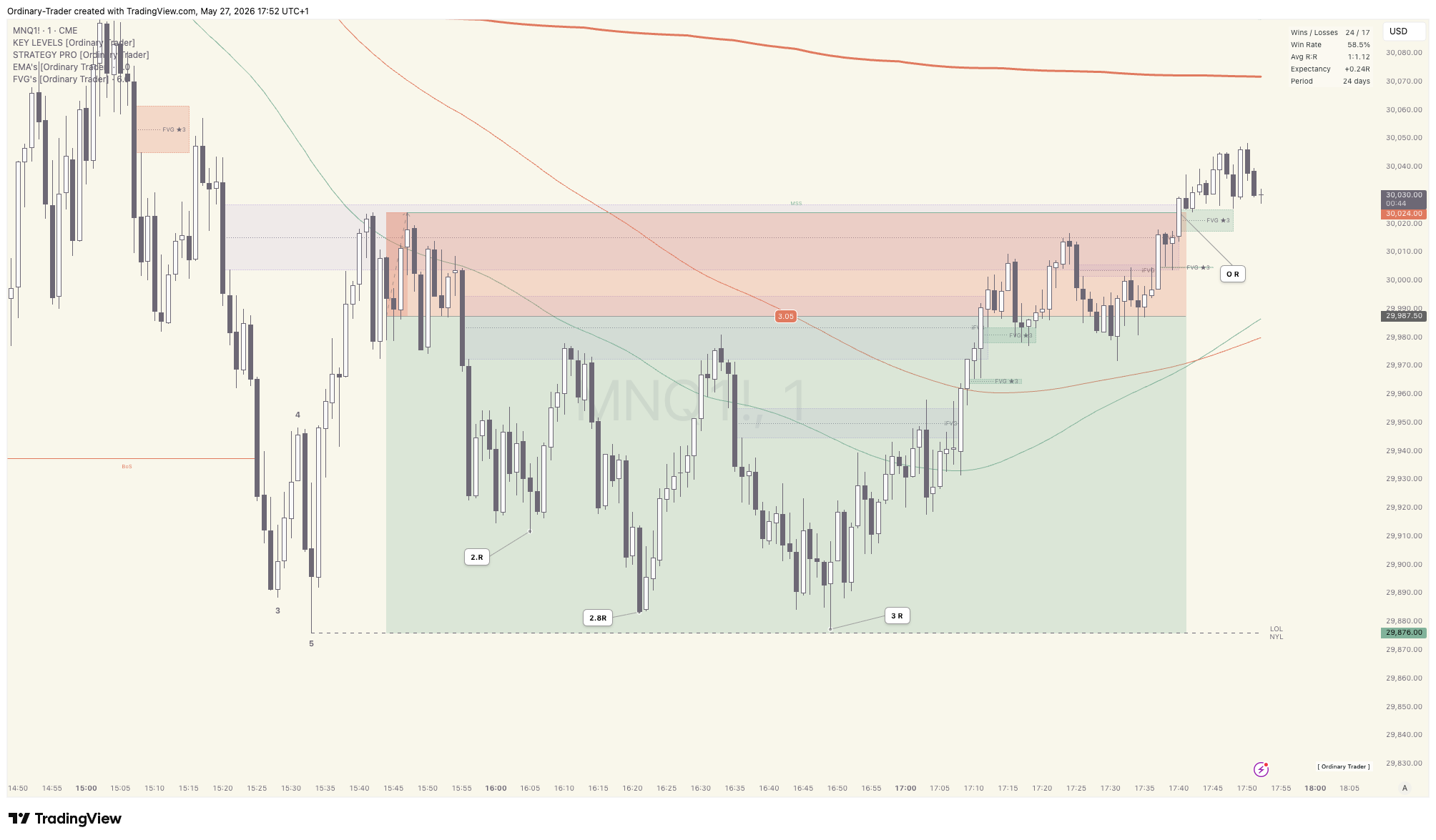
3 Opportunities to take profit before getting stopped out.

Base hits add up

There’s an idea trading culture borrows from elsewhere. That every entry has to be the big one. The full extension. The screenshot trade. The home run that makes the week.

It doesn’t.

A run of clean base hits at +1R, +1.2R, +0.8R is a perfectly good week. It’s a great year. Most of the equity curves I respect were built on base hits, not on the chase for the occasional 5R that gets posted.

Taking the partial isn’t selling yourself short. It’s collecting on the work the trade has already done. The next one is allowed to be ordinary too.

Some exits are mapped before the trade starts

A lot of this work happens before the trade is even live.

If you’ve done the Path to Profit work, you already know what sits between your entry and your target. The FVGs that might cause a stall. The opposing liquidity sitting just before TP. The big opposing candles where prior intent is still visible.

Those aren’t just risks. They’re also the most honest places to take something off. A partial at the FVG. A move to break even before the opposing liquidity. A full exit when the path beyond looks crowded.

The decision is always calmer when the chart is.

Trailing helps, when it can

The honest answer is that trailing the stop is what we should be doing. Locking in some of the move as structure gives us room to. Moving to break even when the trade clears the first leg. Tucking the stop behind a new swing low when one forms.

This works. Some of the time.

The rest of the time, structure doesn’t give us anything to trail to. The leg is too clean, the move is too vertical, the next swing point is further behind than we’d ever want our stop. Trailing in that situation either gives back all the profit or sits in a place that does nothing useful.

In those trades, the trail isn’t an answer. It’s just a comfort blanket that hasn’t been put to work yet.

The question we’re actually avoiding

What we don’t ask ourselves, in that moment when we’re +2R and the candle is looking heavy, is the only question that matters.

What does this trade still owe me?

Not what’s on the chart. Not what the plan said. Not what the screenshot of the winning version would look like if it played out perfectly.

What does it still owe me, from here, with the information I now have?

Sometimes the answer is real. Structure is building, momentum hasn’t broken, the next level is right there. Hold.

Other times the answer is uncomfortable. The move has already happened. The candles are smaller and rounder. There’s no obvious reason for the next leg. Price has done what we asked of it, and we are now just hoping.

The trade doesn’t owe us anything else. We are the ones still asking.


Sitting with it

I don’t have a clean rule for this. I’m not sure a clean rule exists.

Some days I take the partial too early and watch the trade run without me. Some days I hold past the point of reason and give it all back. Both feel bad. Neither feels like progress on the day it happens.

What I’m trying to do, slowly, is just notice the moment. The one where I stop watching the trade and start willing it forward. That moment is the answer to the question, even if I don’t always act on it.

Enough profit is enough when the trade has done what I asked it to do, and I’m now asking for more than the chart is willing to give.

I don’t always get that right. I’d rather get it wrong honestly than dress it up as a system.

Starting the day with a win feels good. Quietly so.

There’s a small lift you can sometimes feel after a clean trade closes in profit – confidence settling in, the day already feeling productive, the rest of the session looking easier than it did an hour ago.

That feeling is the problem.

Not the feeling itself. The way it nudges the next decision.

The win you didn’t earn the next trade with

A losing streak gets a lot of attention in trading education, and rightly so. Drawdown is loud. You notice it. The account balance flashes the warning at you, and most traders have at least one rule about stepping away when losses pile up.

An early win is quieter. It hides behind the fact that you did the right thing. You followed the plan, the setup played out, the entry was valid, and the trade closed in profit. There’s nothing to flag, nothing to log as a mistake.

But what often follows is a version of you that’s slightly more relaxed. Slightly more willing. The next setup looks a bit better than it should. The next stop sits a bit wider. The size creeps. You’re still doing the work, but the work is being done by someone who already feels like the day is going their way.

That’s where the damage starts.

The asymmetry nobody flags

Most traders are trained, by experience, to expect emotional drift after losses. Frustration, the urge to revenge trade, the temptation to chase. There are whole books on managing the downside of the emotional curve.

The upside of the curve gets much less attention. Overconfidence doesn’t feel like a problem in the moment. It feels like momentum. It feels like a green day in motion. And it often delivers a second decent trade before it delivers a stupid one.

Wins don’t feel like a risk. That’s exactly why they are one.

What I actually do after a clean morning trade

I treat an early win the same way I treat a string of losses.

Same protocol. Step away from the desk. Let the moment settle. Come back to the chart with the same eyes I started the session with.

A few specifics, because the abstract version of this is too easy to nod along to and then ignore:

  • I close the chart. Not minimise. Close.
  • I leave the room for at least fifteen minutes. Coffee, a walk, anything that isn’t a screen.
  • I don’t review the winning trade until the session is over. Reviewing it mid-session can quietly turn into validating it, and validating it can quietly turn into pattern-matching the next setup against it.
  • When I come back, I open the Daily Trading Planner first, not the chart. The plan for the day hasn’t changed. My state has. The plan is what will keep me honest during the rest of the session.

It’s a small set of actions. It works because it’s the same set of actions I use after a bad sequence. The brain doesn’t get to vote on whether the day is going well or badly. The protocol just runs.

The trade isn’t where the damage happens

A useful frame: most blow-up days don’t begin with a single bad trade. They begin with a slightly emotional trader making slightly worse decisions for a slightly longer stretch. The drift is the problem, not any one entry.

That’s true on the downside, where revenge trading is well-documented. It’s also true on the upside, where overconfidence does the same job with a friendlier face. By the time the giving-back trade hits, the conditions that caused it were set up trades earlier, when a win felt like permission.

The point of stepping away isn’t to dampen the win. The win is on the books. It already happened. The point is to protect the next decision from being shaped by a state that has nothing to do with the chart in front of you.

Sit with it

There’s a quiet bit of work in trading that nobody finds glamorous: noticing your own state and treating it as data. Not analysing it for an hour. Not journalling three pages about it. Just noticing, and then doing the small thing that the noticing demands.

After an early win, the small thing is to stop. Same as after losses. The session can wait. The market will still be there in fifteen minutes, and so will the next valid setup. If anything, you’ll see it more clearly.

The win is on the books. That’s enough for now.

Trading Should Be Ordinary

There is a quiet misconception at the heart of modern trading culture. Many people arrive at the markets searching for something different from ordinary life. They want fast moves, big wins, and the rush of adrenaline that comes from watching price surge in their favour. Trading is marketed as excitement. As freedom. As a shortcut to something extraordinary.

That expectation does more damage than most beginners realise.

Because the moment trading feels exciting, something has usually already gone wrong.

In the early stages, excitement feels harmless. You place a trade and price starts moving quickly. Your heart rate rises. A win feels incredible. A loss feels personal. The emotional swing creates the illusion of engagement. It feels like focus. It feels like intensity.

But it is neither.

It is noise.

Excitement does not sharpen decision making. It distorts it. Under its influence, traders begin to deviate from plans they carefully built when calm. They hold positions longer than their rules allow. They increase size without fully acknowledging the added risk. They take setups that do not meet their usual standards.

the moment trading feels exciting, something has usually already gone wrong.

Nothing about the strategy changed. Only the feeling did.

And feelings are unreliable risk managers.

The traders who endure for years tend to describe their sessions very differently. There is no drama in their routine. No rush. No theatre. They sit down at the same time each day. They review the same markets. They execute within the same framework. Most trading days look remarkably similar to the one before.

To an outsider, it can seem repetitive. Even dull.

It is not a lack of passion. It is professionalism.

When a trade works, there is no surge of triumph. The outcome was always part of the statistical expectation. When a trade fails, it is recorded, reviewed, and filed away. There is no spiral of frustration and no grand story attached to it. It is simply another data point in a long series.

This emotional neutrality is not accidental. It is cultivated.

Excitement is expensive in trading. It encourages impatience. It fuels reactive decisions. It creates the illusion that this trade, right now, is more important than the next hundred that will follow. It convinces you that you must act, that you must participate, that you must prove something.

You do not.

Consistency in trading is not built on intensity. It is built on repetition. The same preparation. The same criteria. The same risk management. Over and over again.

From the outside, ordinary trading does not make compelling headlines. There are no dramatic screenshots. No wild equity swings. No visible emotional highs and lows. There is simply process. Structure. Restraint.

But boring is stable.

Boring is repeatable.

Boring is where edge lives.

Trading should not feel like a performance. It is not a game and it is not a test of confidence or intelligence. It is work. Quiet work, done methodically, without seeking emotional stimulation.

Trading should not feel like a performance. It is not a game and it is not a test of confidence or intelligence. It is work. Quiet work, done methodically, without seeking emotional stimulation.

That may sound less glamorous than the promises that pull people into the markets. It is meant to.

Trading should be ordinary.

Not because ordinary is small, but because ordinary is sustainable.

Most people come into trading looking for excitement. Fast moves. Big wins. Adrenaline. That expectation is usually where things start to go wrong.

The best trading days I’ve had are forgettable. No drama. No stories worth telling. Just routine.

I sit down at the same time. I look at the same markets. I follow the same process. There’s nothing clever or impressive about it.

When a trade works, it doesn’t feel amazing. It feels expected. When it doesn’t, it’s accepted, logged, and left alone.

Emotion is expensive in trading. Excitement leads to oversizing. Frustration leads to overtrading. Boredom, it turns out, is much safer.

As my routine became more consistent, I felt less during the session. That isn’t a flaw. That’s the point.

I’m not trying to read the market in real time. I’m trying to execute a process I’ve already thought through. The thinking happens before the session. During the session, I follow instructions.

Repetition builds trust. Trust in the setup. Trust in the risk. Without that, every trade feels like a gamble rather than a decision.

Most deviations start small. A slightly early entry. A slightly wider stop. In the moment, they don’t feel like mistakes.

They show up later in the journal. Not because the trade lost, but because the routine broke.

Boring trading looks the same every day. Same risk. Same rules. Same response to wins and losses. No improvisation.

If I feel excited, something is off. If I feel rushed, I stop. If I feel the urge to make something happen, I’m already done for the day.

This isn’t about removing personality. It’s about removing noise. The market provides enough uncertainty on its own.

Trading shouldn’t feel like a highlight reel. It should feel like work. Quiet, repetitive, sometimes dull work.

And that’s exactly why it works.

For a long time, I thought consistency meant winning more trades. More green days. Fewer red ones. If I could just improve my hit rate, everything else would take care of itself.

That isn’t what changed my results.

What changed everything was learning how to lose.

Not avoiding losses. Not trying to eliminate them. But controlling how much damage they were allowed to do.

Losses are part of the job. Every strategy has them. Every trader experiences them. The difference isn’t whether you lose. It’s how expensive those losses become.

Early on, my losing days were messy. One loss turned into two. Two turned into “just one more.” By the end of the session, the damage had very little to do with the original setup.

The trades weren’t the problem.

My reaction to them was.

When I reviewed my journal, a pattern stood out. My best weeks didn’t have fewer losses. They had smaller ones. Cleaner ones. Losses that stopped where they were supposed to stop.

That observation reframed everything.

The moment I accepted that losing is unavoidable, my focus shifted. Away from how do I win more, and toward how do I protect myself when I’m wrong. That single question changed my behaviour.

I started predefining risk before every trade. Not as a suggestion, but as a boundary. I knew exactly what a mistake could cost me, and I accepted it in advance.

I also learned to stop trading after bad sequences. Not because the market was broken, but because I was. Two losses in a row didn’t mean my edge had disappeared. It meant my decision-making was under pressure.

That distinction mattered.

Losing better looks boring. Smaller size. Fewer attempts. Earlier stops. It doesn’t feel heroic. There’s nothing exciting about walking away after a controlled loss.

But it compounds.

A bad day becomes manageable. A bad week becomes survivable. A bad month no longer threatens to undo everything that came before it.

Consistency isn’t built on your best days. It’s built on the days where things don’t work. How you behave when you’re wrong is the real edge.

I still have losing days. Plenty of them. The difference now is that they don’t spill over. They don’t leak into tomorrow.

Winning more is nice. Losing better is necessary. And once you get that part right, consistency tends to follow.

For a long time, I believed my edge would come from better charts. Cleaner levels. Tighter entries. More confluence. If I refined the technicals enough, consistency would follow.

What actually changed my trading wasn’t on the chart at all.

I started journaling properly when I realised I was making the same mistakes across different markets. Different instruments. Different days. The outcomes kept repeating.

The chart had changed but my behaviour hadn’t.

The chart had changed but my behaviour hadn’t.

At first, my journal was basic. Entry. Stop. Target. Result. It was useful, but shallow. It told me what happened, not why it happened.

The real shift came when I started writing how the trade felt.

Not emotions in a dramatic sense. Just simple observations. Rushed. Hesitant. Confident but distracted. Forcing it. Nothing profound on its own, but over time, patterns emerged.

I noticed something uncomfortable. Many of my worst trades looked fine technically. Structure was there. Levels made sense. On paper, they were valid.

My state wasn’t.

I was taking trades when I was bored. Or slightly annoyed. Or trying to make the session feel productive. None of that shows up on a chart.

The journal also revealed something unexpected. My best trades were quiet. No adrenaline. No urgency. Just execution. When a trade felt exciting, it was often because I was bending something without admitting it.

Over time, the journal became a mirror. Not of the market, but of me. It showed when I ignored my rules. When I sized up. When I traded after I should have stopped.

The chart never told me that story.

My best trades were quiet. No adrenaline. No urgency. Just execution.

One of the clearest lessons was this: most mistakes happen before the entry. In the mindset. In the intention. By the time I click buy or sell, the damage is often already done.

Now, some of my most important journal entries don’t include screenshots at all. They include sentences like trading to prove something, didn’t like the loss before this, should have stopped after the first win.

The journal taught me what no indicator ever could. That consistency isn’t about being right more often. It’s about recognising yourself in real time.

Charts are objective. They don’t lie. But they’re also incomplete.

The journal fills in the missing half. The human half.

If I could only keep one tool as a trader, it wouldn’t be a strategy or an indicator. It would be the journal.

The market keeps changing. My patterns repeat.