Tag Archive for: Discipline

My partner can now tell when I’m about to lose an argument. Not because I raise my voice. Because I go quiet, stare at the middle distance, and clearly start “reading the situation and waiting for a better entry.”

This is what trading does to you. It leaks. You spend enough hours watching charts and managing risk, and the habits stop staying at the desk. They follow you to the dinner table, into the school run, into the small daily negotiations of living with other people. Mostly that is a good thing. Occasionally it is deeply annoying for everyone around you.

Let me poke fun at us for a second before I defend us.

Yes, we are a bit much

We talk in R-multiples. We describe a good day as “low and slow”, and how a trump tweet killed your setup.   We have opinions about candle colours. Some of us have built a command centre of six monitors to trade an instrument that requires roughly one decision a day. We say “it would be interesting to monitor that” about things that are not worth monitoring, like whether the bins go out on a Tuesday or a Wednesday.

The stereotype exists for a reason, and I am not above it. I have absolutely paused a family conversation to “just check one thing.” and then ending up watching candles print for the next hour. I have described my own toddler’s tantrum as “a liquidity grab.” Nobody asked me to. I did it anyway.

So no, I’m not here to tell you trading makes you a better person by default. It does not. But the actual skills, the unglamorous ones underneath the jargon, turn out to travel surprisingly well into family life. Far better than the jargon does.

The old me heard a complaint and fired back instantly, full port, no stop loss.

Patience stops being a trading word

The first thing trading teaches you, if you let it, is that doing nothing is a position.

You wait for the setup. You sit on your hands through twenty moves that look tempting and are not. You learn that the urge to act is not the same as a reason to act.

That single habit has done more for my relationship than any book on communication. The old me heard a complaint and fired back instantly, full port, no stop loss. The newer me has learned to wait for the actual point to form. Most arguments at home are like most setups on the chart. If you wait a beat, the thing you were about to react to turns out not to be the thing that matters.

Not passive. Not avoiding it. Just not entering on the first candle.

Risk management is really just not betting the house on the dishwasher

Here is the unsexy heart of trading: you decide, in advance, how much you are willing to lose on any one idea. Then you stick to it, even when you are convinced you are right.

You are always convinced you are right. That is the point. The rule exists precisely for the moments your conviction is loudest.

Drop that into family life and it changes everything. Is being correct about whose turn it was to load the dishwasher worth risking the whole evening? You can size that position. Small. Tiny, actually. Some disagreements are a 0.25% risk and you treat them that way. Others genuinely matter, and you commit properly. Knowing the difference, and deciding the size before you are emotional rather than during, is the whole game in both places.

The trader who blows the account is the one who turns every trade into the trade. The same person, at home, turns every disagreement into the disagreement. I have been that person. The account and the evening both recover faster when you don’t.

Cutting a loss instead of doubling down

Every trader knows the temptation to add to a losing position to “prove” it will come back. We have a name for the family version. It is called continuing to argue your point after everyone, including you, has quietly realised you are wrong.

Revenge trading and the angry follow-up text are the same instinct wearing different clothes. The discipline that stops me sending the second, worse message at 11pm is the exact discipline that stops me clicking buy again after a stopout. Accept the loss. Log it. Move on. Apologise if the loss was your fault, which, statistically, it often is.

Turns out the people I live with do not care about my win rate or the trump tweet that killed my setup.

The review matters more than the result

The habit I value most is the boring one. After a trading session I write down what happened and why, without flinching, win or lose.

I have started doing a quieter version of this after a rough day at home. Not ruminating too much. Just asking honestly: what was actually going on there, and what would I do differently. Process over outcome. You stop scoring conversations by who won and start scoring them by whether you showed up the way you wanted to.

Turns out the people I live with do not care about my win rate or the trump tweet that killed my setup. They care whether I’m present, steady, and not staring at a phone under the table. Funny how the brand line about ordinary process and real progress applies to a marriage roughly as well as it applies to a chart.

The honest bit

Trading will not fix your relationships. If anything, untreated, it gives you a new vocabulary to be annoying in. But the skills underneath it, patience, sizing your bets, cutting losses, reviewing honestly, are just life skills that happen to be taught very efficiently by a market that charges you money for getting them wrong.

The market made me calmer at home mostly by making me poorer every time I wasn’t. That is a harsh teacher, but an effective one.

Now if you’ll excuse me, I have a family conversation about no phones at the dinner table.
The story you tell yourself

You’ve just taken a loss. Clean setup, sensible risk, nothing reckless. But the market did what markets do, and you’re down.

You close the trade and scan the chart again. Another setup appears. Clear structure, a level that holds, everything pointing in the right direction. You size up slightly to recover ground. You enter.

That is the moment. Not obviously revenge trading. Not a red-mist doubling down. Just a trade. Justified. Logical. Backed by analysis.

Or was it?

The disguise

Most traders think they’d recognise revenge trading if it showed up. The obvious version is easy to spot: tripling size, ignoring every rule you built, entering on impulse and calling it a hunch. That failure mode gets talked about.

The harder version looks nothing like that.

It looks like patience. Like carefully reading the chart and finding what you were looking for. The position size is only slightly larger. The entry makes sense. You could walk someone through it and they’d probably nod along.

But underneath all of that, the question you were actually answering was not “is this a good trade?” It was “how do I get that money back?”

The analysis was real. The justification was real. The conviction felt real. But the thing driving the decision was not analysis at all.

most emotional decisions happen in the first twenty minutes after a losing trade.

The tells

There is no clean single diagnostic for this. But there are patterns worth watching.

You entered faster than usual. Normally you wait for a specific condition – a close through a level, a retest, some form of confirmation. On this one, you moved quicker. The reason felt sound. But if you’re honest, you were looking for permission rather than evidence.

The position size changed. Not dramatically. But it went up. And the reason you gave yourself – strong setup, good R – would apply to most of your trades. Size doesn’t usually move for good setups. It moved because you needed more on the line.

You skipped a step. The Daily Trading Planner didn’t get filled in. Or it was filled in after the trade was already open. Or you glanced at it and decided the trade had already passed the check. There’s a difference between working through the checklist and working around it.

You felt better after entering. This one is subtle. Good trades usually come with calm. You’ve done the work, you’re in the trade, now you wait. This one felt like relief. Like something had been repaired. That shift in feeling is worth noticing.

None of these individually disqualifies a trade. But when several arrive together, shortly after a loss, they’re worth pausing for.

The self-check

Before the next entry, try three things.

Write down why you’re taking the trade in a single sentence. Not a paragraph, not a bullet list. One sentence. If that sentence contains anything about the previous trade – recovering a loss, proving a read was right, getting back to flat – the trade isn’t ready.

Then write down the R. Not what you hope it will be. What it actually is, based on where your stop sits right now. If that number is larger than your usual position, ask why. If the answer is anything other than “the setup calls for it,” step away.

Finally, check how long it has been since the loss. There’s no magic number. But most emotional decisions happen in the first twenty minutes after a losing trade. Most sound ones happen after you’ve had time to reset. Entering again quickly isn’t always wrong, but it deserves more scrutiny, not less.

Before the account shows you

The account has no patience for this distinction. It doesn’t know whether you were trading from conviction or from frustration. It just records the outcome.

That’s part of what makes this pattern hard to break. You might take a revenge trade dressed as conviction and win. The justification gets reinforced. The process that generated the decision feels validated. And the next time a loss arrives, the same pattern runs again with a little more confidence behind it.

Catching it early isn’t about doubting every trade you place after a loss. It’s about being honest with yourself about the question you’re actually trying to answer when you enter.

Analysis asks: does this setup meet my criteria?

Revenge asks: can this trade undo what just happened?

They can produce the same entry. But only one of them is a repeatable process.

Most blown accounts don’t die from a single dramatic loss. They die quietly, from one bad habit repeated until the balance runs out.

The frustrating part is that none of these habits feel like mistakes in the moment. They feel like instinct. They feel like you’re doing something. And that is exactly why they’re so hard to spot in yourself.

So here are the worst of them. Some are genuinely expensive. Some are just a bit silly. I’ve been guilty of most, which is the only reason I can describe them so precisely.

Revenge trading: the most expensive way to feel better

You take a loss. It stings. Instead of closing the laptop, you immediately look for the next trade to win it back.

This is the big one. Revenge trading is what turns a bad trade into a bad day, and a bad day into a bad week.

The logic feels airtight at the time. The market took something from you, so you’re going to take it back. But the market doesn’t know you exist, and it certainly doesn’t owe you a refund. What actually happens is you trade bigger, with less patience, on a worse setup, while your judgement is at its lowest point of the day.

The fix isn’t complicated. It’s just hard. After a loss that gets under your skin, you stop. Not “stop after one more.” Stop.

Collecting indicators like they’re going out of fashion

Here’s the stereotype, and you’ve met him. The chart so crowded with indicators it looks like air traffic control. Three moving averages, two oscillators, a cloud, volume profile, and something with a German name you found on a forum at 2am.

You’re not reading the market. You’re waiting for all eleven things to agree, which they never do, because half of them are measuring the same price action in slightly different colours.

More inputs don’t make a clearer decision. They just make more noise. The trader who watches structure and one or two clean levels usually sees more than the one drowning in confluence. A chart should help you think, not hide the thinking.

The trader who watches structure and one or two clean levels usually sees more than the one drowning in confluence.

Moving the stop loss because “it’ll come back”

You set a stop. Price moves towards it. And right before it hits, you drag it a little further away. Just to give the trade room.

It usually does come back, the first few times. That’s the trap. The market teaches you the worst possible lesson by occasionally rewarding the worst possible behaviour.

Then one day it doesn’t come back, and the loss you’ve been avoiding arrives all at once, several times larger than the one you originally agreed to take. A stop loss you move isn’t a stop loss. It’s a suggestion you make to yourself and then ignore.

The whole point of deciding your risk before the trade is that the version of you placing the trade is calmer than the version of you watching it go wrong.

Only ever posting the wins

This one is more of a culture problem than a personal one, but it shapes how everybody else behaves.

Scroll through any trading feed and you’ll see an unbroken stream of green. +400%. Account up. Another clean win. Funny how nobody seems to post the day they blew up and gave it all back.

The selective screenshot is the dishonest heart of trading culture. It sells a version of the job that doesn’t exist, where every entry is a winner and the equity curve only points one way. New traders see it, assume that’s normal, and then quietly panic when their own results look like real results, which is to say lumpy, occasionally red, and slow.

I’d rather see someone’s losing month than their best ever day. The losing month tells me how they handle the part of trading that actually decides whether they last.

Funny how nobody seems to post the day they blew up and gave it all back.

Trading without a journal, then wondering what went wrong

If you don’t write down what you did, you can’t learn from it. You can only remember it, and memory is a generous liar.

Ask a trader without a journal why they lost last week and you’ll get a feeling, not an answer. “I think I was overtrading.” Maybe. Or maybe you took the same B-grade setup eleven times and it lost eight, and you’d know that for certain if it were written down.

A journal turns vague guilt into specific evidence. It’s the difference between “I need to be more disciplined” and “I lose money every time I trade the first ten minutes of the session, so I’ll stop doing that.” One is a New Year’s resolution. The other is a rule.

It doesn’t need to be fancy. A notebook and an honest sentence about each trade beats a spreadsheet you never open.

The habit underneath all the habits

Look closely and most of these share a root. They’re all ways of avoiding a small, uncomfortable thing now, in exchange for a larger, worse thing later. Skip the loss, skip the discipline, skip the honest record, skip the boredom etc

Good trading is mostly the willingness to be a bit bored and a bit uncomfortable on purpose. Not careless or reckless, but controlled. The best habits aren’t exciting. They’re just the unglamorous things, done again and again, on the days you don’t feel like it.

The best habits aren’t exciting. They’re just the unglamorous things, done again and again

That’s the whole job, really. Spot the habit, name it honestly, and replace it with something duller and better.

You sit down to review yesterday’s trade. The chart is still there. The entry, the exit, the result, all logged. But the part you actually need has gone. What were you thinking when you moved that stop? Why did you nearly close the position early? You can’t quite remember.

That critical lost in detail is the whole reason I journal. And it is why I care more about the notes than the numbers.

I use TradeZella for this. It is a solid platform, and most people know it for the stats: win rate, average R, all the dashboards. Useful, but not what this post is about. I want to talk about the Notes side, where you capture what you were thinking and feeling before, during and after a trade. Tags and Strategies are worth their own post another day. For now, here is the template I use and how I actually use it.

That critical lost in detail is the whole reason I journal.

Three sections, one job

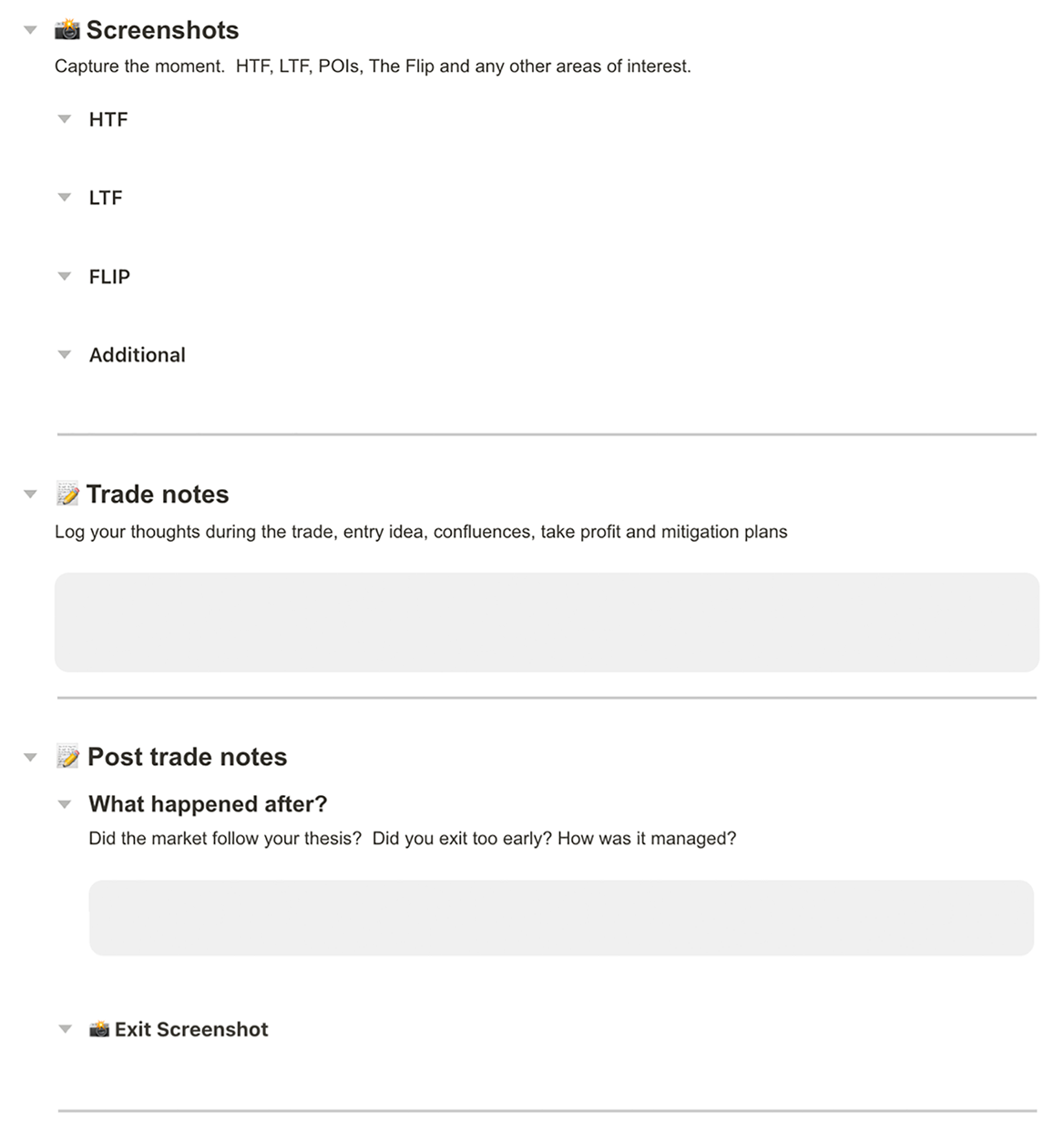
My template has three parts. Screenshots, Trade Notes, and Post Trade Notes. Each one captures a different slice of the same trade, and together they let me rebuild the whole thing later without relying on memory.


Screenshots: capture the moment

The first section is just images. I take a few as the trade develops, not all at the end.

A higher time frame shot (HTF, usually the 15 minute) to show the structure and the bias. A lower time frame shot (LTF, usually the 1 or 2 minute) for the detail of the entry. A zoomed-in shot of The Flip, because that is a key part of the setup I want to study again later. And an Additional slot for anything else worth keeping: the Path to Profit, a point of interest (POI) like a supply and demand zone (SNDR) or a fair value gap, whatever mattered on the day.

A fair value gap, by the way, is just the imbalance price leaves behind when it moves too fast to trade an area cleanly.

The reason I screenshot in the moment is that a chart looks completely different an hour later. Price has moved on, levels have been swept, and the thing that looked obvious at entry is buried. The screenshot freezes what I actually saw.

And this is the part most people skip. I write down how I am feeling.

Trade notes: the thinking and the feeling

This is the main section, and the one that does the most work.

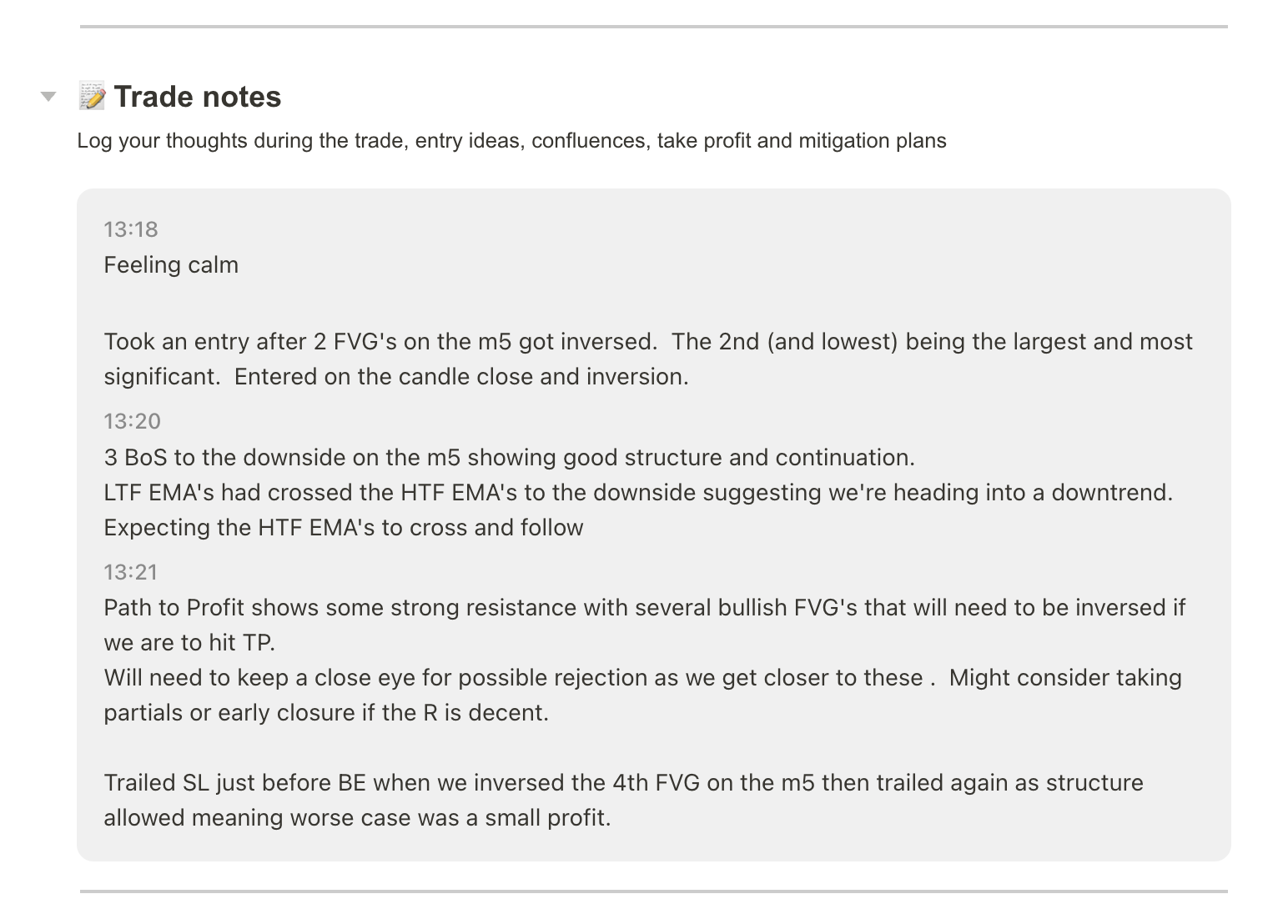
Here I write my thesis before I enter. The idea, the confluences, where I expect price to react, my take profit plan, and how I will manage the trade if it goes against me. Getting this down before entry matters, because it is the version of my thinking that has not yet been bent by an open position.

Then I keep adding to it as the trade runs. And this is the part most people skip. I write down how I am feeling.

That sounds soft. It is not. Emotion is where most of my mistakes start, and the only way to catch the pattern is to have it written down in your own words at the time. Read it back later and you can often see exactly where a feeling got in the way of a perfectly good setup. Sometimes it works the other way, and a note of unease turns out to be a warning sign you should have listened to.

Post trade notes: what actually happened

The last section is the review. I answer a few plain questions.

What happened after I took the trade? Did the market follow my thesis, or not? Did I exit too early, or enter too early? How did I manage it? Then the one that matters most: what would I do better next time, and if I could go back, what is the single piece of advice I would give myself?

This section also holds the exit screenshot. Did I hit my target, get stopped out, or close manually? I grab the final chart, and often what happened next too. Plenty of times I have hit TP1 and then watched price run on to take the previous day’s high. Capturing that teaches me something about where I am leaving money, and whether my targets are too conservative.

Capture it live, not from memory

I keep the journal open on my screen the entire session, next to the chart. I write as I go, in real time, as I enter and manage.

If you leave it until the evening, you do not really journal the trade. You are actually journalling your memory of the trade, which is a tidier, kinder, less accurate version of events. The hesitation gets smoothed over. The near-miss exit disappears. The thing you most needed to see is exactly the thing memory edits out.

You are actually journalling your memory of the trade, which is a tidier, kinder, less accurate version of events.

One trade, fully journalled, before the next

One rule I hold myself to. I do not take another trade until the first one is journalled and the lesson is captured.

Easier said than done, especially on an active session. But the moment you skip it “just this once,” the journal stops being a record and starts being a highlight reel. I treat finishing the journal as part of finishing the trade.

None of this is here to make me feel good about wins or bad about losses. It is here to make my behaviour visible. When I follow my rules, the results tend to take care of themselves. When I do not, the journal shows me exactly where. The chart only ever tells me what I did. The notes are the only place that remembers why.

Starting the day with a win feels good. Quietly so.

There’s a small lift you can sometimes feel after a clean trade closes in profit – confidence settling in, the day already feeling productive, the rest of the session looking easier than it did an hour ago.

That feeling is the problem.

Not the feeling itself. The way it nudges the next decision.

The win you didn’t earn the next trade with

A losing streak gets a lot of attention in trading education, and rightly so. Drawdown is loud. You notice it. The account balance flashes the warning at you, and most traders have at least one rule about stepping away when losses pile up.

An early win is quieter. It hides behind the fact that you did the right thing. You followed the plan, the setup played out, the entry was valid, and the trade closed in profit. There’s nothing to flag, nothing to log as a mistake.

But what often follows is a version of you that’s slightly more relaxed. Slightly more willing. The next setup looks a bit better than it should. The next stop sits a bit wider. The size creeps. You’re still doing the work, but the work is being done by someone who already feels like the day is going their way.

That’s where the damage starts.

The asymmetry nobody flags

Most traders are trained, by experience, to expect emotional drift after losses. Frustration, the urge to revenge trade, the temptation to chase. There are whole books on managing the downside of the emotional curve.

The upside of the curve gets much less attention. Overconfidence doesn’t feel like a problem in the moment. It feels like momentum. It feels like a green day in motion. And it often delivers a second decent trade before it delivers a stupid one.

Wins don’t feel like a risk. That’s exactly why they are one.

What I actually do after a clean morning trade

I treat an early win the same way I treat a string of losses.

Same protocol. Step away from the desk. Let the moment settle. Come back to the chart with the same eyes I started the session with.

A few specifics, because the abstract version of this is too easy to nod along to and then ignore:

  • I close the chart. Not minimise. Close.
  • I leave the room for at least fifteen minutes. Coffee, a walk, anything that isn’t a screen.
  • I don’t review the winning trade until the session is over. Reviewing it mid-session can quietly turn into validating it, and validating it can quietly turn into pattern-matching the next setup against it.
  • When I come back, I open the Daily Trading Planner first, not the chart. The plan for the day hasn’t changed. My state has. The plan is what will keep me honest during the rest of the session.

It’s a small set of actions. It works because it’s the same set of actions I use after a bad sequence. The brain doesn’t get to vote on whether the day is going well or badly. The protocol just runs.

The trade isn’t where the damage happens

A useful frame: most blow-up days don’t begin with a single bad trade. They begin with a slightly emotional trader making slightly worse decisions for a slightly longer stretch. The drift is the problem, not any one entry.

That’s true on the downside, where revenge trading is well-documented. It’s also true on the upside, where overconfidence does the same job with a friendlier face. By the time the giving-back trade hits, the conditions that caused it were set up trades earlier, when a win felt like permission.

The point of stepping away isn’t to dampen the win. The win is on the books. It already happened. The point is to protect the next decision from being shaped by a state that has nothing to do with the chart in front of you.

Sit with it

There’s a quiet bit of work in trading that nobody finds glamorous: noticing your own state and treating it as data. Not analysing it for an hour. Not journalling three pages about it. Just noticing, and then doing the small thing that the noticing demands.

After an early win, the small thing is to stop. Same as after losses. The session can wait. The market will still be there in fifteen minutes, and so will the next valid setup. If anything, you’ll see it more clearly.

The win is on the books. That’s enough for now.

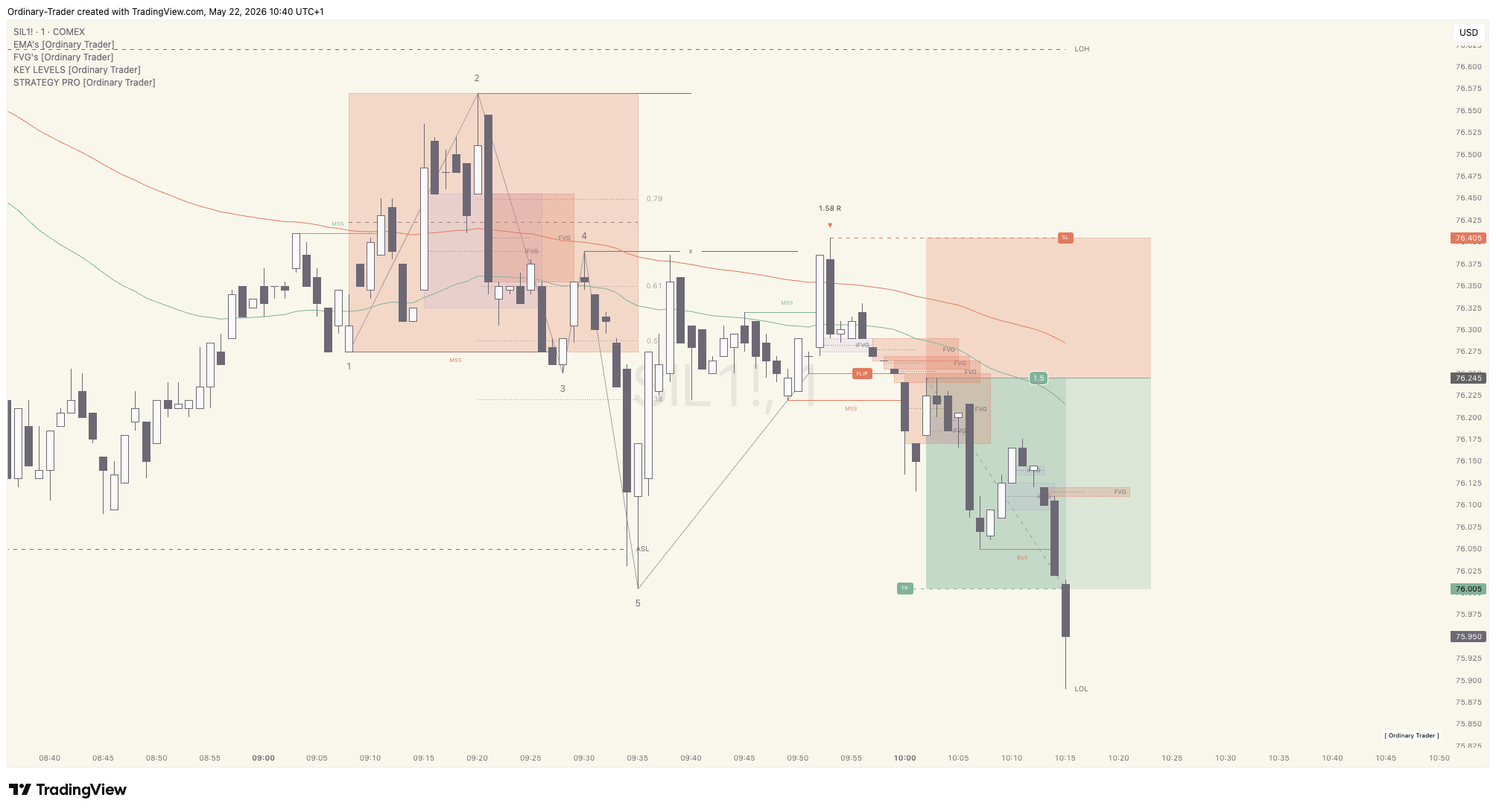
Silver futures, just after 10am London time. The 1-minute chart had been grinding lower into the session. Bearish bias was there on the higher timeframes, and the indicator was painting a five-point sequence I’ve now seen play out enough times to know what to look for.

The trade ran 1.58R with effectively zero drawdown.

But the result isn’t the point. The setup is. Most sequences that print on the indicator are fine. They work often enough. The A+ ones look different, and once you’ve watched a few play out, you stop being willing to risk real money on the average ones.

Here’s what made this one A+, walking through it in roughly the order it printed.

The geometry has to make sense first

Before anything else, I’m looking at the distance between Step 3 and Step 5.

Step 3 is the swing low we want to see break out of the zone. Step 5 is the deeper swing low that completes the bearish structure, the furthest point from the zone before price heads back toward our liquidity at Step 4. A short distance between (3) and (5) means the pullback is shallow and the R:R gets compressed before you’ve even started.

This trade had room. Step 5 sat a meaningful distance below Step 3, which meant any pullback back up into Step 4 had to be substantial. A substantial pullback means a deeper entry, a tighter stop relative to the target, and a setup that’s worth taking risk on. If the geometry’s wrong, nothing else on the chart matters.

The depth of the Step 4 tap

The second filter is how price interacts with the Step 4 zone.

What I want to see is a clean sweep of (4) and an immediate rejection, not a deep mitigation well beyond (4). On this trade, price came back into the zone, wicked (4), and turned. That’s the indicator’s job, to observe, track and display these sequences as they play out, and it did it.

What made it A+ rather than just acceptable was what other confluences we could observe around that tap. The rejection came off a bearish fair value gap (FVG), an unfilled imbalance left by an earlier full-bodied bearish candle. So it wasn’t just price sweeping the liquidity at (4) and turning. It was price sweeping liquidity, hitting fresh bearish imbalance from a candle that had real intent behind it, and refusing to push through.

That’s not a coincidence. That’s sellers showing up exactly where you’d expect them to.

The Flip and what sits around it

The Flip is my entry trigger, the moment the indicator confirms a structural break in the direction of the original bias. On its own, it’s a signal. With the right context around it, it’s a different category of signal.

What I want to see around The Flip

Two things gave this one extra weight.

First, fresh bearish FVGs started forming right after The Flip. Multiple of them. That tells me the move down isn’t a one-candle reaction, it’s a sequence with momentum behind it. Each new FVG is an unfilled gap, and unfilled gaps are evidence that price is moving with intent rather than chopping.

Second, The Flip printed below both the 50 and 100 EMA. This one’s a hard filter for me in bearish setups, and I’ve built it directly into the indicator. If The Flip is above the 50 EMA, I’m probably looking at a counter-trend reversal, and counter-trend trades are a different beast. Below the 50 EMA, in an already bearish higher-timeframe context, means I’m taking continuation in the direction of the trend. The old adage holds up here, the trend is your friend, and on this setup everything was pointing the same way.

Execution becomes easy when the setup is right

Here’s the part I want to be honest about. When the setup is genuinely A+, execution stops being the hard part.

On this trade, I set my entry exactly on the flip line. There was zero drawdown. Not “almost zero,” literally none, because price had already committed to the move before The Flip printed, and the entry sat at the boundary of that commitment.

When price pushed close to 1R, I moved my stop to break even. That’s the rule, and it didn’t require any negotiation with myself. Target was Step 5, same as always.

After a minor pullback (the kind that always shows up and always feels worse than it is), price continued down. Two more fresh bearish FVGs formed on the way. TP hit cleanly.

The trade took care of itself, because everything that needed to be true at entry was already true.

A+ setups are filters, not formulas

The reason I keep using the phrase A+ instead of just “valid” is that the indicator will give you valid signals all day long. A large percentage of them will work. The job isn’t to take all of them.

The job is to wait for the ones where the geometry, the conditions of the sweep, the quality of the rejection, the freshness of the imbalance, and the EMA position all line up the same way.

You won’t get many of these every session, sometimes only 1 or 2 a week.

That’s fine. The discipline is in the waiting, not the trading.